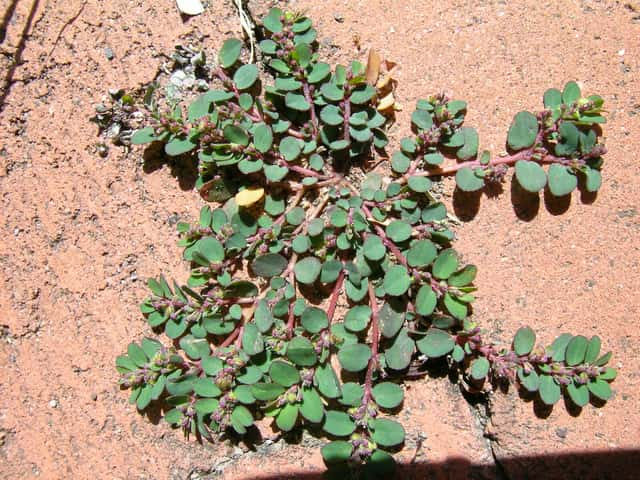
Euphorbiaceae
Prostrate Sandmat (Euphorbia prostrata)
Euphorbia prostrata
A weedy annual that grows on its own in full sun and dry, sandy or gravelly soil with no feeding. It sets seed within weeks and spreads easily. The latex is an irritant and mildly toxic to people, dogs and cats: wear gloves when pulling it.
Every 10 days
Bright indirect
° - °C
% - %
Categories
What is Prostrate sandmat?
Prostrate sandmat (Euphorbia prostrata) is a easy-care plant from the Euphorbiaceae family. Euphorbia prostrata is an annual herb in the spurge family, native to the Americas from the central and southern United States through the Caribbean to most of South America. It is now naturalized almost worldwide as a weed of lawns, pavement cracks, roadsides and dry, disturbed ground. It forms fla...
Prostrate sandmat grows up to 10cm, spread of 30cm, watering every 10 days. It is not suitable for indoor environments and not safe for pets.
Unlike many tropical plants, Prostrate sandmat tolerates watering mistakes. Best for beginners. Without precautions, ingestion can cause irritation in pets. Keep out of reach of cats and dogs.
How to Care for Prostrate sandmat?
TLDR: Prostrate sandmat needs Bright indirect, watering every 10 days, and temperatures between 15-30°C with 40-70% humidity.
How Often Should You Water Prostrate sandmat?
It barely needs water: it tolerates drought and grows on rainfall. In a pot, water only when the soil is fully dry, about every 10 days in hot weather. Soggy soil makes it rot.
How Much Light Does Prostrate sandmat Need?
Full sun. It takes part shade but grows thinner and smaller.
What Is the Best Soil for Prostrate sandmat?
Sandy, gravelly or shallow, well-drained soil of any pH. It even grows in pavement cracks.
What Pot Should You Use for Prostrate sandmat?
If you want to grow it, use a shallow terracotta pot with drainage and sandy soil. Keep it away from children and pets because of the latex.
What Is Prostrate sandmat and Where Does It Come From?
Euphorbia prostrata is an annual herb in the spurge family, native to the Americas from the central and southern United States through the Caribbean to most of South America. It is now naturalized almost worldwide as a weed of lawns, pavement cracks, roadsides and dry, disturbed ground. It forms flat mats: the thin, often purple-tinged stems reach 20 cm long, and the plant stays under 10 cm tall. The small oval leaves, up to 1 cm, are finely toothed and often hairy. From summer into autumn it bears tiny cyathia under 2 mm with white to pinkish appendages, followed by hairy fruits 1-2 mm wide. Broken stems leak a white latex that irritates skin and eyes. It dies at the first frost.
How to Propagate Prostrate sandmat?
Seed
It germinates best in warm soil, 24-29 °C. Wear gloves when collecting: the latex irritates skin and eyes. It self-seeds very easily.
- 1 Collect dry capsules in late summer
- 2 Scatter the seed on loose, sandy soil, barely covering it
- 3 Keep in full sun with the soil lightly moist until it sprouts
- 4 Once up, water only when the soil is dry
Materials needed:
How Big Does Prostrate sandmat Grow?
TLDR: Prostrate sandmat can reach up to 10cm tall with Fast growth rate.
Max height
10cm
Spread
30cm
Growth rate
Fast
Warning: Toxic Plant
This plant can be toxic if ingested. Keep out of reach of:
Plant Uses
Medicinal
Medicinal properties
Medicinal Uses
- Extracts of the plant are used in India to treat hemorrhoids
- Used in folk medicine in parts of the Americas; the latex is an irritant, so use needs caution
Is your plant showing symptoms?
Click on the symptom to discover possible causes:
What Diseases Commonly Affect Prostrate sandmat?
TLDR: Prostrate sandmat is susceptible to 5 known diseases. Monitor regularly for early detection.
Cold Damage
Cold damage, also known as frost injury, occurs when plants are exposed to freezing or near-freezing temperatures. This environmental stress can cause cellular damage as ice crystals form within plant tissues, rupturing cells and disrupting normal plant functions. Chilling injury can also occur in sensitive species at temperatures between 32-55°F (0-10°C), even without actual freezing.
Root Rot
Root rot is a serious fungal disease that affects the root system of plants, causing them to decay and die. It is primarily caused by overwatering, poor drainage, or soil-borne fungi such as Pythium, Phytophthora, Rhizoctonia, and Fusarium. The disease thrives in waterlogged conditions where roots are deprived of oxygen, making them susceptible to fungal infection.
Overwatering
Overwatering occurs when plants receive too much water, depriving roots of oxygen and causing root rot. This environmental stress is one of the most common causes of houseplant death, as waterlogged soil prevents roots from breathing and functioning properly.
Aphids
Aphids are small, soft-bodied, pear-shaped insects (1/16 to 1/8 inch long) that feed by sucking nutrient-rich sap from plants. They reproduce rapidly and can quickly weaken plants, causing distorted growth and transmitting plant viruses. Aphids come in various colors including green, black, red, yellow, brown, and gray. They secrete honeydew, a sticky substance that attracts ants and encourages sooty mold growth.
Fun Facts
Its flower, under 2 mm, is really a cyathium holding four male flowers and one female.
A plant can drop seed just a few weeks after it sprouts.
In India, extracts of it are sold as a remedy for hemorrhoids.
Frequently asked questions
Is prostrate sandmat toxic?
How do I get rid of it in my lawn?
How is it different from spotted spurge?
Why does it disappear in winter?
Compare with similar plants
| Attribute | Difficulty | Light | Watering | Pet Safe |
|---|---|---|---|---|
| Field Maple | Easy | Bright indirect | 14d | ✓ |
| Iberian Houseleek | Easy | Direct sun | 14d | ✓ |
| Silver Birch | Easy | Direct sun | 14d | ✓ |
| Common Blanketflower | Easy | Direct sun | 10d | ✓ |





