Ricciaceae
Purple-fringed Riccia (Ricciocarpos natans)
Ricciocarpos natans
An easy floating plant for aquariums and ponds: still water, moderate light, 20-28 °C and nutrients in the water. It grows fast; just remove the excess every couple of weeks.
Every 7 days
Partial shade
20° - 28°C
% - %
Categories
What is Purple-fringed Riccia?
Purple-fringed Riccia (Ricciocarpos natans) is a easy-care plant from the Ricciaceae family. Ricciocarpos natans is a liverwort, a simple plant related to mosses, with no flowers, seeds or true roots. It is the only species in its genus and grows almost worldwide except in polar regions. It floats on still water in ponds, ditches and swamps. Each plant is a green heart- to fan-shaped thallu...
Purple-fringed Riccia grows up to 1cm, spread of 3cm, watering every 7 days, 20°C – 28°C. It is suitable for indoor environments and safe for pets.
Unlike many tropical plants, Purple-fringed Riccia tolerates watering mistakes. Best for beginners. Unlike many popular species, Purple-fringed Riccia is safe to keep around pets. Without adequate drainage, root rot can develop within 14 days.
How to Care for Purple-fringed Riccia?
TLDR: Purple-fringed Riccia needs Partial shade, watering every 7 days, and temperatures between 20-28°C with 40-70% humidity.
How Often Should You Water Purple-fringed Riccia?
No watering: it lives on the water surface. Keep the water level up, do weekly partial water changes, and avoid strong filter flow, which sinks and breaks up the plants.
How Much Light Does Purple-fringed Riccia Need?
Moderate light. A standard aquarium light is enough; in ponds, full sun to part shade. Strong light and cold can turn the thallus reddish.
What Is the Best Soil for Purple-fringed Riccia?
No soil. It floats and takes nutrients from the water; available nitrogen and potassium help it grow.
What Pot Should You Use for Purple-fringed Riccia?
Aquarium, mini pond, bowl or tub with still water and open surface. A light lid helps keep the air humid above the plants.
What Is Purple-fringed Riccia and Where Does It Come From?
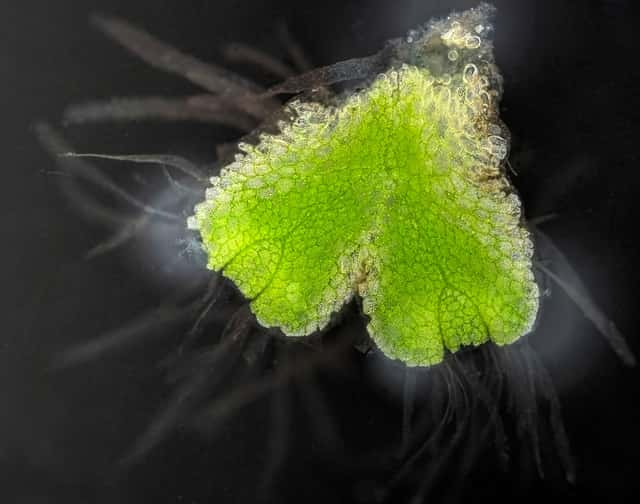
Ricciocarpos natans is a liverwort, a simple plant related to mosses, with no flowers, seeds or true roots. It is the only species in its genus and grows almost worldwide except in polar regions. It floats on still water in ponds, ditches and swamps. Each plant is a green heart- to fan-shaped thallus up to about 1 cm long, with a forked groove on top. Long, narrow purple scales hang from the underside and look like roots. It multiplies by forking and splitting into two equal plants. When the water dries up, it grows as rosettes on the mud.
How to Propagate Purple-fringed Riccia?
Thallus division
Do not let other floaters such as duckweed cover the whole surface: this liverwort loses the competition.
- 1 Take a few plants from a healthy colony
- 2 Place them on still water with no current
- 3 Keep moderate light and nutrient-rich water
- 4 Let the thallus fork and split into two plants on its own
Materials needed:
How Big Does Purple-fringed Riccia Grow?
TLDR: Purple-fringed Riccia can reach up to 1cm tall with Fast growth rate.
Max height
1cm
Spread
3cm
Growth rate
Fast
Foliage
Evergreen
Plant Uses
Ornamental
Great for decoration
Is your plant showing symptoms?
Click on the symptom to discover possible causes:
Fun Facts
The purple 'roots' are not roots: they are long scales that help keep the plant balanced on the water.
Its aquatic and land forms look so different that they were first described as separate species.
It is the only species in the genus Ricciocarpos and grows on every continent except Antarctica.
Frequently asked questions
Is Ricciocarpos natans a plant?
How do I grow purple-fringed riccia in an aquarium?
Will it take over like duckweed?
Why is it turning red?
Compare with similar plants
| Attribute | Difficulty | Light | Watering | Pet Safe |
|---|---|---|---|---|
| Field Maple | Easy | Bright indirect | 14d | ✓ |
| Iberian Houseleek | Easy | Direct sun | 14d | ✓ |
| Silver Birch | Easy | Direct sun | 14d | ✓ |
| Common Blanketflower | Easy | Direct sun | 10d | ✓ |





