Orchidaceae
Rabbit orchid (Leptoceras menziesii): growing guide
Leptoceras menziesii
A difficult collector's plant. It grows with winter and spring rain and spends summer dormant and dry as a tuber. It needs a soil fungus to survive.
Every 7 days
Partial shade
° - °C
% - %
Categories
What is Rabbit orchid?
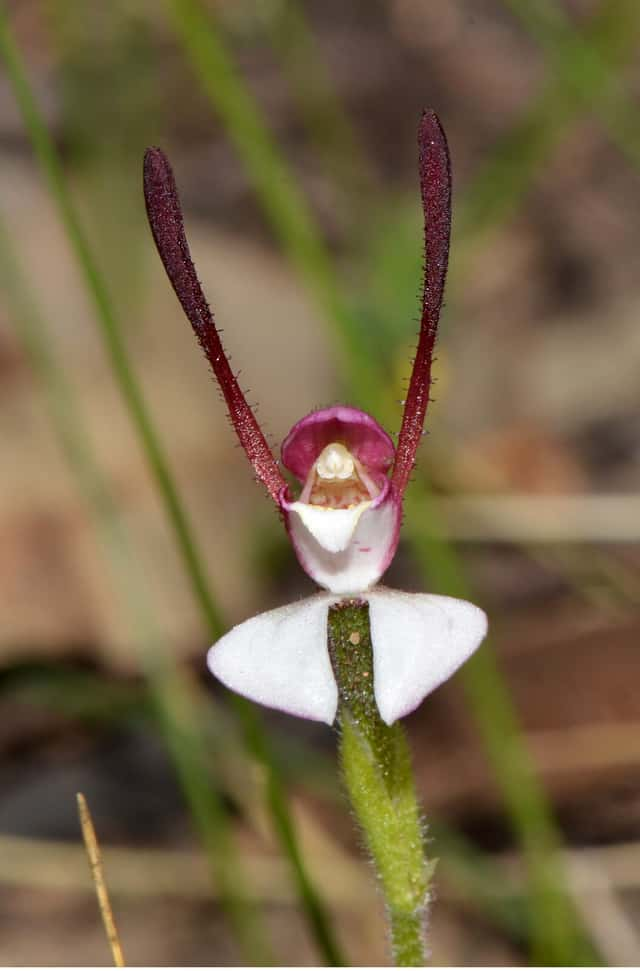
Rabbit orchid (Leptoceras menziesii) is a hard-care plant from the Orchidaceae family. The rabbit orchid is a small terrestrial orchid, 6 to 30 cm tall, endemic to southern Australia. It grows from a tuber in winter with a single glossy leaf, and from late winter to spring opens one to three white flowers marked with red. Its two purplish-red petals stand upright like rabbit ears. It...
Rabbit orchid grows up to 30cm, watering every 7 days. It is not suitable for indoor environments and safe for pets.
Unlike easy-care plants, Rabbit orchid demands constant attention to humidity and light. Not recommended for beginners. Unlike many popular species, Rabbit orchid is safe to keep around pets.
How to Care for Rabbit orchid?
TLDR: Rabbit orchid needs Partial shade, watering every 7 days, and temperatures between 15-30°C with 40-70% humidity.
How Often Should You Water Rabbit orchid?
While in growth keep the mix moist, watering about once a week. When the leaf dies back, stop watering: the dormant tuber rots if kept wet.
How Much Light Does Rabbit orchid Need?
Bright light, as in open woodland or heath. In a pot, avoid harsh midday sun.
What Is the Best Soil for Rabbit orchid?
A very free-draining mix with coarse sand and some organic matter to feed the associated fungus.
What Pot Should You Use for Rabbit orchid?
A shallow clay pot with good holes and sandy mix. Do not use soil from the wild site: tubers rot in it during dormancy.
What Is Rabbit orchid and Where Does It Come From?
The rabbit orchid is a small terrestrial orchid, 6 to 30 cm tall, endemic to southern Australia. It grows from a tuber in winter with a single glossy leaf, and from late winter to spring opens one to three white flowers marked with red. Its two purplish-red petals stand upright like rabbit ears. It flowers almost only after summer bushfires, with smoke as the trigger.
How to Propagate Rabbit orchid?
Daughter tubers
The plant forms colonies from tubers. Growers report that storing dormant tubers with a banana skin for two weeks helps flowering, but this is unproven.
- 1 At the end of dormancy, tip the tubers out of the pot
- 2 Separate the new tubers formed beside the old one
- 3 Replant in free-draining mix and water only once the leaf appears
Materials needed:
How Big Does Rabbit orchid Grow?
TLDR: Rabbit orchid can reach up to 30cm tall with Slow growth rate.
Max height
30cm
Growth rate
Slow
Foliage
Deciduous
Plant Uses
Ornamental
Great for decoration
Is your plant showing symptoms?
Click on the symptom to discover possible causes:
What Diseases Commonly Affect Rabbit orchid?
TLDR: Rabbit orchid is susceptible to 1 known diseases. Monitor regularly for early detection.
Fun Facts
It forms whole colonies from tubers
Without fire it can go years producing only a leaf
It was once called Caladenia menziesii and some herbaria still use that name
Frequently asked questions
Why is it called the rabbit orchid?
Does it only flower after fire?
Can I grow it at home?
Compare with similar plants
| Attribute | Difficulty | Light | Watering | Pet Safe |
|---|---|---|---|---|
| Sticky false asphodel | Hard | Bright indirect | 1d | ✓ |
| Truckee lewisia | Hard | Bright indirect | 10d | ✓ |
| Creeping bentgrass | Hard | Direct sun | 3d | ✓ |
| Walking Palm | Hard | Bright indirect | 3d | ✓ |
Choose & Compare
Sources & References
- Leptoceras (Wikipedia)
- Beauty emerges from the ashes: rabbit orchids (Department for Environment and Water, South Australia)
- Leptoceras menziesii (Yarra Ranges Council Plant Directory)
- Leptoceras menziesii (Orchids of Western Australia, Lucid key)
- Orchid losers and winners after fire in Western Australia (Pacific Conservation Biology)
- Pacific Bulb Society list: Leptoceras cultivation note