Fabaceae
Rain Tree: Edible Plant
Samanea saman
Requires full sun and plenty of space to spread its massive canopy. It grows quickly, tolerates a wide variety of soils, and once established, is very drought-resistant; it thrives in warm tropical climates with temperatures between 18-35°C.
Every 14 days
Direct sun
18° - 35°C
50% - 90%
Categories
What is Rain Tree?
Rain Tree (Samanea saman) is a easy-care plant from the Fabaceae family. Samanea saman, commonly known as the Rain Tree or Monkeypod, is a monumental tropical tree native to Central and South America, now naturalized in tropical regions worldwide. It reaches heights of 15 to 30 m and develops an umbrella-shaped canopy that can exceed 30-40 m in diameter, providing except...
Rain Tree grows up to 30.0m, spread of 4000cm, watering every 14 days, 18°C – 35°C, 50–90% humidity. It is not suitable for indoor environments and safe for pets.
Unlike many tropical plants, Rain Tree tolerates watering mistakes. Best for beginners. Unlike many popular species, Rain Tree is safe to keep around pets.
How to Care for Rain Tree?
TLDR: Rain Tree needs Direct sun, watering every 14 days, and temperatures between 18-35°C with 50-90% humidity.
How Often Should You Water Rain Tree?
Water regularly during the first few years to encourage deep rooting; once established, it tolerates dry periods well and only needs supplemental watering during prolonged droughts.
How Much Light Does Rain Tree Need?
Requires direct sun for most of the day; in partial shade, its canopy develops incompletely and it produces fewer flowers.
What Is the Best Soil for Rain Tree?
Adapts to almost any well-drained soil, from sandy to clayey, with a pH ranging from moderately acidic to alkaline (5.5-8.5); it prefers fertile, moist substrates but not waterlogged ones.
What Pot Should You Use for Rain Tree?
Not suitable for pots: its root system is aggressive and its adult size is too large; a temporary container is only recommended during the nursery phase before final transplanting into the ground.
Care Schedule
Fertilize
Every 90 days
What Is Rain Tree and Where Does It Come From?
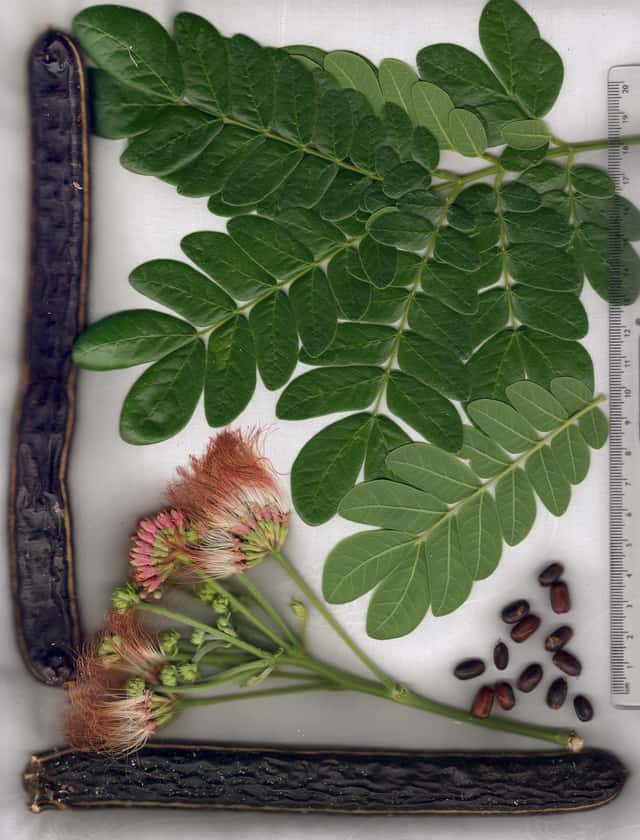
Samanea saman, commonly known as the Rain Tree or Monkeypod, is a monumental tropical tree native to Central and South America, now naturalized in tropical regions worldwide. It reaches heights of 15 to 30 m and develops an umbrella-shaped canopy that can exceed 30-40 m in diameter, providing exceptional shade. It is famous for folding its leaflets at night or before rain, allowing water to reach the ground. Its flowers are tassel-like heads, pink with white stamens, highly attractive to pollinators, and its pods contain a sweet edible pulp.
How to Propagate Rain Tree?
Seed Propagation
- Do not let the substrate dry out during germination.
- Transplant to its final location as soon as possible: the species does not tolerate prolonged pot cultivation well.
- 1 Scarification
Lightly sand the seed coat or soak in hot water for 24 hours to break its natural hardness.
- 2 Sowing
Sow in nursery bags with fertile, moist substrate at a depth similar to the width of the seed.
- 3 Germination and Growth
Keep in a warm, bright place until germination; the seedling will be ready for field transplanting in 3-5 months, once it reaches 20-30 cm.
Materials needed:
How Big Does Rain Tree Grow?
TLDR: Rain Tree can reach up to 30.0m tall with Fast growth rate.
Max height
30.0m
Spread
40.0m
Growth rate
Fast
Foliage
Semi-evergreen
Plant Uses
Ornamental
Great for decoration
Medicinal
Medicinal properties
Edible
Can be consumed
Air Purifying
Improves air quality
Medicinal Uses
- Bark decoction to treat diarrhea and stomach pain
- Leaf infusion traditionally used as a mild sedative and for headaches
- Traditional use as a laxative
Culinary Uses
- Sweet pulp from the pods consumed as a snack or used in beverages
- Fallen pods used as livestock fodder during the dry season
Is your plant showing symptoms?
Click on the symptom to discover possible causes:
What Diseases Commonly Affect Rain Tree?
TLDR: Rain Tree is susceptible to 6 known diseases. Monitor regularly for early detection.
Mealybugs
Mealybugs are small, soft-bodied insects covered with a white, waxy, cottony material. They are common pests of houseplants and outdoor plants in mild climates. These sap-sucking insects feed on plant tissue, causing damage, stunted growth, and can lead to plant death if left untreated. They produce sticky honeydew which attracts sooty mold.
Aphids
Aphids are small, soft-bodied, pear-shaped insects (1/16 to 1/8 inch long) that feed by sucking nutrient-rich sap from plants. They reproduce rapidly and can quickly weaken plants, causing distorted growth and transmitting plant viruses. Aphids come in various colors including green, black, red, yellow, brown, and gray. They secrete honeydew, a sticky substance that attracts ants and encourages sooty mold growth.
Root-Knot Nematodes
Root-knot nematodes (Meloidogyne species) are microscopic roundworms that parasitize plant roots, causing characteristic galls or knots. These soil-borne pests are among the most economically damaging plant pathogens worldwide, affecting a wide range of ornamental and edible plants. The nematodes inject enzymes into root cells, causing abnormal swelling and disrupting water and nutrient uptake.
Caterpillars
Caterpillars are the larval stage of moths and butterflies that feed voraciously on plant foliage, stems, flowers, and fruits. Common species include cabbage loopers, tomato hornworms, armyworms, and cutworms. These pests can cause extensive damage by consuming large amounts of plant tissue in a short time. They vary in size from small (1/4 inch) to large (5 inches), with colors ranging from green to brown, often featuring stripes or spots. Caterpillars are highly mobile and can quickly spread throughout gardens, making them one of the most destructive common pests.
Meaning & Symbolism
In many tropical cultures, it symbolizes protection, shelter, and wisdom due to the immense shade it provides for generations.
Compare with similar plants
| Attribute | Difficulty | Light | Watering | Pet Safe |
|---|---|---|---|---|
| Field Maple | Easy | Bright indirect | 14d | ✓ |
| Silver Birch | Easy | Direct sun | 14d | ✓ |
| Common Blanketflower | Easy | Direct sun | 10d | ✓ |
| Cushion Bush | Easy | Direct sun | 14d | ✓ |





