Podocarpaceae
Real Yellowwood (Podocarpus latifolius)
Podocarpus latifolius
A tough, long-lived tree that is easy to grow but slow. Give it full sun to partial shade, deep humus-rich soil and regular moderate watering, especially while young. It tolerates frost down to about -10 C and is the most cold-hardy of the yellowwoods. It works as a specimen tree, a screen or hedge, in a large container for many years and even as a bonsai. Avoid waterlogged soil, which can cause root rot.
Every 7 days
Bright indirect
-10° - °C
% - %
Categories
What is Real Yellowwood?
Real Yellowwood (Podocarpus latifolius) is a easy-care plant from the Podocarpaceae family. Podocarpus latifolius, the real yellowwood, is a slow-growing evergreen conifer of the Podocarpaceae family and the national tree of South Africa. It grows naturally in the afromontane forests of southern and eastern South Africa, from the Western Cape to KwaZulu-Natal and Limpopo, and in Eswatini a...
Real Yellowwood grows up to 35.0m, watering every 7 days. It is suitable for indoor environments and safe for pets.
Unlike many tropical plants, Real Yellowwood tolerates watering mistakes. Best for beginners. Unlike many popular species, Real Yellowwood is safe to keep around pets. Without adequate drainage, root rot can develop within 14 days.
How to Care for Real Yellowwood?
TLDR: Real Yellowwood needs Bright indirect, watering every 7 days, and temperatures between -10-30°C with 40-70% humidity.
How Often Should You Water Real Yellowwood?
Water regularly so the soil stays slightly moist, roughly once a week in warm weather, more often in pots and less in winter. Young trees need steady water to establish; mature trees in the ground cope with short dry spells but grow best with a regular supply. Never leave the roots sitting in water.
How Much Light Does Real Yellowwood Need?
Full sun to partial shade. Young plants appreciate some shade, as they would get in the forest. In a pot it tolerates short periods indoors in a bright spot, but it grows best outdoors.
What Is the Best Soil for Real Yellowwood?
Plant in deep, fertile, humus-rich soil improved with compost. It tolerates loamy or sandy soils as long as they hold some moisture and drain well. In pots, use a good potting mix with added compost.
What Pot Should You Use for Real Yellowwood?
A large, deep pot with drainage holes, to make room for the taproot; terracotta or heavy plastic both work.
What Is Real Yellowwood and Where Does It Come From?
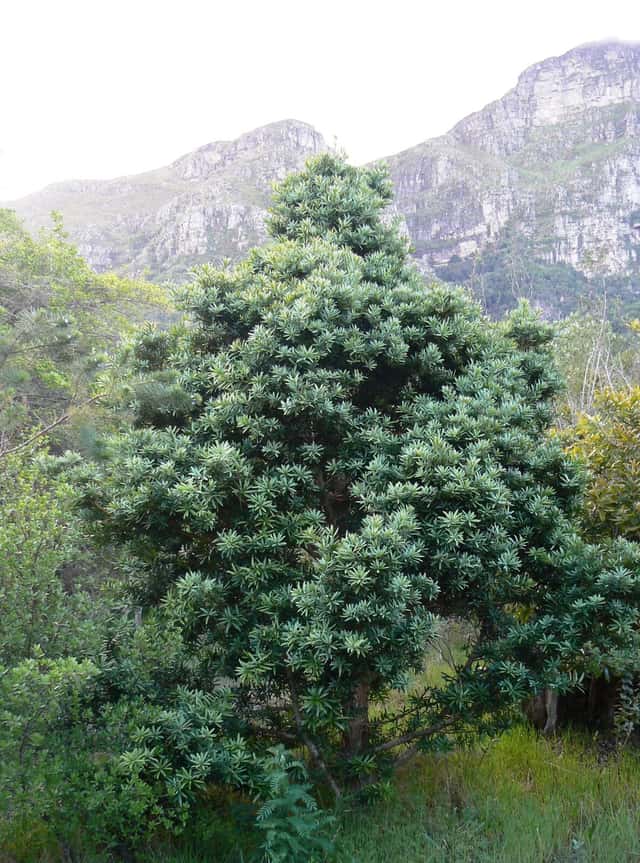
Podocarpus latifolius, the real yellowwood, is a slow-growing evergreen conifer of the Podocarpaceae family and the national tree of South Africa. It grows naturally in the afromontane forests of southern and eastern South Africa, from the Western Cape to KwaZulu-Natal and Limpopo, and in Eswatini and Lesotho, from sea level to over 1,800 m. In the forest it can reach 20-35 m, but in the open and in gardens it stays much smaller, with a dense, rounded crown. The strap-shaped leaves are 25-40 mm long on adult trees (up to 100 mm on young plants), dark green and leathery, while new growth is soft and pale, contrasting with the older foliage. Trees are male or female: female trees carry round, grey-blue seeds on a fleshy receptacle that ripens purple and is eaten by birds and monkeys.
How to Propagate Real Yellowwood?
Fresh seed
Sow the seed fresh: if it dries out it will not germinate, and stored seed germinates late. Handle the taproot gently when transplanting.
- 1 Pick the ripe fruits from a female tree before they fall
- 2 Remove the fleshy receptacle and clean the seed
- 3 Sow immediately in a mix of sand and compost, just covered
- 4 Keep the mix constantly moist in a warm, lightly shaded place
- 5 Transplant seedlings carefully without damaging the taproot
Materials needed:
How Big Does Real Yellowwood Grow?
TLDR: Real Yellowwood can reach up to 35.0m tall with Slow growth rate.
Max height
35.0m
Growth rate
Slow
Foliage
Evergreen
Plant Uses
Ornamental
Great for decoration
Edible
Can be consumed
Culinary Uses
- The fleshy receptacle under the seed is sweet and edible in small amounts, eaten fresh or cooked into jams and pies.
Is your plant showing symptoms?
Click on the symptom to discover possible causes:
What Diseases Commonly Affect Real Yellowwood?
TLDR: Real Yellowwood is susceptible to 3 known diseases. Monitor regularly for early detection.
Root Rot
Root rot is a serious fungal disease that affects the root system of plants, causing them to decay and die. It is primarily caused by overwatering, poor drainage, or soil-borne fungi such as Pythium, Phytophthora, Rhizoctonia, and Fusarium. The disease thrives in waterlogged conditions where roots are deprived of oxygen, making them susceptible to fungal infection.
Scale Insects
Scale insects are small sap-sucking pests that appear as brown, shell-like bumps on plant stems and leaves. There are over 25 species, divided into armored (hard) and unarmored (soft) scales. They feed by piercing plant tissue and extracting sap, which weakens the plant and can lead to yellowing, stunted growth, and even death if left untreated. They also excrete honeydew, which attracts ants and promotes sooty mold growth.
Aphids
Aphids are small, soft-bodied, pear-shaped insects (1/16 to 1/8 inch long) that feed by sucking nutrient-rich sap from plants. They reproduce rapidly and can quickly weaken plants, causing distorted growth and transmitting plant viruses. Aphids come in various colors including green, black, red, yellow, brown, and gray. They secrete honeydew, a sticky substance that attracts ants and encourages sooty mold growth.
Meaning & Symbolism
South Africa's national tree: the real yellowwood stands for strength, longevity and heritage, a forest giant that can live for centuries and once supplied the country's most prized timber.
Fun Facts
The real yellowwood is South Africa's national tree and is protected by law.
In the forest it can reach about 35 m, with a trunk up to 3 m wide.
Trees are either male or female; only female trees produce the purple, berry-like receptacles.
Its yellow timber was used for floors, furniture, railway sleepers and wagons.
Frequently asked questions
How fast does real yellowwood grow?
Is real yellowwood frost hardy?
Can I grow Podocarpus latifolius in a pot?
Are the fruits of real yellowwood edible?
How do I propagate real yellowwood?
Compare with similar plants
| Attribute | Difficulty | Light | Watering | Pet Safe |
|---|---|---|---|---|
| Field Maple | Easy | Bright indirect | 14d | ✓ |
| Iberian Houseleek | Easy | Direct sun | 14d | ✓ |
| Silver Birch | Easy | Direct sun | 14d | ✓ |
| Common Blanketflower | Easy | Direct sun | 10d | ✓ |