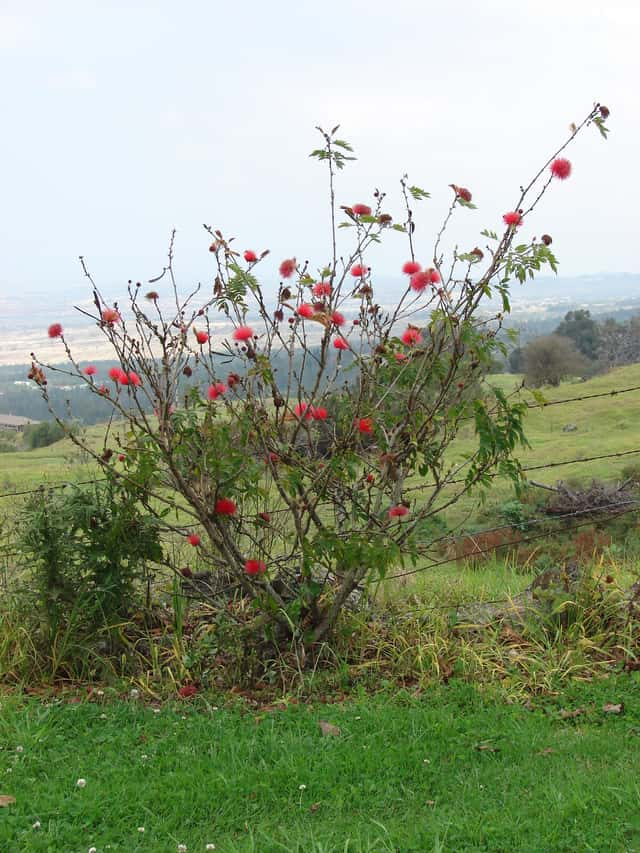
Fabaceae
Red Powderpuff (Calliandra haematocephala)
Calliandra haematocephala
An easy shrub for full sun and well-drained soil. Water regularly in the first year; after that it is quite drought tolerant. It cannot take frost. Prune in late winter to shape.
Every 7 days
Direct sun
0° - °C
% - %
Categories
What is Red Powderpuff?
Red Powderpuff (Calliandra haematocephala) is a easy-care plant from the Fabaceae family. Red powderpuff (Calliandra haematocephala) is an evergreen shrub or small tree in the pea family (Fabaceae), native to Bolivia. It grows 3-4.5 m tall (up to 5 m), with compound leaves whose leaflets fold up at night. From fall to spring it opens 6-8 cm puffs made of hundreds of red stamens (pinkish...
Red Powderpuff grows up to 4.5m, watering every 7 days. It is suitable for indoor environments and safe for pets.
Unlike many tropical plants, Red Powderpuff tolerates watering mistakes. Best for beginners. Unlike many popular species, Red Powderpuff is safe to keep around pets. Without adequate drainage, root rot can develop within 14 days.
How to Care for Red Powderpuff?
TLDR: Red Powderpuff needs Direct sun, watering every 7 days, and temperatures between 0-30°C with 40-70% humidity.
How Often Should You Water Red Powderpuff?
In the first year, water about once a week without waterlogging. Once established, water deeply only in long dry spells. In pots, water when the top few centimetres of mix are dry.
How Much Light Does Red Powderpuff Need?
Full sun, ideally 6 hours or more a day. It tolerates part shade but flowers less.
What Is the Best Soil for Red Powderpuff?
Well-drained sandy or loamy soil, slightly acidic to neutral. It does not tolerate waterlogging.
What Pot Should You Use for Red Powderpuff?
A large, deep pot with drainage holes. In a container, pruning keeps it to about 1.5 m.
What Is Red Powderpuff and Where Does It Come From?
Red powderpuff (Calliandra haematocephala) is an evergreen shrub or small tree in the pea family (Fabaceae), native to Bolivia. It grows 3-4.5 m tall (up to 5 m), with compound leaves whose leaflets fold up at night. From fall to spring it opens 6-8 cm puffs made of hundreds of red stamens (pinkish forms and the white 'Alba' exist) that hummingbirds love. It grows fast and is widely planted in warm-climate gardens as a specimen shrub, hedge or pruned small tree.
How to Propagate Red Powderpuff?
Seed
It also self-seeds around cultivated plants.
- 1 Soak the seeds in warm water for 24 hours
- 2 Sow 1 cm deep in light seed mix
- 3 Keep moist, warm and bright
Materials needed:
Semi-hardwood cuttings
Rooting hormone markedly improves the strike rate.
- 1 In late spring or summer, take 10-15 cm semi-hardwood cuttings
- 2 Strip the lower leaves and dip in rooting hormone
- 3 Insert into moist, free-draining mix
- 4 Keep warm in indirect light
Materials needed:
How Big Does Red Powderpuff Grow?
TLDR: Red Powderpuff can reach up to 4.5m tall with Fast growth rate.
Max height
4.5m
Growth rate
Fast
Foliage
Evergreen
Plant Uses
Ornamental
Great for decoration
Is your plant showing symptoms?
Click on the symptom to discover possible causes:
What Diseases Commonly Affect Red Powderpuff?
TLDR: Red Powderpuff is susceptible to 5 known diseases. Monitor regularly for early detection.
Spider Mites
Spider mites are tiny arachnids (less than 1/20 inch long) related to spiders and ticks that feed on plant sap. They thrive in hot, dry conditions and can cause significant damage to ornamental and vegetable plants. During severe infestations, crop losses can reach 14% or higher as these pests disrupt vital plant processes including photosynthesis, carbon dioxide absorption, and transpiration.
Mealybugs
Mealybugs are small, soft-bodied insects covered with a white, waxy, cottony material. They are common pests of houseplants and outdoor plants in mild climates. These sap-sucking insects feed on plant tissue, causing damage, stunted growth, and can lead to plant death if left untreated. They produce sticky honeydew which attracts sooty mold.
Aphids
Aphids are small, soft-bodied, pear-shaped insects (1/16 to 1/8 inch long) that feed by sucking nutrient-rich sap from plants. They reproduce rapidly and can quickly weaken plants, causing distorted growth and transmitting plant viruses. Aphids come in various colors including green, black, red, yellow, brown, and gray. They secrete honeydew, a sticky substance that attracts ants and encourages sooty mold growth.
Caterpillars
Caterpillars are the larval stage of moths and butterflies that feed voraciously on plant foliage, stems, flowers, and fruits. Common species include cabbage loopers, tomato hornworms, armyworms, and cutworms. These pests can cause extensive damage by consuming large amounts of plant tissue in a short time. They vary in size from small (1/4 inch) to large (5 inches), with colors ranging from green to brown, often featuring stripes or spots. Caterpillars are highly mobile and can quickly spread throughout gardens, making them one of the most destructive common pests.
Fun Facts
Each puff is made of hundreds of red stamens; the petals are tiny.
The leaflets fold up at night.
In south-eastern Queensland it has escaped gardens and become a weed along waterways.
Frequently asked questions
Does red powderpuff need full sun?
How much water does it need?
When does it bloom?
Can I grow it in a pot?
Compare with similar plants
| Attribute | Difficulty | Light | Watering | Pet Safe |
|---|---|---|---|---|
| Field Maple | Easy | Bright indirect | 14d | ✓ |
| Iberian Houseleek | Easy | Direct sun | 14d | ✓ |
| Silver Birch | Easy | Direct sun | 14d | ✓ |
| Common Blanketflower | Easy | Direct sun | 10d | ✓ |





