Montiaceae
Rock purslane
Cistanthe grandiflora
An easy plant as long as it gets three things: full sun, fast-draining soil and little water. It handles drought and heat but suffers from too much water, especially in winter. Where frosts are hard, grow it in a pot and bring it under cover for the cold months. Cut off spent flower stems to keep it tidy.
Every 14 days
Direct sun
° - °C
% - %
Categories
What is Rock purslane?
Rock purslane (Cistanthe grandiflora) is a easy-care plant from the Montiaceae family. Rock purslane is a perennial succulent endemic to Chile, where it grows from the Antofagasta Region south to La Araucanía on open slopes, among dry scrub and in the foothills. It forms a low clump of fleshy, narrow, blue-green leaves. In spring it sends up long, slender stems up to 90 cm tall carryi...
Rock purslane grows up to 90cm, spread of 75cm, watering every 14 days. It is not suitable for indoor environments and safe for pets.
Unlike many tropical plants, Rock purslane tolerates watering mistakes. Best for beginners. Unlike many popular species, Rock purslane is safe to keep around pets.
How to Care for Rock purslane?
TLDR: Rock purslane needs Direct sun, watering every 14 days, and temperatures between 15-30°C with 40-70% humidity.
How Often Should You Water Rock purslane?
Water only when the soil is completely dry, roughly every two weeks in spring and summer. Keep it almost dry in winter. Soggy soil rots the base of the plant.
How Much Light Does Rock purslane Need?
Full sun is best: more light means more flowers and a tighter clump. It tolerates some part shade but flowers less.
What Is the Best Soil for Rock purslane?
Sandy or gravelly, free-draining soil. It accepts acid, neutral or alkaline soil. In a pot, mix the potting soil with coarse sand or grit.
What Pot Should You Use for Rock purslane?
Terracotta pot with drainage holes, wider than deep, filled with cactus mix plus coarse sand.
What Is Rock purslane and Where Does It Come From?
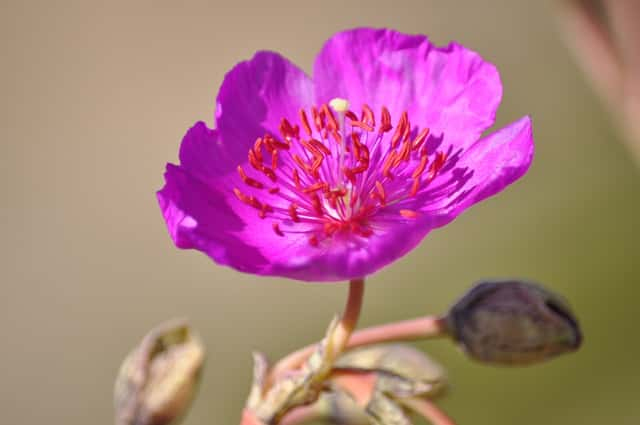
Rock purslane is a perennial succulent endemic to Chile, where it grows from the Antofagasta Region south to La Araucanía on open slopes, among dry scrub and in the foothills. It forms a low clump of fleshy, narrow, blue-green leaves. In spring it sends up long, slender stems up to 90 cm tall carrying large magenta flowers. Each flower lasts only one day, but the buds open one after another for weeks. It used to be called Calandrinia grandiflora and is still sold under that name.
How to Propagate Rock purslane?
Stem cutting
Like any succulent, the cutting rots in wet soil. Underwatering is safer than overwatering.
- 1 In spring, cut a piece of stem with leaves
- 2 Let it dry in the shade for a few days until the cut seals
- 3 Plant it in barely moist sandy mix
- 4 Do not water again until the mix dries
Materials needed:
How Big Does Rock purslane Grow?
TLDR: Rock purslane can reach up to 90cm tall with Medium growth rate.
Max height
90cm
Spread
75cm
Foliage
Evergreen
Plant Uses
Ornamental
Great for decoration
Is your plant showing symptoms?
Click on the symptom to discover possible causes:
What Diseases Commonly Affect Rock purslane?
TLDR: Rock purslane is susceptible to 2 known diseases. Monitor regularly for early detection.
Overwatering
Overwatering occurs when plants receive too much water, depriving roots of oxygen and causing root rot. This environmental stress is one of the most common causes of houseplant death, as waterlogged soil prevents roots from breathing and functioning properly.
Slugs and Snails
Slugs and snails are mollusks that feed on plant tissue, causing irregular holes in leaves and damage to young seedlings. They are most active at night and in moist conditions, leaving characteristic silvery slime trails. These pests can quickly devastate gardens, especially during wet seasons.
Fun Facts
It is endemic to Chile and grows wild nowhere else
It was formerly placed in the genus Calandrinia, the name it is still sold under
Frequently asked questions
How often should I water rock purslane?
Is rock purslane frost hardy?
Why do the flowers last only a day?
Can I grow it indoors?
Compare with similar plants
| Attribute | Difficulty | Light | Watering | Pet Safe |
|---|---|---|---|---|
| Field Maple | Easy | Bright indirect | 14d | ✓ |
| Iberian Houseleek | Easy | Direct sun | 14d | ✓ |
| Silver Birch | Easy | Direct sun | 14d | ✓ |
| Common Blanketflower | Easy | Direct sun | 10d | ✓ |





