Marantaceae
Rose Painted Calathea: Perfect Indoor Houseplant
Calathea roseopicta
Moderate care plant requiring high humidity (60-80%), indirect light and frequent watering with filtered or rainwater. Avoid direct sun and cold drafts. Ideal temperature range is 18-27°C (65-80°F).
Every 5 days
Partial shade
18° - 27°C
60% - 80%
Categories
What is Rose Painted Calathea?
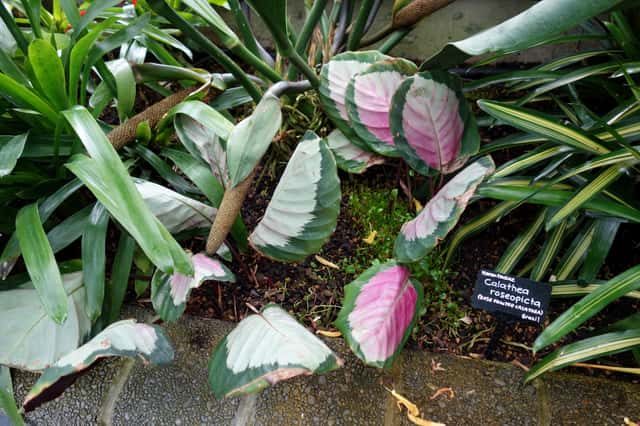
Rose Painted Calathea (Calathea roseopicta) is a medium-care plant from the Marantaceae family. Calathea roseopicta is a perennial rhizomatous herb native to the tropical rainforests of Brazil and South America. Part of the Marantaceae family, it is admired for its oval dark green leaves with pink and silvery-green markings, plus a purple underside. Known as a "prayer plant" because its leaves...
Rose Painted Calathea grows up to 60cm, spread of 50cm, watering every 5 days, 18°C – 27°C, 60–80% humidity. It is suitable for indoor environments and safe for pets.
Unlike many popular species, Rose Painted Calathea is safe to keep around pets. Without adequate drainage, root rot can develop within 10 days.
How to Care for Rose Painted Calathea?
TLDR: Rose Painted Calathea needs Partial shade, watering every 5 days, and temperatures between 18-27°C with 60-80% humidity.
How Often Should You Water Rose Painted Calathea?
Water when the top 2-3 cm of soil feels dry. Use distilled, filtered or rainwater - this plant is sensitive to chlorine and minerals. Increase frequency in summer; reduce in winter. Never let the soil become waterlogged.
How Much Light Does Rose Painted Calathea Need?
Prefers medium to bright indirect light. Position near windows with sheer curtains. Avoid direct sunlight which can burn leaves and fade colors. Tolerates low light conditions, but colors remain more vibrant with adequate lighting.
What Is the Best Soil for Rose Painted Calathea?
Use a light, organic-rich, well-draining substrate. Mix potting soil with coconut coir and perlite in a 2/3 peat + 1/3 perlite ratio. Ideal pH is between 5.5 and 6.5.
What Pot Should You Use for Rose Painted Calathea?
Prefer ceramic or plastic pots that retain moisture. Choose wide models rather than deep ones, always with drainage holes. Line the bottom with clay balls.
Care Schedule
Fertilize
Every 20 days
Misting
Every 3 days
Rotate
Every 14 days
Repot
Every 365 days
What Is Rose Painted Calathea and Where Does It Come From?
Calathea roseopicta is a perennial rhizomatous herb native to the tropical rainforests of Brazil and South America. Part of the Marantaceae family, it is admired for its oval dark green leaves with pink and silvery-green markings, plus a purple underside. Known as a "prayer plant" because its leaves fold up at night like hands in prayer.
How to Propagate Rose Painted Calathea?
Division
Each division should have at least 3 leaves and 2-3 healthy roots
- 1 Divide in spring during repotting
- 2 Carefully remove the plant from its pot
- 3 Locate a rhizome with one or more stems (minimum 3 leaves)
- 4 Separate the rhizome using hands or a clean tool
- 5 Plant in a pot with drainage layer
- 6 Add seedling substrate
- 7 Water to eliminate air bubbles
Materials needed:
How Big Does Rose Painted Calathea Grow?
TLDR: Rose Painted Calathea can reach up to 60cm tall with Medium growth rate.
Max height
60cm
Spread
50cm
Growth rate
Medium
Foliage
Evergreen
Plant Uses
Ornamental
Great for decoration
Air Purifying
Improves air quality
Is your plant showing symptoms?
Click on the symptom to discover possible causes:
What Diseases Commonly Affect Rose Painted Calathea?
TLDR: Rose Painted Calathea is susceptible to 16 known diseases. Monitor regularly for early detection.
Root Rot
Root rot is a serious fungal disease that affects the root system of plants, causing them to decay and die. It is primarily caused by overwatering, poor drainage, or soil-borne fungi such as Pythium, Phytophthora, Rhizoctonia, and Fusarium. The disease thrives in waterlogged conditions where roots are deprived of oxygen, making them susceptible to fungal infection.
Spider Mites
Spider mites are tiny arachnids (less than 1/20 inch long) related to spiders and ticks that feed on plant sap. They thrive in hot, dry conditions and can cause significant damage to ornamental and vegetable plants. During severe infestations, crop losses can reach 14% or higher as these pests disrupt vital plant processes including photosynthesis, carbon dioxide absorption, and transpiration.
Low Humidity Stress
Low humidity stress occurs when indoor air becomes too dry, causing plants to lose moisture faster than they can absorb it through their roots. This is especially common during winter heating periods, near radiators and heating vents, or in air-conditioned spaces. Tropical plants are particularly susceptible to low humidity damage.
Cercospora Leaf Spot
Cercospora leaf spot is a common fungal disease caused by Cercospora species that affects many plant types, particularly beets, roses, and leafy vegetables. The disease thrives in warm, humid conditions and can cause significant defoliation, reducing plant vigor and yield. It spreads rapidly through water splash, wind, and contaminated tools.
Meaning & Symbolism
Represents inner beauty, spiritual protection and positive energy for the home. In popular culture, it is considered a plant that brings peace and harmony to spaces.
Compare with similar plants
| Attribute | Difficulty | Light | Watering | Pet Safe |
|---|---|---|---|---|
| Dark Fieldcap | Medium | Low light | 2d | ⚠️ |
| Azalea | Medium | Partial shade | 3d | ⚠️ |
| Muriel's Bamboo | Medium | Partial shade | 3d | ✓ |
| Bougainvillea | Medium | Direct sun | 7d | ⚠️ |