Equisetaceae
Rough Horsetail (Equisetum hyemale) Care Guide
Equisetum hyemale
Rough horsetail is a virtually indestructible, low-maintenance plant once its moisture needs are met. Give it full sun to part shade, keep the soil consistently moist to wet (it even tolerates a few centimeters of standing water), and it will need almost no fertilizing or pest control. Its biggest care challenge is containing its vigorous rhizomatous spread, not keeping it alive.
Every 3 days
Partial shade
10° - 24°C
40% - 70%
Categories
What is Rough Horsetail?
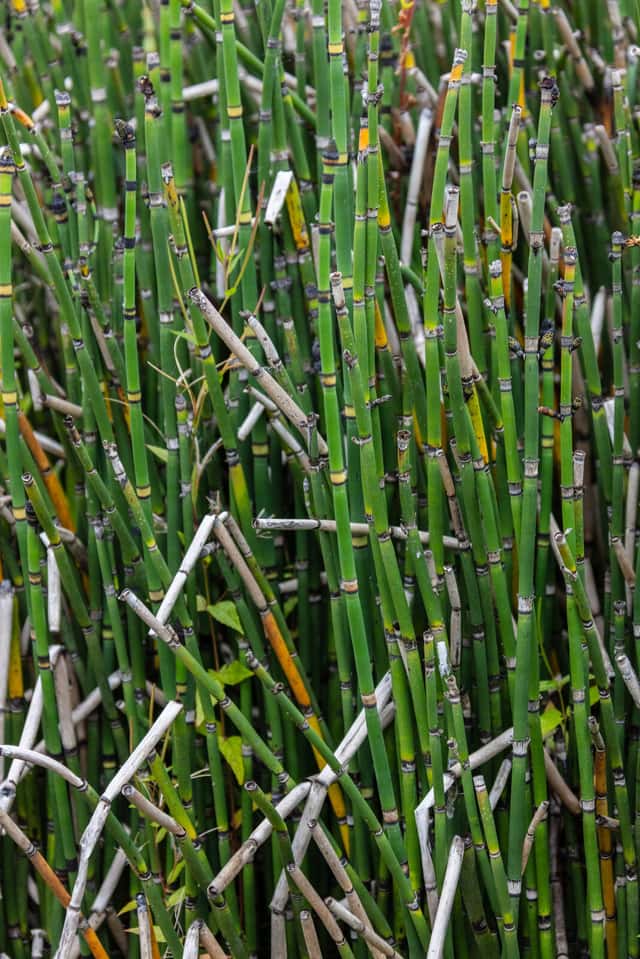
Rough Horsetail (Equisetum hyemale) is a easy-care plant from the Equisetaceae family. Equisetum hyemale, commonly known as rough horsetail or scouring rush, is an evergreen, non-flowering perennial in the ancient Equisetaceae family. Its hollow, jointed, bamboo-like stems grow upright to 1-1.8 m and stay a striking dark green year-round, ringed with black-and-tan banded nodes. As a s...
Rough Horsetail grows up to 1.5m, spread of 180cm, watering every 3 days, 10°C – 24°C, 40–70% humidity. It is suitable for indoor environments and safe for pets.
Unlike many tropical plants, Rough Horsetail tolerates watering mistakes. Best for beginners. Unlike many popular species, Rough Horsetail is safe to keep around pets. Without adequate drainage, root rot can develop within 7 days.
How to Care for Rough Horsetail?
TLDR: Rough Horsetail needs Partial shade, watering every 3 days, and temperatures between 10-24°C with 40-70% humidity.
How Often Should You Water Rough Horsetail?
Keep the soil consistently moist to wet at all times; horsetail is a marginal wetland plant and should never be allowed to dry out completely. In containers, water when the top of the soil begins to feel dry, roughly every 3 days, and it can even sit in a saucer of standing water.
How Much Light Does Rough Horsetail Need?
Grows best in full sun to part shade and tolerates deep shade, though stems may become sparser and lankier with less light. A south-facing window or bright outdoor spot with a few hours of direct sun produces the densest growth.
What Is the Best Soil for Rough Horsetail?
Use a moisture-retentive, slightly acidic to neutral mix (pH 6.0-7.5) such as peat, sand, and perlite. It tolerates a wide range of soils as long as they stay consistently damp; good organic content helps retain moisture.
What Pot Should You Use for Rough Horsetail?
Use a sturdy, deep plastic or glazed ceramic pot without drainage holes (or with a saucer kept full of water) to mimic its natural wet habitat and to physically contain its aggressive rhizomes from invading garden beds.
What Is Rough Horsetail and Where Does It Come From?
Equisetum hyemale, commonly known as rough horsetail or scouring rush, is an evergreen, non-flowering perennial in the ancient Equisetaceae family. Its hollow, jointed, bamboo-like stems grow upright to 1-1.8 m and stay a striking dark green year-round, ringed with black-and-tan banded nodes. As a spore-bearing pteridophyte, it never produces flowers or seeds; instead, small cone-like strobili form at the stem tips and release spores. The species spreads vigorously through branching underground rhizomes, forming dense colonies that make it an excellent architectural accent for wet, boggy sites or contained water features, though its aggressive spread means it should almost always be planted in a pot or behind a root barrier.
How to Propagate Rough Horsetail?
Rhizome Division
Always divide horsetail in a contained pot or with a rhizome barrier, since even small rhizome fragments left in open ground can sprout aggressively.
- 1 In early spring, dig up an established clump and locate a healthy rhizome section with visible nodes and shoots.
- 2 Cut the rhizome into segments roughly 10-15 cm long using clean, sharp shears, ensuring each segment has at least one node.
- 3 Plant segments horizontally about 5 cm deep in moist, peaty soil or directly into a container to control spread.
- 4 Keep the soil consistently moist until new shoots emerge, usually within a few weeks.
Materials needed:
Spore Propagation
Spore propagation is slow and unreliable for home growers; rhizome division is far more practical and commonly used.
- 1 Collect ripe brown strobili (cone-like tips) from fertile stems in early summer.
- 2 Tap the strobili over paper to release the fine green spores, which must be sown fresh within hours since they lose viability quickly.
- 3 Sprinkle spores onto the surface of sterile, moist peat-based medium without covering them.
- 4 Keep the tray covered and consistently moist in bright, indirect light; gametophytes and young sporophytes take weeks to months to develop.
Materials needed:
How Big Does Rough Horsetail Grow?
TLDR: Rough Horsetail can reach up to 1.5m tall with Fast growth rate.
Max height
1.5m
Spread
1.8m
Growth rate
Fast
Foliage
Evergreen
Plant Uses
Ornamental
Great for decoration
Medicinal
Medicinal properties
Medicinal Uses
- Traditional diuretic tea
- Wound-healing poultice
- Silica supplement for hair, skin, and nails
Is your plant showing symptoms?
Click on the symptom to discover possible causes:
What Diseases Commonly Affect Rough Horsetail?
TLDR: Rough Horsetail is susceptible to 4 known diseases. Monitor regularly for early detection.
Spider Mites
Spider mites are tiny arachnids (less than 1/20 inch long) related to spiders and ticks that feed on plant sap. They thrive in hot, dry conditions and can cause significant damage to ornamental and vegetable plants. During severe infestations, crop losses can reach 14% or higher as these pests disrupt vital plant processes including photosynthesis, carbon dioxide absorption, and transpiration.
Mealybugs
Mealybugs are small, soft-bodied insects covered with a white, waxy, cottony material. They are common pests of houseplants and outdoor plants in mild climates. These sap-sucking insects feed on plant tissue, causing damage, stunted growth, and can lead to plant death if left untreated. They produce sticky honeydew which attracts sooty mold.
Aphids
Aphids are small, soft-bodied, pear-shaped insects (1/16 to 1/8 inch long) that feed by sucking nutrient-rich sap from plants. They reproduce rapidly and can quickly weaken plants, causing distorted growth and transmitting plant viruses. Aphids come in various colors including green, black, red, yellow, brown, and gray. They secrete honeydew, a sticky substance that attracts ants and encourages sooty mold growth.
Root Rot
Root rot is a serious fungal disease that affects the root system of plants, causing them to decay and die. It is primarily caused by overwatering, poor drainage, or soil-borne fungi such as Pythium, Phytophthora, Rhizoctonia, and Fusarium. The disease thrives in waterlogged conditions where roots are deprived of oxygen, making them susceptible to fungal infection.
Meaning & Symbolism
As one of the oldest surviving plant lineages on Earth, largely unchanged for over 300 million years, rough horsetail is often seen as a symbol of resilience, endurance, and ancient wisdom.
Fun Facts
Horsetails are living fossils - the genus Equisetum has existed largely unchanged for over 300 million years, predating the dinosaurs.
The stems contain high levels of silica, giving them a gritty texture that was historically used to scour pots and polish wood and metal - hence the name scouring rush.
Unlike almost all other garden plants, horsetail never flowers; it reproduces through spores like ferns and mosses.
A single horsetail colony can spread for meters underground through rhizomes that may reach over a meter deep, making it one of the toughest plants to eradicate.
Frequently asked questions
Does Equisetum hyemale flower?
Is rough horsetail invasive?
Is Equisetum hyemale toxic to pets?
How much water does rough horsetail need?
How do I propagate rough horsetail?
Compare with similar plants
| Attribute | Difficulty | Light | Watering | Pet Safe |
|---|---|---|---|---|
| Field Maple | Easy | Bright indirect | 14d | ✓ |
| Silver Birch | Easy | Direct sun | 14d | ✓ |
| Common Blanketflower | Easy | Direct sun | 10d | ✓ |
| Cushion Bush | Easy | Direct sun | 14d | ✓ |





