Bromeliaceae
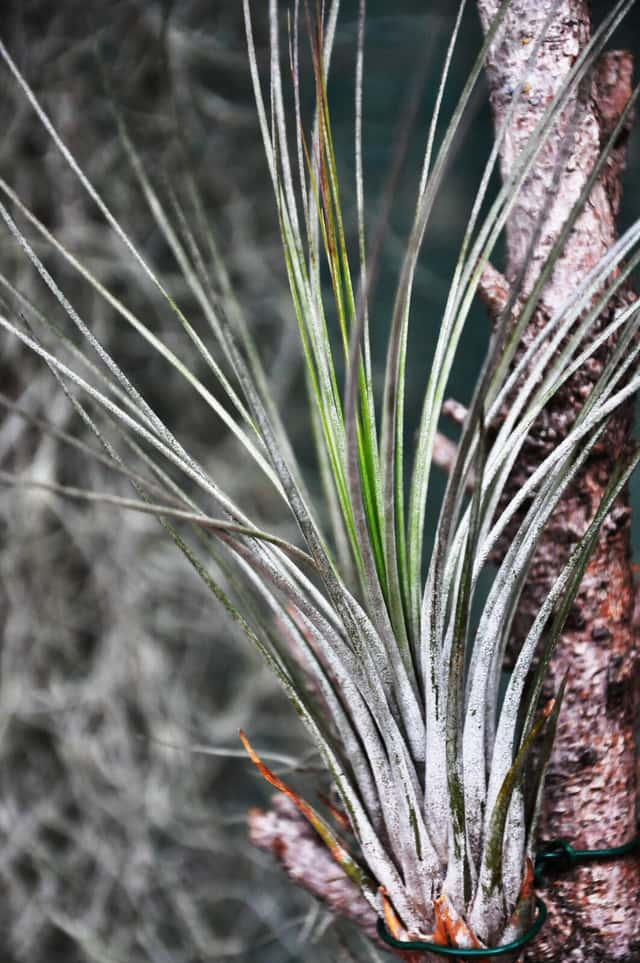
Rush-leaf Air Plant (Tillandsia juncea)
Tillandsia juncea
An easy air plant for a bright spot. Give it plenty of bright, indirect light (a little morning or late-afternoon sun is fine), soak it in water about twice a week and shake it out so it dries within about 4 hours. Keep it above 5 °C, with good air movement and 50-70% humidity. Mount it on wood or cork or set it loose in an open holder; never plant it in soil.
Every 4 days
Bright indirect
5° - °C
50% - 70%
Categories
What is Rush-leaf Air Plant?
Rush-leaf Air Plant (Tillandsia juncea) is a easy-care plant from the Bromeliaceae family. Tillandsia juncea, the rush-leaf air plant, is an epiphytic bromeliad found from Mexico, Central America and the West Indies down to Colombia, Venezuela, Ecuador, Peru, Bolivia and eastern Brazil. It lives on tree trunks and branches from the lowlands up to mountain forests; in Mexico it is a classi...
Rush-leaf Air Plant grows up to 40cm, watering every 4 days, 50–70% humidity. It is suitable for indoor environments and safe for pets.
Unlike many tropical plants, Rush-leaf Air Plant tolerates watering mistakes. Best for beginners. Unlike many popular species, Rush-leaf Air Plant is safe to keep around pets. Without adequate drainage, root rot can develop within 8 days.
How to Care for Rush-leaf Air Plant?
TLDR: Rush-leaf Air Plant needs Bright indirect, watering every 4 days, and temperatures between 5-30°C with 50-70% humidity.
How Often Should You Water Rush-leaf Air Plant?
Misting alone is not enough for this species. Soak the whole plant for 20-30 minutes about twice a week in spring and summer (a little less in winter), ideally in rainwater, distilled or filtered water. Turn it upside down and shake out the water caught between the leaves, then let it dry in a spot with moving air within about 4 hours. In very dry rooms, mist lightly between soaks.
How Much Light Does Rush-leaf Air Plant Need?
It wants bright, indirect light: near an east- or west-facing window is ideal. Some gentle direct sun in the morning or late afternoon is welcome and can tint the leaves, but avoid long hours of harsh midday sun behind glass. In weak light it stops growing and will not flower.
What Is the Best Soil for Rush-leaf Air Plant?
No soil at all. It is an epiphyte whose roots only hold on to bark. Mount it on cork, driftwood or a branch with wire or a plant-safe glue, or rest it in an open holder. Never bury the base in soil or moss that stays wet, or it will rot.
What Pot Should You Use for Rush-leaf Air Plant?
No pot needed. Mount it on cork, driftwood or a branch, or set it in an open glass, wire or ceramic holder that lets water drain and air circulate. Avoid closed terrariums.
Care Schedule
Misting
Every 3 days
What Is Rush-leaf Air Plant and Where Does It Come From?
Tillandsia juncea, the rush-leaf air plant, is an epiphytic bromeliad found from Mexico, Central America and the West Indies down to Colombia, Venezuela, Ecuador, Peru, Bolivia and eastern Brazil. It lives on tree trunks and branches from the lowlands up to mountain forests; in Mexico it is a classic fog-catcher, sitting high in the exposed canopy and drinking moisture from mist through the silvery scales (trichomes) that cover its leaves. It forms an upright clump up to about 40 cm tall of long, very narrow, grey-green leaves that look like rushes or grass. In spring and summer a mature plant sends up a spike of red bracts with small purple tubular flowers. Like other air plants it needs no soil: its roots only anchor it to bark. Each rosette flowers once, then produces offsets (pups) that carry on the clump.
How to Propagate Rush-leaf Air Plant?
Offsets (pups)
You can also leave the pups attached to build a large clump. The mother rosette slowly declines after flowering, which is normal.
- 1 Wait until the pup is at least one third the size of the mother plant
- 2 Gently twist or cut it away at the base with a clean blade
- 3 Let the cut dry for a day
- 4 Mount or place the pup in bright, indirect light and water it like an adult
Materials needed:
Seed
Very slow: plants take 5 to 10 years to mature from seed. Offsets are far quicker.
- 1 Collect the fluffy, wind-borne seeds from a ripe capsule
- 2 Scatter them on a mesh, cork or rough bark
- 3 Mist daily and keep in bright shade with good humidity
- 4 Grow on for several years until the plants reach flowering size
Materials needed:
How Big Does Rush-leaf Air Plant Grow?
TLDR: Rush-leaf Air Plant can reach up to 40cm tall with Slow growth rate.
Max height
40cm
Growth rate
Slow
Foliage
Evergreen
Plant Uses
Ornamental
Great for decoration
Is your plant showing symptoms?
Click on the symptom to discover possible causes:
What Diseases Commonly Affect Rush-leaf Air Plant?
TLDR: Rush-leaf Air Plant is susceptible to 3 known diseases. Monitor regularly for early detection.
Crown Rot
Crown rot is a serious fungal disease that attacks the crown (base) of the plant where the stem meets the soil. It is caused by various fungal pathogens including Phytophthora, Fusarium, and Rhizoctonia. The disease thrives in waterlogged conditions and can quickly spread to kill the entire plant if not addressed promptly.
Mealybugs
Mealybugs are small, soft-bodied insects covered with a white, waxy, cottony material. They are common pests of houseplants and outdoor plants in mild climates. These sap-sucking insects feed on plant tissue, causing damage, stunted growth, and can lead to plant death if left untreated. They produce sticky honeydew which attracts sooty mold.
Scale Insects
Scale insects are small sap-sucking pests that appear as brown, shell-like bumps on plant stems and leaves. There are over 25 species, divided into armored (hard) and unarmored (soft) scales. They feed by piercing plant tissue and extracting sap, which weakens the plant and can lead to yellowing, stunted growth, and even death if left untreated. They also excrete honeydew, which attracts ants and promotes sooty mold growth.
Fun Facts
In Mexico it is a fog-catcher: it lives in the highest, most exposed parts of the canopy and drinks moisture from mist.
In a study in Calakmul, Mexico, 90% of the plants found grew on a single tree species, the huaya (Melicoccus oliviformis).
Its name juncea means rush-like, for its long, thin leaves.
Its range stretches from Mexico and the Caribbean to Bolivia and eastern Brazil.
Frequently asked questions
How often should I water Tillandsia juncea?
Does the rush-leaf air plant need soil?
Is Tillandsia juncea safe for cats and dogs?
Why is the center of my air plant turning brown or black?
Will my juncea die after flowering?
Compare with similar plants
| Attribute | Difficulty | Light | Watering | Pet Safe |
|---|---|---|---|---|
| Field Maple | Easy | Bright indirect | 14d | ✓ |
| Iberian Houseleek | Easy | Direct sun | 14d | ✓ |
| Silver Birch | Easy | Direct sun | 14d | ✓ |
| Common Blanketflower | Easy | Direct sun | 10d | ✓ |





