Lamiaceae
How to Care for Sage (Salvia spp.)
Salvia
Sage is an easy-care, drought-tolerant plant that thrives in sunny spots with well-draining soil. Once established it needs minimal watering and little fertilizer. Ideal for garden beds, borders, and containers.
Every 7 days
Bright indirect
-10° - 38°C
40% - 60%
Categories
What is Sage?
Sage (Salvia) is a easy-care plant from the Lamiaceae family. Salvia is one of the largest genera in the mint family Lamiaceae, comprising over 900 species native to regions spanning the Mediterranean, the Americas, and Asia. The genus encompasses culinary herbs such as S. officinalis, brilliant ornamentals like S. splendens (scarlet sage), and hardy perennial...
Sage grows up to 1.8m, spread of 91cm, watering every 7 days, -10°C – 38°C, 40–60% humidity. It is not suitable for indoor environments and safe for pets.
Unlike many tropical plants, Sage tolerates watering mistakes. Best for beginners. Unlike many popular species, Sage is safe to keep around pets.
How to Care for Sage?
TLDR: Sage needs Bright indirect, watering every 7 days, and temperatures between -10-38°C with 40-60% humidity.
How Often Should You Water Sage?
Water every 7-10 days or when the top 2 inches of soil are dry. Salvia dislikes waterlogged soil – overwatering is the most common cause of problems. Reduce watering in winter.
How Much Light Does Sage Need?
Prefers full sun (6-8 hours daily). Most species tolerate partial shade but will produce fewer flowers.
What Is the Best Soil for Sage?
Use well-draining soil with a pH of 6.0-7.0. Avoid heavy clay soils that retain moisture. Amend with sand or grit if needed.
What Pot Should You Use for Sage?
Terracotta or ceramic pots with drainage holes work best. For larger perennial species, garden beds are preferred.
Care Schedule
Fertilize
Every 90 days
What Is Sage and Where Does It Come From?
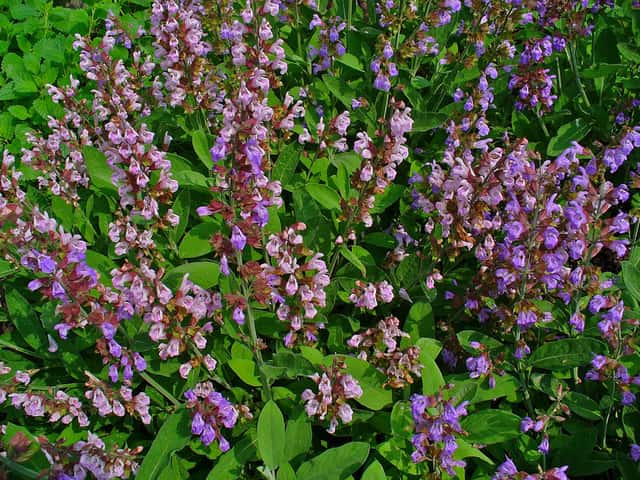
Salvia is one of the largest genera in the mint family Lamiaceae, comprising over 900 species native to regions spanning the Mediterranean, the Americas, and Asia. The genus encompasses culinary herbs such as S. officinalis, brilliant ornamentals like S. splendens (scarlet sage), and hardy perennials like S. nemorosa (woodland sage). All species are aromatic, typically featuring soft or velvety foliage and tubular flowers highly attractive to pollinators.
How Big Does Sage Grow?
TLDR: Sage can reach up to 1.8m tall with Fast growth rate.
Max height
1.8m
Spread
91cm
Growth rate
Fast
Foliage
Semi-evergreen
Plant Uses
Ornamental
Great for decoration
Medicinal
Medicinal properties
Aromatic
Pleasant fragrance
Edible
Can be consumed
Medicinal Uses
- Natural antiseptic
- Digestive aid
- Anti-inflammatory (traditional use)
- Relief for night sweats
- Throat and mouth health
Culinary Uses
- Classic herb for poultry and meat (S. officinalis)
- Infused butters and oils
- Herbal teas
Is your plant showing symptoms?
Click on the symptom to discover possible causes:
What Diseases Commonly Affect Sage?
TLDR: Sage is susceptible to 7 known diseases. Monitor regularly for early detection.
Powdery Mildew
Powdery mildew is a common fungal disease caused by various fungi species including Erysiphe, Podosphaera, Oïdium, and Leveillula. It affects over 10,000 plant species worldwide. The disease thrives in warm, dry climates with high humidity and appears as a distinctive white powdery coating on plant surfaces.
Gray Mold (Botrytis Blight)
Gray mold, caused by the fungus Botrytis cinerea, is one of the most common fungal diseases in plants. It affects over 200 plant species, including ornamentals, vegetables, fruits, and houseplants. The disease thrives in cool, humid conditions with poor air circulation, causing grayish spots and soft rot on infected tissues.
Root Rot
Root rot is a serious fungal disease that affects the root system of plants, causing them to decay and die. It is primarily caused by overwatering, poor drainage, or soil-borne fungi such as Pythium, Phytophthora, Rhizoctonia, and Fusarium. The disease thrives in waterlogged conditions where roots are deprived of oxygen, making them susceptible to fungal infection.
Damping Off
Damping off is a soil-borne fungal disease that affects seeds and young seedlings, causing rotting of stem and root tissues at and below the soil line. It is caused by several fungi including Pythium, Rhizoctonia, Fusarium, and Phytophthora. The disease thrives in cold, wet conditions with poor air circulation.
Meaning & Symbolism
Wisdom, healing, longevity, and purification. Historically associated with immortality and used in ceremonial cleansing rituals.
Fun Facts
The Salvia genus contains over 900 species, making it one of the largest flowering plant genera on Earth.
The name Salvia derives from the Latin "salvare," meaning to heal or save.
Salvia flowers are specially shaped to favour pollination by bees and hummingbirds.
Frequently asked questions
How often should I water Salvia?
Is Salvia toxic to pets?
Can Salvia be grown in pots?
Compare with similar plants
| Attribute | Difficulty | Light | Watering | Pet Safe |
|---|---|---|---|---|
| Field Maple | Easy | Bright indirect | 14d | ✓ |
| Silver Birch | Easy | Direct sun | 14d | ✓ |
| Common Blanketflower | Easy | Direct sun | 10d | ✓ |
| Cushion Bush | Easy | Direct sun | 14d | ✓ |





