Cactaceae
San Antonio Prickly Pear (Opuntia soederstromiana): How to Grow It
Opuntia soederstromiana
Tough full-sun cactus. Give it very free-draining soil, water only when the soil is dry, and protect it from hard frost. Too much water is the main risk.
Every 21 days
Direct sun
5° - 32°C
% - %
Categories
What is San Antonio Prickly Pear?
San Antonio Prickly Pear (Opuntia soederstromiana) is a easy-care plant from the Cactaceae family. Opuntia soederstromiana is a paddle cactus native to the dry inter-Andean valleys of Ecuador and eastern Colombia, at about 770 to 3100 m. It was described from plants collected near San Antonio and Pomasqui, north of Quito. It grows upright as a shrub or small tree 1 to 3.5 m tall, with a spiny tru...
San Antonio Prickly Pear grows up to 3.5m, watering every 21 days, 5°C – 32°C. It is not suitable for indoor environments and safe for pets.
Unlike many tropical plants, San Antonio Prickly Pear tolerates watering mistakes. Best for beginners. Unlike many popular species, San Antonio Prickly Pear is safe to keep around pets.
How to Care for San Antonio Prickly Pear?
TLDR: San Antonio Prickly Pear needs Direct sun, watering every 21 days, and temperatures between 5-32°C with 40-70% humidity.
How Often Should You Water San Antonio Prickly Pear?
In the warm season, water deeply every 2-3 weeks, only once the soil is completely dry. In the cold or rainy season, barely water. Never leave water in the saucer.
How Much Light Does San Antonio Prickly Pear Need?
Needs direct sun for most of the day, as in its native Andean dry scrub. In low light the pads grow long and weak.
What Is the Best Soil for San Antonio Prickly Pear?
Sandy or rocky, very well-drained soil. In pots, use cactus mix with coarse sand or pumice.
What Pot Should You Use for San Antonio Prickly Pear?
Large, heavy terracotta pot with a drainage hole; the plant grows tall and can tip over.
Care Schedule
Fertilize
Every 60 days
What Is San Antonio Prickly Pear and Where Does It Come From?
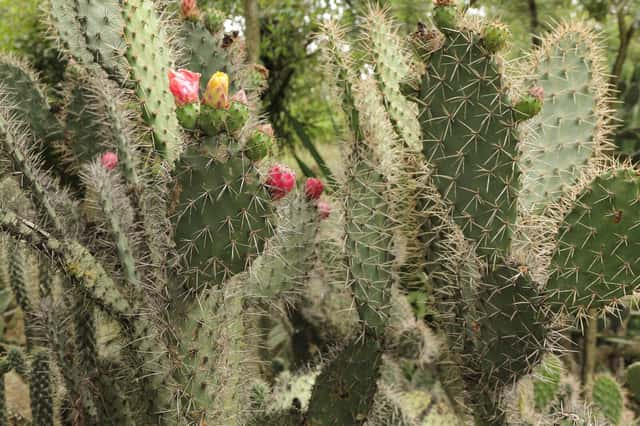
Opuntia soederstromiana is a paddle cactus native to the dry inter-Andean valleys of Ecuador and eastern Colombia, at about 770 to 3100 m. It was described from plants collected near San Antonio and Pomasqui, north of Quito. It grows upright as a shrub or small tree 1 to 3.5 m tall, with a spiny trunk and green pads 17 to 35 cm long. Each areole carries up to 8-12 white spines up to 5 cm long. The flowers are 5-7 cm long and range from yellow to red; the fruits are oval, red-purple and set with short spines. In the wild it hybridizes with the common prickly pear (Opuntia ficus-indica).
How to Propagate San Antonio Prickly Pear?
Pad cutting
Do not water a freshly planted pad; a wet cut rots. Hold it with tongs or folded newspaper to avoid the spines.
- 1 Wearing thick gloves, cut a mature pad at the joint
- 2 Let it dry in the shade for 1-2 weeks until the cut calluses
- 3 Set the base 3-5 cm deep in dry cactus mix
- 4 Wait about 2 weeks before the first light watering
Materials needed:
Seed
Opuntia seeds have hard coats and germinate unevenly; pads are much faster.
- 1 Take seeds from ripe fruit and wash them
- 2 Sow on moist sandy mix and cover lightly
- 3 Keep warm and in bright light until they sprout
Materials needed:
How Big Does San Antonio Prickly Pear Grow?
TLDR: San Antonio Prickly Pear can reach up to 3.5m tall with Medium growth rate.
Max height
3.5m
Growth rate
Medium
Foliage
Evergreen
Plant Uses
Ornamental
Great for decoration
Is your plant showing symptoms?
Click on the symptom to discover possible causes:
What Diseases Commonly Affect San Antonio Prickly Pear?
TLDR: San Antonio Prickly Pear is susceptible to 3 known diseases. Monitor regularly for early detection.
Root Rot
Root rot is a serious fungal disease that affects the root system of plants, causing them to decay and die. It is primarily caused by overwatering, poor drainage, or soil-borne fungi such as Pythium, Phytophthora, Rhizoctonia, and Fusarium. The disease thrives in waterlogged conditions where roots are deprived of oxygen, making them susceptible to fungal infection.
Mealybugs
Mealybugs are small, soft-bodied insects covered with a white, waxy, cottony material. They are common pests of houseplants and outdoor plants in mild climates. These sap-sucking insects feed on plant tissue, causing damage, stunted growth, and can lead to plant death if left untreated. They produce sticky honeydew which attracts sooty mold.
Scale Insects
Scale insects are small sap-sucking pests that appear as brown, shell-like bumps on plant stems and leaves. There are over 25 species, divided into armored (hard) and unarmored (soft) scales. They feed by piercing plant tissue and extracting sap, which weakens the plant and can lead to yellowing, stunted growth, and even death if left untreated. They also excrete honeydew, which attracts ants and promotes sooty mold growth.
Fun Facts
It was described in 1919 from plants collected near San Antonio and Pomasqui, north of Quito.
It is octoploid and hybridizes in the wild with the common prickly pear (Opuntia ficus-indica).
It was first recorded in Colombia in 2020, in dry pockets of Boyacá and Santander.
Frequently asked questions
How often should I water it?
Is it toxic to pets?
Can it grow indoors?
How do I propagate it?
Compare with similar plants
| Attribute | Difficulty | Light | Watering | Pet Safe |
|---|---|---|---|---|
| Field Maple | Easy | Bright indirect | 14d | ✓ |
| Iberian Houseleek | Easy | Direct sun | 14d | ✓ |
| Silver Birch | Easy | Direct sun | 14d | ✓ |
| Common Blanketflower | Easy | Direct sun | 10d | ✓ |





