Lamiaceae
Savory (Genus Satureja)
Satureja
An easy herb: full sun, light free-draining soil and little water once established. It needs no feeding in the ground. Pick often to keep fresh leaves coming, and trim winter savory in early spring.
Every 7 days
Bright indirect
° - °C
% - %
Categories
What is Savory?
Savory (Satureja) is a easy-care plant from the Lamiaceae family. Satureja is the savory genus, aromatic herbs in the mint family related to thyme and rosemary. They are native to southern and southeastern Europe, North Africa, the Middle East and Central Asia. Savories are low herbs or small subshrubs 15 to 50 cm tall, with narrow leaves 1 to 3 cm long and a pepp...
Savory grows up to 50cm, spread of 45cm, watering every 7 days. It is not suitable for indoor environments and safe for pets.
Unlike many tropical plants, Savory tolerates watering mistakes. Best for beginners. Unlike many popular species, Savory is safe to keep around pets.
How to Care for Savory?
TLDR: Savory needs Bright indirect, watering every 7 days, and temperatures between 15-30°C with 40-70% humidity.
How Often Should You Water Savory?
Water when the top few centimetres of soil are dry. Winter savory is drought tolerant once established; summer savory likes soil that stays lightly moist but never soggy. Pots dry out faster in hot weather.
How Much Light Does Savory Need?
Full sun, at least 6 hours a day. It tolerates light shade but produces fewer leaves and less aroma.
What Is the Best Soil for Savory?
Sandy or stony, free-draining soil, even poor soil. If your soil is heavy or stays damp, use a raised bed or a pot. Acid, neutral and alkaline soils all work.
What Pot Should You Use for Savory?
A pot at least 20 cm wide and deep with plenty of drainage holes. Mix up to a quarter of horticultural grit into the compost.
What Is Savory and Where Does It Come From?
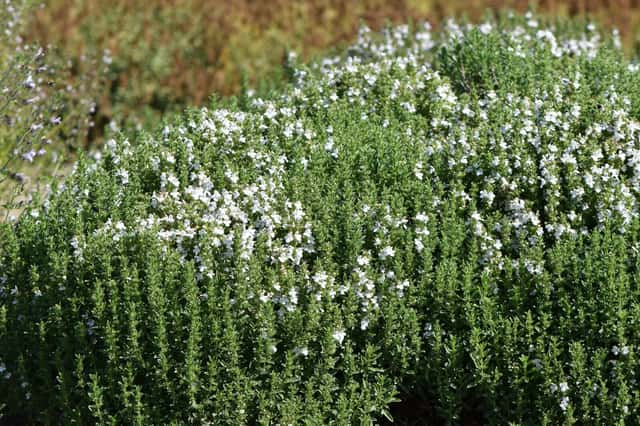
Satureja is the savory genus, aromatic herbs in the mint family related to thyme and rosemary. They are native to southern and southeastern Europe, North Africa, the Middle East and Central Asia. Savories are low herbs or small subshrubs 15 to 50 cm tall, with narrow leaves 1 to 3 cm long and a peppery taste. In summer they bear small white, pink or mauve flowers that bees love. The two most grown are summer savory (S. hortensis), an annual with a milder flavour, and winter savory (S. montana), a woody perennial with a stronger one.
How to Propagate Savory?
Seed
Seeds need light to germinate. Do not overwater, as seedlings are prone to damping off.
- 1 In spring, sow seeds thinly on the surface of moist compost without covering them
- 2 Keep somewhere bright at about 20 °C
- 3 Move seedlings to individual pots once they have several leaves
- 4 Plant out when well rooted, at least 20 cm apart
Materials needed:
Stem cutting
Cuttings work for the perennial species; summer savory is grown from seed.
- 1 Take 5-8 cm shoot tips from winter savory
- 2 Remove the lower leaves
- 3 Insert in moist, sandy compost
- 4 Keep in bright light out of strong sun until rooted
Materials needed:
How Big Does Savory Grow?
TLDR: Savory can reach up to 50cm tall with Fast growth rate.
Max height
50cm
Spread
45cm
Growth rate
Fast
Plant Uses
Edible
Can be consumed
Aromatic
Pleasant fragrance
Medicinal
Medicinal properties
Ornamental
Great for decoration
Medicinal Uses
- The leaves are traditionally used to aid digestion.
Culinary Uses
- A classic seasoning for beans and lentils.
- Used in stuffings, sausages and herbes de Provence.
- Leaves can be used fresh or dried.
Is your plant showing symptoms?
Click on the symptom to discover possible causes:
What Diseases Commonly Affect Savory?
TLDR: Savory is susceptible to 4 known diseases. Monitor regularly for early detection.
Aphids
Aphids are small, soft-bodied, pear-shaped insects (1/16 to 1/8 inch long) that feed by sucking nutrient-rich sap from plants. They reproduce rapidly and can quickly weaken plants, causing distorted growth and transmitting plant viruses. Aphids come in various colors including green, black, red, yellow, brown, and gray. They secrete honeydew, a sticky substance that attracts ants and encourages sooty mold growth.
Root Rot
Root rot is a serious fungal disease that affects the root system of plants, causing them to decay and die. It is primarily caused by overwatering, poor drainage, or soil-borne fungi such as Pythium, Phytophthora, Rhizoctonia, and Fusarium. The disease thrives in waterlogged conditions where roots are deprived of oxygen, making them susceptible to fungal infection.
Damping Off
Damping off is a soil-borne fungal disease that affects seeds and young seedlings, causing rotting of stem and root tissues at and below the soil line. It is caused by several fungi including Pythium, Rhizoctonia, Fusarium, and Phytophthora. The disease thrives in cold, wet conditions with poor air circulation.
Overwatering
Overwatering occurs when plants receive too much water, depriving roots of oxygen and causing root rot. This environmental stress is one of the most common causes of houseplant death, as waterlogged soil prevents roots from breathing and functioning properly.
Fun Facts
Savory has been grown as a culinary herb since at least ancient Greece.
In the Middle Ages it was strewn on floors to scent rooms and deter pests.
In Germany savory is called Bohnenkraut, literally "bean herb".
Frequently asked questions
What is the difference between summer and winter savory?
Can savory grow in a pot?
When should I harvest savory?
Does savory need fertilizer?
Compare with similar plants
| Attribute | Difficulty | Light | Watering | Pet Safe |
|---|---|---|---|---|
| Field Maple | Easy | Bright indirect | 14d | ✓ |
| Iberian Houseleek | Easy | Direct sun | 14d | ✓ |
| Silver Birch | Easy | Direct sun | 14d | ✓ |
| Common Blanketflower | Easy | Direct sun | 10d | ✓ |





