Crassulaceae
Showy Trailing Jade (Crassula sarmentosa)
Crassula sarmentosa
An easy succulent for hanging baskets, walls and dry ground cover. Give it full sun or bright light, a fast-draining mix and infrequent watering. Pinch the tips to keep it bushy.
Every 10 days
Bright indirect
-5° - °C
% - %
Categories
What is Showy trailing jade?
Showy trailing jade (Crassula sarmentosa) is a easy-care plant from the Crassulaceae family. A trailing succulent from the east coast of South Africa, where it grows among rocks, in ravines and draped over cliffs and bushes from Knysna to central KwaZulu-Natal. Small tubers sit at the base and slender stems 50 cm to 1 m long scramble, hang or sprawl. The paired leaves are glossy with finely...
Showy trailing jade grows up to 35cm, watering every 10 days. It is suitable for indoor environments and safe for pets.
Unlike many tropical plants, Showy trailing jade tolerates watering mistakes. Best for beginners. Unlike many popular species, Showy trailing jade is safe to keep around pets. Without adequate drainage, root rot can develop within 20 days.
How to Care for Showy trailing jade?
TLDR: Showy trailing jade needs Bright indirect, watering every 10 days, and temperatures between -5-30°C with 40-70% humidity.
How Often Should You Water Showy trailing jade?
Water thoroughly, then wait until the mix is completely dry before watering again. Overwatering is the main way to lose it, so when in doubt, wait a few more days.
How Much Light Does Showy trailing jade Need?
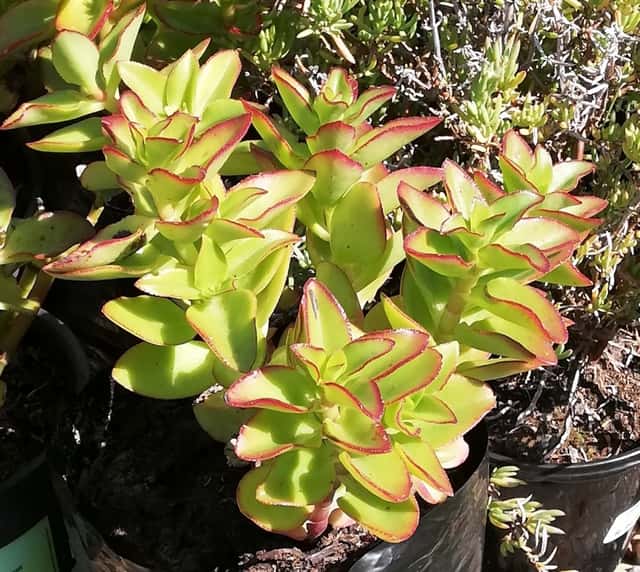
Full sun to bright part shade, up to about 6 hours of direct sun. Sun turns the leaves lime green with red edges; in shade they stay dark green and the stems stretch.
What Is the Best Soil for Showy trailing jade?
Well-drained succulent mix, such as two parts coarse sand, two parts potting soil and one part perlite. In the ground, sandy to loamy soil that never stays wet.
What Pot Should You Use for Showy trailing jade?
A hanging basket or a wide, shallow terracotta pot with drainage holes so the stems can trail.
What Is Showy trailing jade and Where Does It Come From?
A trailing succulent from the east coast of South Africa, where it grows among rocks, in ravines and draped over cliffs and bushes from Knysna to central KwaZulu-Natal. Small tubers sit at the base and slender stems 50 cm to 1 m long scramble, hang or sprawl. The paired leaves are glossy with finely toothed edges: dark green in shade, lime green with red margins in sun. In the southern winter it carries rounded heads of small star-shaped white or cream flowers, sometimes tinged pink. The variegated form 'Comet' is the one most often sold.
How to Propagate Showy trailing jade?
Stem cutting
Trimmed tips can be pushed into the same pot to fill it out. Stems also root by themselves where they touch the soil.
- 1 Cut 5-7 cm stem tips, keeping two leaves at the top
- 2 Dip the base in rooting hormone if you have it
- 3 Insert into dry or barely moist succulent mix
- 4 Keep in bright light out of harsh sun and water only once roots form
Materials needed:
Leaf cutting
A leaf without its base will not root. Slower than stem cuttings.
- 1 Detach whole leaves with the base intact
- 2 Insert them at a slight angle into the mix
- 3 Keep in light shade and mist lightly
- 4 Pot up once roots are 4-5 cm long
Materials needed:
How Big Does Showy trailing jade Grow?
TLDR: Showy trailing jade can reach up to 35cm tall with Medium growth rate.
Max height
35cm
Foliage
Evergreen
Plant Uses
Ornamental
Great for decoration
Ground Cover
Soil coverage
Is your plant showing symptoms?
Click on the symptom to discover possible causes:
What Diseases Commonly Affect Showy trailing jade?
TLDR: Showy trailing jade is susceptible to 5 known diseases. Monitor regularly for early detection.
Mealybugs
Mealybugs are small, soft-bodied insects covered with a white, waxy, cottony material. They are common pests of houseplants and outdoor plants in mild climates. These sap-sucking insects feed on plant tissue, causing damage, stunted growth, and can lead to plant death if left untreated. They produce sticky honeydew which attracts sooty mold.
Spider Mites
Spider mites are tiny arachnids (less than 1/20 inch long) related to spiders and ticks that feed on plant sap. They thrive in hot, dry conditions and can cause significant damage to ornamental and vegetable plants. During severe infestations, crop losses can reach 14% or higher as these pests disrupt vital plant processes including photosynthesis, carbon dioxide absorption, and transpiration.
Root Rot
Root rot is a serious fungal disease that affects the root system of plants, causing them to decay and die. It is primarily caused by overwatering, poor drainage, or soil-borne fungi such as Pythium, Phytophthora, Rhizoctonia, and Fusarium. The disease thrives in waterlogged conditions where roots are deprived of oxygen, making them susceptible to fungal infection.
Rhizoctonia solani
Rhizoctonia solani is a soil-borne fungus that attacks stems, roots, and young seedlings. It thrives in warm, humid weather and in soil that stays wet or drains poorly. Typical signs include seedlings collapsing at the soil line (damping-off), sunken brown lesions near the soil on stems, brown rotting roots, wilting even when the soil is moist, and slow, stunted growth. In lawns, it can cause the well-known “brown patch” during warm, humid periods. Many plants are at risk, including vegetables (such as lettuce, beans, and brassicas), ornamentals, houseplants, and turfgrass.
Fun Facts
Sarmentosa refers to its long, thin stems, which root where they touch the ground.
In the wild it often hangs down cliffs and climbs over shrubs.
Crassula comes from the Latin crassus, thick, for its fleshy leaves.
Frequently asked questions
How often should I water trailing jade?
Is Crassula sarmentosa frost hardy?
Why are the leaves dark green and the stems long?
How do I make the pot fuller?
Compare with similar plants
| Attribute | Difficulty | Light | Watering | Pet Safe |
|---|---|---|---|---|
| Field Maple | Easy | Bright indirect | 14d | ✓ |
| Iberian Houseleek | Easy | Direct sun | 14d | ✓ |
| Silver Birch | Easy | Direct sun | 14d | ✓ |
| Common Blanketflower | Easy | Direct sun | 10d | ✓ |





