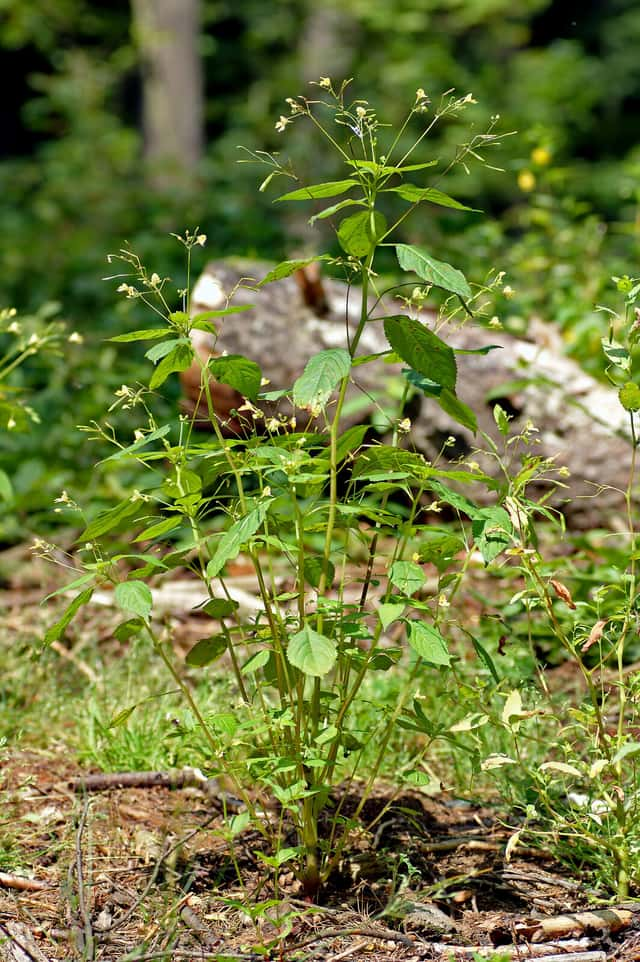
Balsaminaceae
Small Balsam (Impatiens parviflora)
Impatiens parviflora
This plant is rarely grown on purpose. It turns up by itself in woods and shady gardens, so the real question is whether to let it stay. Since it's invasive across much of Europe, the usual advice is to pull it before it sets seed.
Every 3 days
Partial shade
° - °C
% - %
Categories
What is Small balsam?
Small balsam (Impatiens parviflora) is a easy-care plant from the Balsaminaceae family. Small balsam is an annual in the busy Lizzie family, native to the mountains of Central Asia. It grows 20 to 60 cm tall, sometimes close to 1 m, in damp, shady places. The flowers are small and pale yellow, appearing from early summer into early autumn. Ripe seed pods burst at the slightest touch an...
Small balsam grows up to 1.0m, watering every 3 days. It is not suitable for indoor environments and safe for pets.
Unlike many tropical plants, Small balsam tolerates watering mistakes. Best for beginners. Unlike many popular species, Small balsam is safe to keep around pets.
How to Care for Small balsam?
TLDR: Small balsam needs Partial shade, watering every 3 days, and temperatures between 15-30°C with 40-70% humidity.
How Often Should You Water Small balsam?
It likes soil that stays a little moist. In dry weather it wilts fast and needs water every 2 or 3 days.
How Much Light Does Small balsam Need?
It's happy in the shade of trees and in part shade. Hot, dry sun doesn't suit it.
What Is the Best Soil for Small balsam?
It prefers moist, humus-rich soil that drains, but also grows in sandy and clay soils.
What Pot Should You Use for Small balsam?
Not recommended for pots. The pods fire seed so hard that a pot can seed the whole garden.
What Is Small balsam and Where Does It Come From?
Small balsam is an annual in the busy Lizzie family, native to the mountains of Central Asia. It grows 20 to 60 cm tall, sometimes close to 1 m, in damp, shady places. The flowers are small and pale yellow, appearing from early summer into early autumn. Ripe seed pods burst at the slightest touch and can throw seeds more than 3 m. It escaped from European botanic gardens around 1835 and is now a strong invader of Central European woods.
How to Propagate Small balsam?
Seed
Before sowing, check whether it's invasive where you live. Across much of Europe the right thing is not to spread it.
- 1 Sow in spring under cover
- 2 Move seedlings into their own pots once you can handle them
- 3 Plant out in summer in a shady spot
Materials needed:
How Big Does Small balsam Grow?
TLDR: Small balsam can reach up to 1.0m tall with Medium growth rate.
Max height
1.0m
Warning: Toxic Plant
This plant can be toxic if ingested. Keep out of reach of:
Is your plant showing symptoms?
Click on the symptom to discover possible causes:
What Diseases Commonly Affect Small balsam?
TLDR: Small balsam is susceptible to 1 known diseases. Monitor regularly for early detection.
Fun Facts
Seeds can fly up to 3.4 m when a pod bursts.
Hoverflies are among the main visitors to its flowers.
It escaped from botanic gardens such as Dresden, Berlin and Geneva around 1835.
Frequently asked questions
It came up in my garden. Should I pull it out?
How do I recognize it?
Is it toxic? Can you eat it?
What are these orange spots on the leaves?
Compare with similar plants
| Attribute | Difficulty | Light | Watering | Pet Safe |
|---|---|---|---|---|
| Field Maple | Easy | Bright indirect | 14d | ✓ |
| Iberian Houseleek | Easy | Direct sun | 14d | ✓ |
| Silver Birch | Easy | Direct sun | 14d | ✓ |
| Common Blanketflower | Easy | Direct sun | 10d | ✓ |





