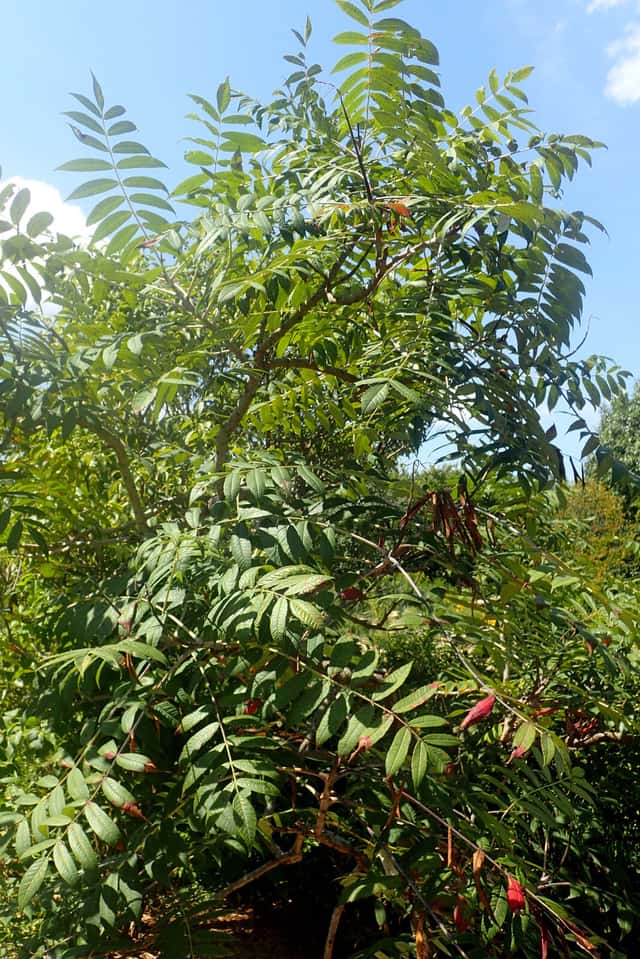
Anacardiaceae
Smooth Sumac (Rhus glabra)
Rhus glabra
A very tough shrub for full sun or part shade. It grows in almost any soil that does not stay wet and, once established, survives severe drought without watering. It needs no fertilizer. It spreads by root suckers into colonies; pull suckers where you do not want it, or let it fill slopes and open ground. Every few years you can rejuvenate a colony by cutting it to the ground in mid-winter.
Every 14 days
Bright indirect
° - °C
% - %
Categories
What is Smooth Sumac?
Smooth Sumac (Rhus glabra) is a easy-care plant from the Anacardiaceae family. Rhus glabra is a deciduous shrub or small tree in the Anacardiaceae family, the same family as cashew and mango. It is native to North America, from southern Canada to northeastern Mexico, and is the only shrub native to all 48 contiguous US states. It grows 3 to 6 m tall and spreads by root suckers...
Smooth Sumac grows up to 6.0m, spread of 450cm, watering every 14 days. It is not suitable for indoor environments and safe for pets.
Unlike many tropical plants, Smooth Sumac tolerates watering mistakes. Best for beginners. Unlike many popular species, Smooth Sumac is safe to keep around pets.
How to Care for Smooth Sumac?
TLDR: Smooth Sumac needs Bright indirect, watering every 14 days, and temperatures between 15-30°C with 40-70% humidity.
How Often Should You Water Smooth Sumac?
Water every 1 to 2 weeks in the first year to establish the roots. After that, rainfall is usually enough: it is very drought tolerant and only needs water in long dry spells. Avoid waterlogged soil.
How Much Light Does Smooth Sumac Need?
Full sun to part shade. More sun gives stronger fall colour and more fruit on female plants.
What Is the Best Soil for Smooth Sumac?
Grows in clay, sand or shallow rocky soil as long as it drains; the one thing it will not take is wet ground. It does not need rich soil.
What Pot Should You Use for Smooth Sumac?
Not a container plant: it forms colonies several metres wide and belongs in the ground. For young plants use a deep pot with good drainage and plant out within a year.
What Is Smooth Sumac and Where Does It Come From?
Rhus glabra is a deciduous shrub or small tree in the Anacardiaceae family, the same family as cashew and mango. It is native to North America, from southern Canada to northeastern Mexico, and is the only shrub native to all 48 contiguous US states. It grows 3 to 6 m tall and spreads by root suckers into wide colonies. The compound leaves are 30 to 50 cm long with 11 to 31 serrated leaflets and turn scarlet early in fall. Plants are dioecious: from spring into summer they carry panicles of small yellowish-green flowers, and female plants bear upright clusters of tart red fruits that hang on through winter. Unlike staghorn sumac (Rhus typhina), its twigs are smooth and hairless.
How to Propagate Smooth Sumac?
Division of root suckers
The simplest method, since the plant produces plenty of suckers on its own.
- 1 In late winter, choose a sucker growing from the parent plant's roots
- 2 Sever the root linking it to the parent with a spade
- 3 Dig the sucker up with a good root ball
- 4 Replant in its final spot and water well
Materials needed:
Seed
Without scarification and cold stratification the seeds rarely germinate.
- 1 Collect ripe fruit clusters in fall
- 2 Scarify the hard-coated seeds
- 3 Cold-stratify at about 5 °C for around 30 days
- 4 Sow in spring in well-drained mix
Materials needed:
How Big Does Smooth Sumac Grow?
TLDR: Smooth Sumac can reach up to 6.0m tall with Fast growth rate.
Max height
6.0m
Spread
4.5m
Growth rate
Fast
Foliage
Deciduous
Plant Uses
Ornamental
Great for decoration
Edible
Can be consumed
Medicinal
Medicinal properties
Medicinal Uses
- In Native American tradition, boiled fruit was used for painful menstruation and diarrhea, and roots and berries were steeped as a wash for sores. No clinical studies support these uses.
Culinary Uses
- Tart fruits crushed in cold water for a lemonade-like drink (sumac-ade)
- Young sprouts eaten raw as a salad by Native Americans
Is your plant showing symptoms?
Click on the symptom to discover possible causes:
What Diseases Commonly Affect Smooth Sumac?
TLDR: Smooth Sumac is susceptible to 5 known diseases. Monitor regularly for early detection.
Leaf Spot
Leaf spot is a common fungal disease caused by various pathogens including Alternaria, Ascochyta, Colletotrichum, Septoria, and Venturia. It primarily affects leaves, causing discolored spots that can lead to premature leaf drop if left untreated.
Rust
Rust is a common fungal disease caused by fungi in the order Pucciniales that affects a wide variety of plants. The disease gets its name from the characteristic orange, yellow, or reddish-brown pustules that appear on leaves, resembling metal rust. This obligate fungal parasite requires living plants to survive and can cause significant economic losses in agricultural crops.
Scale Insects
Scale insects are small sap-sucking pests that appear as brown, shell-like bumps on plant stems and leaves. There are over 25 species, divided into armored (hard) and unarmored (soft) scales. They feed by piercing plant tissue and extracting sap, which weakens the plant and can lead to yellowing, stunted growth, and even death if left untreated. They also excrete honeydew, which attracts ants and promotes sooty mold growth.
Aphids
Aphids are small, soft-bodied, pear-shaped insects (1/16 to 1/8 inch long) that feed by sucking nutrient-rich sap from plants. They reproduce rapidly and can quickly weaken plants, causing distorted growth and transmitting plant viruses. Aphids come in various colors including green, black, red, yellow, brown, and gray. They secrete honeydew, a sticky substance that attracts ants and encourages sooty mold growth.
Fun Facts
It is the only shrub native to all 48 contiguous US states
It is one of the first plants to turn red in fall
A 2020 analysis of an ancient pipe showed it was smoked, alone or mixed with tobacco
Frequently asked questions
What is the difference between smooth sumac and staghorn sumac?
Is Rhus glabra fruit edible?
Does smooth sumac spread?
Does smooth sumac need watering?
Compare with similar plants
| Attribute | Difficulty | Light | Watering | Pet Safe |
|---|---|---|---|---|
| Field Maple | Easy | Bright indirect | 14d | ✓ |
| Iberian Houseleek | Easy | Direct sun | 14d | ✓ |
| Silver Birch | Easy | Direct sun | 14d | ✓ |
| Common Blanketflower | Easy | Direct sun | 10d | ✓ |





