Amaryllidaceae
Society Garlic (Tulbaghia violacea)
Tulbaghia violacea
An easy plant for a sunny bed or pot. It wants soil that drains well and regular water while growing, with far less in winter. Once settled it copes with long dry spells. Slugs and snails on the leaves are the usual problem.
Every 7 days
Bright indirect
° - °C
% - %
Categories
What is Society garlic?
Society garlic (Tulbaghia violacea) is a easy-care plant from the Amaryllidaceae family. Society garlic is a clump-forming bulbous plant from South Africa with long, narrow, strap-like leaves that smell strongly of garlic when bruised. In flower it reaches about 60 cm. From early summer into fall, tall stalks rise above the leaves and open clusters of up to 20 lilac to pinkish star-shap...
Society garlic grows up to 60cm, spread of 50cm, watering every 7 days. It is not suitable for indoor environments and safe for pets.
Unlike many tropical plants, Society garlic tolerates watering mistakes. Best for beginners. Unlike many popular species, Society garlic is safe to keep around pets.
How to Care for Society garlic?
TLDR: Society garlic needs Bright indirect, watering every 7 days, and temperatures between 15-30°C with 40-70% humidity.
How Often Should You Water Society garlic?
Water about once a week while it is growing, letting the soil dry a little in between. Cut back a lot in winter. Soggy soil can rot the roots.
How Much Light Does Society garlic Need?
Full sun gives the most flowers. It will live in part shade, but it blooms much less there.
What Is the Best Soil for Society garlic?
Light, fairly rich soil that drains well, with plenty of compost. Sandy or loamy ground suits it. Wet winter soil hurts it more than cold does.
What Pot Should You Use for Society garlic?
A deep, wide pot with good drainage holes in a sunny spot. In zones colder than 7, move the pot to a cool, frost-free place for winter.
What Is Society garlic and Where Does It Come From?
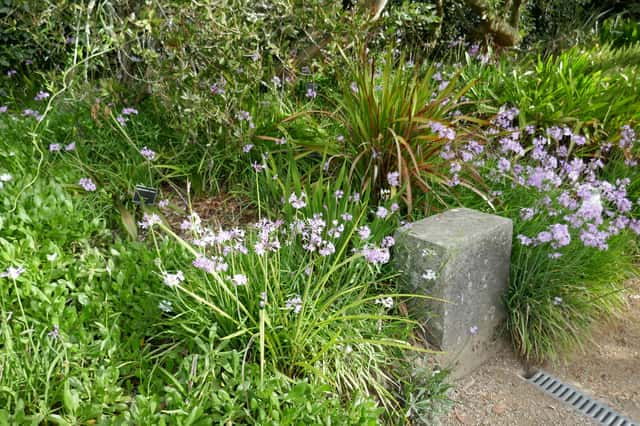
Society garlic is a clump-forming bulbous plant from South Africa with long, narrow, strap-like leaves that smell strongly of garlic when bruised. In flower it reaches about 60 cm. From early summer into fall, tall stalks rise above the leaves and open clusters of up to 20 lilac to pinkish star-shaped flowers. Fat roots below ground slowly widen the clump. It is not a true garlic, only a relative in the same family as onions. Gardeners use it for edging and mass planting in sunny spots.
How to Propagate Society garlic?
Dividing the clump
Leave the divided plants alone for as long as you can. Clumps flower better when they are not disturbed.
- 1 Lift the clump carefully while the plant is dormant
- 2 Pull apart sections that have both leaves and roots
- 3 Replant at the same depth in soil mixed with compost
- 4 Water and keep the soil lightly moist until new growth shows
Materials needed:
Seed
Expect the first flowers in the second or third year.
- 1 Collect the hard black seeds when the capsules split
- 2 Sow in spring in a deep seed tray
- 3 Keep the soil moist in a bright place
- 4 Plant out during the second year
Materials needed:
How Big Does Society garlic Grow?
TLDR: Society garlic can reach up to 60cm tall with Medium growth rate.
Max height
60cm
Spread
50cm
Growth rate
Medium
Foliage
Semi-evergreen
Plant Uses
Ornamental
Great for decoration
Edible
Can be consumed
Medicinal
Medicinal properties
Aromatic
Pleasant fragrance
Ground Cover
Soil coverage
Medicinal Uses
- In South African traditional medicine, crushed leaves were used for sinus headaches
- Bulb decoctions were used for coughs and colds. High-dose home remedies have been linked to serious poisonings, so do not use it without medical advice
Culinary Uses
- Leaves and flowers are used as a seasoning, much like chives or garlic, in salads and cooked dishes. Confirm what the plant is before eating any of it
Is your plant showing symptoms?
Click on the symptom to discover possible causes:
What Diseases Commonly Affect Society garlic?
TLDR: Society garlic is susceptible to 4 known diseases. Monitor regularly for early detection.
Slugs and Snails
Slugs and snails are mollusks that feed on plant tissue, causing irregular holes in leaves and damage to young seedlings. They are most active at night and in moist conditions, leaving characteristic silvery slime trails. These pests can quickly devastate gardens, especially during wet seasons.
Root Rot
Root rot is a serious fungal disease that affects the root system of plants, causing them to decay and die. It is primarily caused by overwatering, poor drainage, or soil-borne fungi such as Pythium, Phytophthora, Rhizoctonia, and Fusarium. The disease thrives in waterlogged conditions where roots are deprived of oxygen, making them susceptible to fungal infection.
Aphids
Aphids are small, soft-bodied, pear-shaped insects (1/16 to 1/8 inch long) that feed by sucking nutrient-rich sap from plants. They reproduce rapidly and can quickly weaken plants, causing distorted growth and transmitting plant viruses. Aphids come in various colors including green, black, red, yellow, brown, and gray. They secrete honeydew, a sticky substance that attracts ants and encourages sooty mold growth.
Thrips
Thrips are tiny cigar-shaped insects (1/25-inch long) that damage plants by sucking plant juices and scraping at fruits, flowers, and leaves. With over 6,000 species and rapid reproduction (lifecycle as short as 14 days), they can quickly infest plants and transmit viruses like tomato spotted wilt virus.
Fun Facts
The name comes from the story that it flavors food like garlic without giving you bad breath.
Police in one neighborhood were called about a smell of cannabis, and the culprit turned out to be society garlic and lemon verbena.
In South Africa, Zulu people plant it around their homes to keep snakes away.
Frequently asked questions
Is society garlic toxic to dogs and cats?
Can you eat society garlic?
Why is my society garlic not flowering?
Will society garlic survive winter?
Compare with similar plants
| Attribute | Difficulty | Light | Watering | Pet Safe |
|---|---|---|---|---|
| Field Maple | Easy | Bright indirect | 14d | ✓ |
| Iberian Houseleek | Easy | Direct sun | 14d | ✓ |
| Silver Birch | Easy | Direct sun | 14d | ✓ |
| Common Blanketflower | Easy | Direct sun | 10d | ✓ |
Choose & Compare
Sources & References
- PlantZAfrica (SANBI) - Tulbaghia violacea
- NC State Extension Plant Toolbox - Tulbaghia violacea
- UF/IFAS Gardening Solutions - Society Garlic
- Wikipedia - Tulbaghia violacea
- RHS - Tulbaghia violacea (search snippet)
- Gardener's HQ - Society Garlic
- Jardineiro.net - Alho-social
- InfoJardin - Ajo de la sociedad (common name, search snippet)





