Asparagaceae
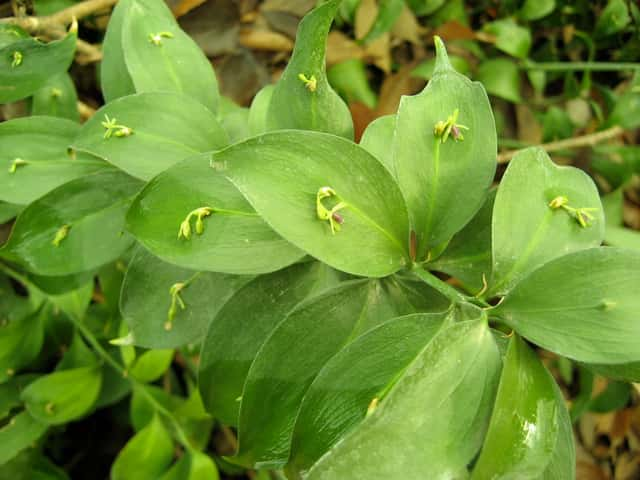
Spanish Butcher's Broom (Ruscus hypophyllum)
Ruscus hypophyllum
Tough, slow-growing shade plant. Give it partial to full shade, well-drained soil and moderate water; avoid waterlogging. Cut out dead stems at the base in spring. Protect from hard frost below about -5 °C.
Every 10 days
Low light
-5° - °C
% - %
Categories
What is Spanish butcher's broom?
Spanish butcher's broom (Ruscus hypophyllum) is a easy-care plant from the Asparagaceae family. Ruscus hypophyllum is an evergreen subshrub from the western Mediterranean (southern Spain and northwest Africa) that forms clumps of upright, unbranched green stems 50-100 cm tall. What look like glossy leaves are cladodes, flattened stems; tiny greenish-white flowers sit on them in winter and spri...
Spanish butcher's broom grows up to 75cm, spread of 75cm, watering every 10 days. It is suitable for indoor environments and not safe for pets.
Unlike many tropical plants, Spanish butcher's broom tolerates watering mistakes. Best for beginners. Without precautions, ingestion can cause irritation in pets. Keep out of reach of cats and dogs. Without adequate drainage, root rot can develop within 20 days.
How to Care for Spanish butcher's broom?
TLDR: Spanish butcher's broom needs Low light, watering every 10 days, and temperatures between -5-30°C with 40-70% humidity.
How Often Should You Water Spanish butcher's broom?
Water when the top few centimetres of soil are dry, roughly every 10 days in pots during the growing season and less in winter. Once established in the ground it tolerates dry shade; never leave it in standing water.
How Much Light Does Spanish butcher's broom Need?
Prefers partial to full shade, such as under trees or in a north-facing spot. It tolerates sun in mild climates, but foliage stays a deeper green in shade. Indoors, bright indirect light is ideal.
What Is the Best Soil for Spanish butcher's broom?
Any well-drained soil works: chalk, clay, loam or sand, acidic to alkaline. Avoid heavy, waterlogged ground. In pots use a standard potting mix with added grit or bark for drainage.
What Pot Should You Use for Spanish butcher's broom?
A medium pot with drainage holes, deep enough for the spreading rhizomes.
Care Schedule
Fertilize
Every 60 days
Repot
Every 730 days
What Is Spanish butcher's broom and Where Does It Come From?
Ruscus hypophyllum is an evergreen subshrub from the western Mediterranean (southern Spain and northwest Africa) that forms clumps of upright, unbranched green stems 50-100 cm tall. What look like glossy leaves are cladodes, flattened stems; tiny greenish-white flowers sit on them in winter and spring and, when male and female plants grow together, are followed by bright red berries. It is grown in shady gardens and as long-lasting cut foliage.
How to Propagate Spanish butcher's broom?
Division
Use a clean sharp knife on tough rhizomes. Divide only established clumps.
- 1 Lift the clump in early spring
- 2 Separate rhizome sections with several stems and roots each
- 3 Replant at the same depth in well-drained soil
- 4 Water in and keep lightly moist until new shoots appear
Materials needed:
Seed
Sow seed fresh; old seed germinates poorly. Berries only form when male and female plants grow together.
- 1 Collect ripe red berries and remove the pulp
- 2 Sow fresh seed in a gritty seed mix
- 3 Keep in a cool, shaded spot and lightly moist
- 4 Be patient: germination is slow and irregular
Materials needed:
How Big Does Spanish butcher's broom Grow?
TLDR: Spanish butcher's broom can reach up to 75cm tall with Slow growth rate.
Max height
75cm
Spread
75cm
Growth rate
Slow
Foliage
Evergreen
Warning: Toxic Plant
This plant can be toxic if ingested. Keep out of reach of:
Plant Uses
Ornamental
Great for decoration
Is your plant showing symptoms?
Click on the symptom to discover possible causes:
What Diseases Commonly Affect Spanish butcher's broom?
TLDR: Spanish butcher's broom is susceptible to 5 known diseases. Monitor regularly for early detection.
Cercospora Leaf Spot
Cercospora leaf spot is a common fungal disease caused by Cercospora species that affects many plant types, particularly beets, roses, and leafy vegetables. The disease thrives in warm, humid conditions and can cause significant defoliation, reducing plant vigor and yield. It spreads rapidly through water splash, wind, and contaminated tools.
Root Rot
Root rot is a serious fungal disease that affects the root system of plants, causing them to decay and die. It is primarily caused by overwatering, poor drainage, or soil-borne fungi such as Pythium, Phytophthora, Rhizoctonia, and Fusarium. The disease thrives in waterlogged conditions where roots are deprived of oxygen, making them susceptible to fungal infection.
Grey Mould
Anthracnose
Anthracnose is a fungal disease caused by fungi in the genus Colletotrichum that affects many plants, including vegetables, fruits, and trees. The disease thrives in cool, wet conditions, causing dark, sunken lesions on leaves, stems, flowers, and fruits.
Fun Facts
The leaves are actually cladodes, flattened stems that carry the flowers on their surface.
Cut stems last for months in a vase and are grown in the Netherlands as cut foliage.
It grows wild in shady, humid stream valleys of the Los Alcornocales Natural Park in Spain.
Frequently asked questions
How often should I water Spanish butcher's broom?
Does it need sun?
Is Ruscus hypophyllum toxic?
Why does my plant have no berries?
Compare with similar plants
| Attribute | Difficulty | Light | Watering | Pet Safe |
|---|---|---|---|---|
| Field Maple | Easy | Bright indirect | 14d | ✓ |
| Iberian Houseleek | Easy | Direct sun | 14d | ✓ |
| Silver Birch | Easy | Direct sun | 14d | ✓ |
| Common Blanketflower | Easy | Direct sun | 10d | ✓ |





