Lamiaceae
Splitlip Hempnettle: Medicinal Uses & Care Tips
Galeopsis bifida
An easygoing, self-sowing annual best grown outdoors in open, disturbed, or naturalized ground rather than as a houseplant. Give it full sun to light shade and keep the soil consistently moist; it tolerates sandy, loamy, or clay soils across a wide pH range. No routine feeding, misting, or repotting is typically needed -- let it seed itself and self-sow for next season.
Every 4 days
Bright indirect
° - °C
% - %
Categories
What is Splitlip Hempnettle?
Splitlip Hempnettle (Galeopsis bifida) is a easy-care plant from the Lamiaceae family. Splitlip hempnettle is a fast-growing annual wildflower in the mint family (Lamiaceae), native across Europe and temperate Asia and now widely naturalized in Canada, the northern United States, and Alaska. It grows as an erect, bristly-haired herb up to about a meter tall, with square stems noticeab...
Splitlip Hempnettle grows up to 1.0m, watering every 4 days. It is not suitable for indoor environments and safe for pets.
Unlike many tropical plants, Splitlip Hempnettle tolerates watering mistakes. Best for beginners. Unlike many popular species, Splitlip Hempnettle is safe to keep around pets.
How to Care for Splitlip Hempnettle?
TLDR: Splitlip Hempnettle needs Bright indirect, watering every 4 days, and temperatures between 15-30°C with 40-70% humidity.
How Often Should You Water Splitlip Hempnettle?
Keep the soil evenly moist, watering whenever the surface starts to dry out; this species does not tolerate prolonged drought well but also dislikes waterlogging.
How Much Light Does Splitlip Hempnettle Need?
Grows best in full sun to light, dappled shade -- it struggles and flowers poorly in deep, heavy shade.
What Is the Best Soil for Splitlip Hempnettle?
Adaptable to sandy, loamy, or clay soils as long as drainage is reasonable and moisture is consistent; tolerates mildly acidic through mildly alkaline pH.
What Pot Should You Use for Splitlip Hempnettle?
Rarely grown in containers; this plant is best left in open garden soil. If attempting container culture, use a wide, unglazed pot with generous drainage holes and a moisture-retentive but well-draining mix to mimic its damp, disturbed-ground habitat.
What Is Splitlip Hempnettle and Where Does It Come From?
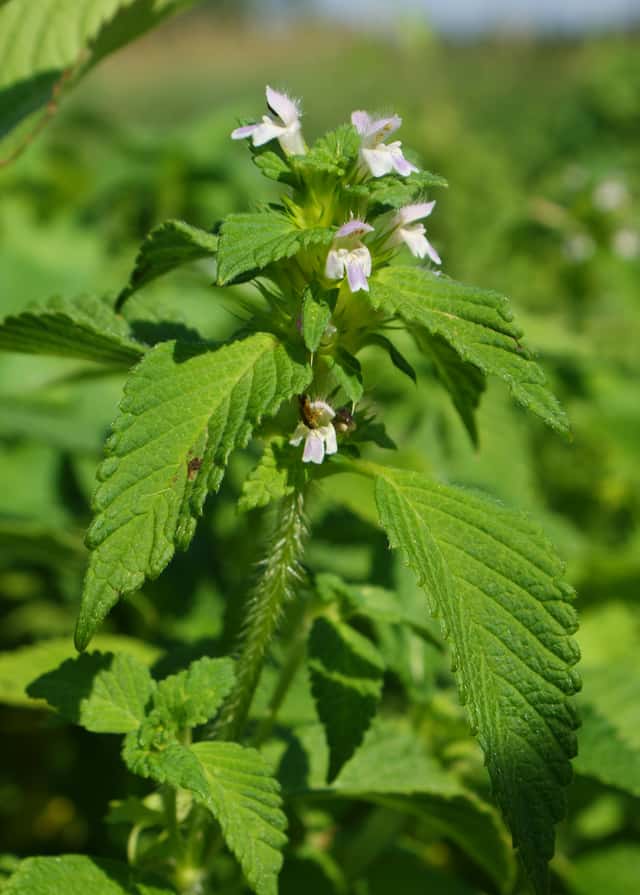
Splitlip hempnettle is a fast-growing annual wildflower in the mint family (Lamiaceae), native across Europe and temperate Asia and now widely naturalized in Canada, the northern United States, and Alaska. It grows as an erect, bristly-haired herb up to about a meter tall, with square stems noticeably swollen below the leaf nodes and opposite, serrated, ovate leaves. From midsummer into autumn it produces small, two-lipped tubular flowers in shades of purple, pink, or white, clustered densely near the stem tips -- the notched lower lip is what distinguishes it from its close relative, brittlestem hempnettle (Galeopsis tetrahit). A true colonizer, it thrives on disturbed ground, roadsides, field margins, and damp waste areas, producing thousands of long-lived seeds per plant. It has a history of use in Tibetan and Buryat folk medicine and is being studied for antioxidant phenolic compounds, though reports on its toxicity are mixed.
How Big Does Splitlip Hempnettle Grow?
TLDR: Splitlip Hempnettle can reach up to 1.0m tall with Fast growth rate.
Max height
1.0m
Growth rate
Fast
Foliage
Deciduous
Plant Uses
Medicinal
Medicinal properties
Medicinal Uses
- Traditional Tibetan and Buryat medicine for oral ailments including stomatitis and tooth decay
- Folk remedy for gastrointestinal complaints such as gastritis and ulcers
- Used traditionally for respiratory infections, including tuberculosis
- Applied in folk medicine for liver and kidney ailments
- Topical folk use for eye conditions and skin wounds
- Vodka infusions used historically in Far Eastern folk medicine for stomach cancer and epilepsy
Is your plant showing symptoms?
Click on the symptom to discover possible causes:
Meaning & Symbolism
The genus name Galeopsis derives from Greek, meaning "weasel-like," a reference to the shape of the flower's corolla. As a resilient, fast-colonizing wildflower of disturbed ground, it is often read as a symbol of tenacity and quiet renewal in overlooked landscapes.
Compare with similar plants
| Attribute | Difficulty | Light | Watering | Pet Safe |
|---|---|---|---|---|
| Field Maple | Easy | Bright indirect | 14d | ✓ |
| Silver Birch | Easy | Direct sun | 14d | ✓ |
| Common Blanketflower | Easy | Direct sun | 10d | ✓ |
| Cushion Bush | Easy | Direct sun | 14d | ✓ |
Choose & Compare
Sources & References
- Galeopsis bifida - Plants For A Future
- Galeopsis bifida - Practical Plants
- Galeopsis bifida - Wikipedia
- Synanthropic Plants as an Underestimated Source of Bioactive Phytochemicals: A Case of Galeopsis bifida (Lamiaceae)
- Splitlip hempnettle (Galeopsis bifida) - Alaska Center for Conservation Science factsheet
- Galeopsis bifida Boenn. - Canada Plant Hardiness Site





