Droseraceae
Drosera spatulata — Spoon-leaved Sundew
Drosera spatulata
Grow in a nutrient-poor mix of equal parts peat/sphagnum moss and perlite, kept constantly moist with distilled, rain, or reverse-osmosis water — never tap water. Provide plenty of bright indirect light or a few hours of filtered sun, high humidity, and never fertilize the soil.
Every 3 days
Bright indirect
7° - 32°C
40% - 70%
Categories
What is Spoon-leaved sundew?
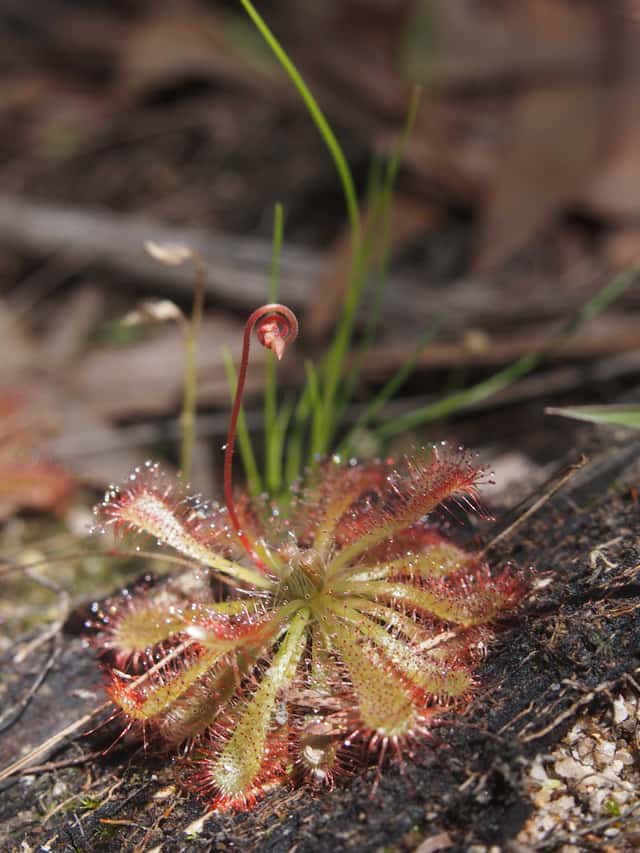
Spoon-leaved sundew (Drosera spatulata) is a easy-care plant from the Droseraceae family. Drosera spatulata, commonly known as the spoon-leaved sundew, is a small carnivorous plant native to Australia, New Zealand, Tasmania, and Southeast Asia. It forms a compact rosette of spoon-shaped leaves covered in red, dew-tipped tentacles that glisten to attract, trap, and digest small insects su...
Spoon-leaved sundew grows up to 8cm, spread of 5cm, watering every 3 days, 7°C – 32°C, 40–70% humidity. It is suitable for indoor environments and safe for pets.
Unlike many tropical plants, Spoon-leaved sundew tolerates watering mistakes. Best for beginners. Unlike many popular species, Spoon-leaved sundew is safe to keep around pets. Without adequate drainage, root rot can develop within 7 days.
How to Care for Spoon-leaved sundew?
TLDR: Spoon-leaved sundew needs Bright indirect, watering every 3 days, and temperatures between 7-32°C with 40-70% humidity.
How Often Should You Water Spoon-leaved sundew?
Use the tray method: keep 2-3 cm of distilled or rainwater in a saucer under the pot so the plant wicks up moisture. Never use tap water — mineral buildup will damage the roots over time.
How Much Light Does Spoon-leaved sundew Need?
Loves bright light but not harsh direct sun; a few hours of filtered morning sun or a bright windowsill works well. Indoors, 12-14 hours under fluorescent/LED grow lights keeps the sticky tentacles active and glistening.
What Is the Best Soil for Spoon-leaved sundew?
Use a nutrient-poor mix such as chopped sphagnum moss with perlite or silica sand in equal parts. Never add potting soil, compost, or fertilizer — the plant gets nutrients from trapped insects, not the substrate.
What Pot Should You Use for Spoon-leaved sundew?
Use plastic (non-porous) pots without a standard drainage saucer, sitting in a shallow humidity tray — avoid terracotta or ceramic, which wick away moisture and accumulate minerals.
What Is Spoon-leaved sundew and Where Does It Come From?
Drosera spatulata, commonly known as the spoon-leaved sundew, is a small carnivorous plant native to Australia, New Zealand, Tasmania, and Southeast Asia. It forms a compact rosette of spoon-shaped leaves covered in red, dew-tipped tentacles that glisten to attract, trap, and digest small insects such as fruit flies and fungus gnats. It is widely regarded as one of the easiest sundews to grow, making it a favorite starter plant for carnivorous plant beginners.
How to Propagate Spoon-leaved sundew?
Seed propagation
Use a clear plastic cover to keep humidity high during germination.
- 1 Collect seeds from dried, self-pollinated flowers
- 2 Sprinkle seeds over moist chopped sphagnum without covering them
- 3 Keep in a high-humidity spot at 21-29°C
- 4 Wait for germination, which occurs within a few weeks under constant light
Materials needed:
Rosette division
Only divide once the offset rosettes have visible roots of their own.
- 1 Carefully remove the plant from its pot
- 2 Separate the offset rosettes growing around the parent plant
- 3 Replant each rosette in a sphagnum and perlite mix
- 4 Keep well moist until established
Materials needed:
Leaf cutting
Use a propagator or closed container to keep humidity constant while rooting.
- 1 Cut a healthy, mature leaf at its base
- 2 Lay the leaf flat on moist sphagnum moss
- 3 Keep in an enclosed, high-humidity environment
- 4 Wait for tiny plantlets to form along the leaf edges
Materials needed:
How Big Does Spoon-leaved sundew Grow?
TLDR: Spoon-leaved sundew can reach up to 8cm tall with Medium growth rate.
Max height
8cm
Spread
5cm
Growth rate
Medium
Foliage
Evergreen
Plant Uses
Ornamental
Great for decoration
Is your plant showing symptoms?
Click on the symptom to discover possible causes:
What Diseases Commonly Affect Spoon-leaved sundew?
TLDR: Spoon-leaved sundew is susceptible to 3 known diseases. Monitor regularly for early detection.
Root Rot
Root rot is a serious fungal disease that affects the root system of plants, causing them to decay and die. It is primarily caused by overwatering, poor drainage, or soil-borne fungi such as Pythium, Phytophthora, Rhizoctonia, and Fusarium. The disease thrives in waterlogged conditions where roots are deprived of oxygen, making them susceptible to fungal infection.
Pythium Root Rot
Pythium root rot is a serious fungal disease caused by various Pythium species including P. aphanidermatum, P. ultimum, and P. irregulare. These water molds are present in practically all cultivated soils and attack plant roots under wet conditions, causing rapid wet rot that can extend into the stem. The disease is favored by poor drainage, overwatering, and specific temperatures depending on the species.
Aphids
Aphids are small, soft-bodied, pear-shaped insects (1/16 to 1/8 inch long) that feed by sucking nutrient-rich sap from plants. They reproduce rapidly and can quickly weaken plants, causing distorted growth and transmitting plant viruses. Aphids come in various colors including green, black, red, yellow, brown, and gray. They secrete honeydew, a sticky substance that attracts ants and encourages sooty mold growth.
Fun Facts
Its spoon-shaped leaves are covered in red tentacles tipped with glistening mucilage that resembles morning dew — hence the name sundew.
It can live up to around 25 years in cultivation with proper care.
It does not need a winter dormancy period, unlike many other sundew species.
It is often considered the perfect gateway plant for beginners starting out with carnivorous plants.
Frequently asked questions
Does Drosera spatulata need fertilizer?
What kind of water should I use?
Does Drosera spatulata need winter dormancy?
Is it toxic to cats and dogs?
Compare with similar plants
| Attribute | Difficulty | Light | Watering | Pet Safe |
|---|---|---|---|---|
| Field Maple | Easy | Bright indirect | 14d | ✓ |
| Silver Birch | Easy | Direct sun | 14d | ✓ |
| Common Blanketflower | Easy | Direct sun | 10d | ✓ |
| Cushion Bush | Easy | Direct sun | 14d | ✓ |





