Apocynaceae
Spreading Dogbane: Medicinal Uses & Care Tips
Apocynum androsaemifolium
Spreading dogbane thrives in average to dry, well-drained sandy or gravelly soil and full sun to partial shade. It is highly drought-tolerant once established and needs little supplemental water or feeding. Because it spreads aggressively via underground rhizomes, give it room to roam or confine the roots - it is not suited to small garden beds or containers without a barrier. Wear gloves when handling it, since the milky sap can irritate skin.
Every 10 days
Bright indirect
-38° - 35°C
% - %
Categories
What is Spreading Dogbane?
Spreading Dogbane (Apocynum androsaemifolium) is a easy-care plant from the Apocynaceae family. Spreading dogbane (Apocynum androsaemifolium) is a bushy, rhizomatous perennial native to a huge swath of North America, from Canada across most of the United States into northeastern Mexico. Widely branching stems bear opposite, oval leaves and exude a bitter, milky sap when broken. From June to Au...
Spreading Dogbane grows up to 90cm, spread of 120cm, watering every 10 days, -38°C – 35°C. It is not suitable for indoor environments and not safe for pets.
Unlike many tropical plants, Spreading Dogbane tolerates watering mistakes. Best for beginners. Without precautions, ingestion can cause irritation in pets. Keep out of reach of cats and dogs.
How to Care for Spreading Dogbane?
TLDR: Spreading Dogbane needs Bright indirect, watering every 10 days, and temperatures between -38-35°C with 40-70% humidity.
How Often Should You Water Spreading Dogbane?
Water new plantings regularly until established, then let the soil dry out between waterings - this plant prefers dry to average moisture and resents soggy, waterlogged soil, which can cause root rot.
How Much Light Does Spreading Dogbane Need?
Give it full sun for the best flowering and compact habit, though it also tolerates partial shade to full shade. In hotter climates, some afternoon shade is fine.
What Is the Best Soil for Spreading Dogbane?
Plant in average to dry, well-drained sandy, gravelly, or rocky soil. It is not particular about fertility and does poorly in constantly wet or heavy, compacted soil.
What Pot Should You Use for Spreading Dogbane?
This is a vigorous, rhizome-spreading wildflower best grown in open garden soil rather than pots. If container growing is necessary to control its spread, use a wide, deep, sturdy container with excellent drainage holes, since the roots will otherwise escape or girdle a small pot.
What Is Spreading Dogbane and Where Does It Come From?
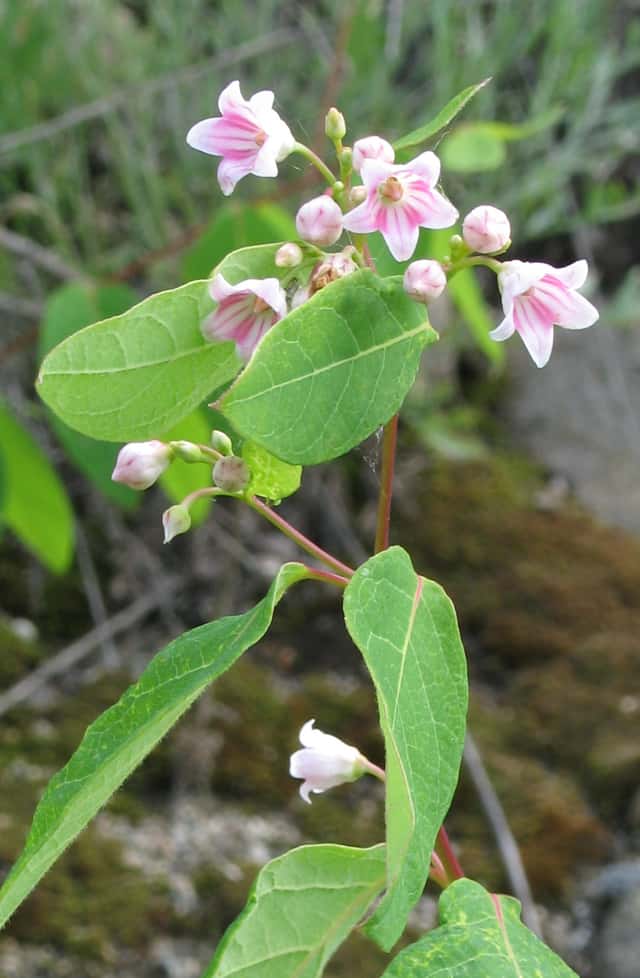
Spreading dogbane (Apocynum androsaemifolium) is a bushy, rhizomatous perennial native to a huge swath of North America, from Canada across most of the United States into northeastern Mexico. Widely branching stems bear opposite, oval leaves and exude a bitter, milky sap when broken. From June to August it produces small, fragrant, nodding, bell-shaped pink flowers striped with deeper pink inside, clustered near the branch tips, followed by narrow paired seed pods filled with silky-haired seeds. All parts of the plant are toxic, containing cardiac glycosides that deter browsing animals and most insect pests.
How to Propagate Spreading Dogbane?
Root division
Wear gloves - the milky sap is a skin irritant. This is the most reliable method since the plant spreads naturally via rhizomes.
- 1 In early spring before new growth or in fall after die-back, dig up an established clump
- 2 Use a sharp spade or knife to divide the rhizome mass into sections, each with roots and at least one growth bud
- 3 Replant divisions immediately at the same depth, spacing them 60-90 cm apart to allow for spreading
- 4 Water thoroughly after planting and keep soil evenly moist until new growth appears
Materials needed:
Seed propagation
Germination can be slow and uneven; division is more dependable for home gardeners.
- 1 Collect seed pods once they split open in late summer or fall and gather the silky-haired seeds
- 2 Sow outdoors in fall, or cold-stratify seeds about 60 days before spring sowing
- 3 Press seeds lightly into well-draining soil without burying deeply
- 4 Keep soil lightly moist until germination
Materials needed:
How Big Does Spreading Dogbane Grow?
TLDR: Spreading Dogbane can reach up to 90cm tall with Medium growth rate.
Max height
90cm
Spread
1.2m
Growth rate
Medium
Foliage
Deciduous
Warning: Toxic Plant
This plant can be toxic if ingested. Keep out of reach of:
Plant Uses
Ornamental
Great for decoration
Medicinal
Medicinal properties
Medicinal Uses
- Historically, Indigenous peoples used preparations of the root and other plant parts as folk remedies for headaches, convulsions, earaches, heart palpitations, colds, and rheumatism, and early 20th-century Western herbalists explored it as a cardiac stimulant.
- The plant contains potent cardiac glycosides (including cymarin) and is dangerously toxic - it should never be self-administered and has no place in modern home use.
Culinary Uses
- None - every part of the plant is toxic to humans and animals, so it has no culinary uses and should not be ingested.
Is your plant showing symptoms?
Click on the symptom to discover possible causes:
Meaning & Symbolism
The common name "dogbane" comes from old folk use of the plant's toxic sap as a canine repellent/poison, and the genus name Apocynum is Greek for "away dog." Several Indigenous North American peoples, including the Ojibwe, valued the plant's tough stem fibers for cordage, thread, and nets, giving it a long history as a practical, if hazardous, plant of the wild landscape.
Compare with similar plants
| Attribute | Difficulty | Light | Watering | Pet Safe |
|---|---|---|---|---|
| Field Maple | Easy | Bright indirect | 14d | ✓ |
| Silver Birch | Easy | Direct sun | 14d | ✓ |
| Common Blanketflower | Easy | Direct sun | 10d | ✓ |
| Cushion Bush | Easy | Direct sun | 14d | ✓ |
Choose & Compare
Sources & References
- Apocynum androsaemifolium - NC State Extension Gardener Plant Toolbox
- Apocynum androsaemifolium - Wikipedia
- Apocynum androsaemifolium - Lady Bird Johnson Wildflower Center
- Apocynum androsaemifolium - Chicago Botanic Garden Plant Finder
- Apocynum Androsaemifolium Plant Care & Growing Basics - PlantIn
- Spreading dogbane Care Guide - ForwardPlant





