Asparagaceae
St Bernard's Lily (Anthericum liliago)
Anthericum liliago
An easy, long-lived border perennial: give it full sun and well-drained soil, water moderately in the growing season and keep it drier in winter. It needs little care beyond removing spent flower stems and dislikes being disturbed once established.
Every 7 days
Bright indirect
-15° - °C
% - %
Categories
What is St Bernard's lily?
St Bernard's lily (Anthericum liliago) is a easy-care plant from the Asparagaceae family. Anthericum liliago is a hardy herbaceous perennial in the asparagus family, native to Europe and Turkey, where it grows in dry pastures, stony ground and open woods. From fleshy, tuberous roots it forms clumps of narrow, grass-like leaves 30-45 cm long, and in late spring to early summer sends up sl...
St Bernard's lily grows up to 1.0m, spread of 50cm, watering every 7 days. It is not suitable for indoor environments and safe for pets.
Unlike many tropical plants, St Bernard's lily tolerates watering mistakes. Best for beginners. Unlike many popular species, St Bernard's lily is safe to keep around pets.
How to Care for St Bernard's lily?
TLDR: St Bernard's lily needs Bright indirect, watering every 7 days, and temperatures between -15-30°C with 40-70% humidity.
How Often Should You Water St Bernard's lily?
Water when the soil has dried out well, roughly weekly in the growing season and during dry spells; the fleshy roots like summer moisture but rot in waterlogged soil. Reduce watering considerably in winter.
How Much Light Does St Bernard's lily Need?
Full sun gives the best flowering; it tolerates light, dappled shade but blooms less.
What Is the Best Soil for St Bernard's lily?
Any well-drained soil works, including sandy, stony or chalky ground, acid or alkaline; it does best with some organic matter added.
What Pot Should You Use for St Bernard's lily?
Deep pot with drainage holes to fit the fleshy roots, filled with a gritty, free-draining mix.
Care Schedule
Fertilize
Every 365 days
What Is St Bernard's lily and Where Does It Come From?
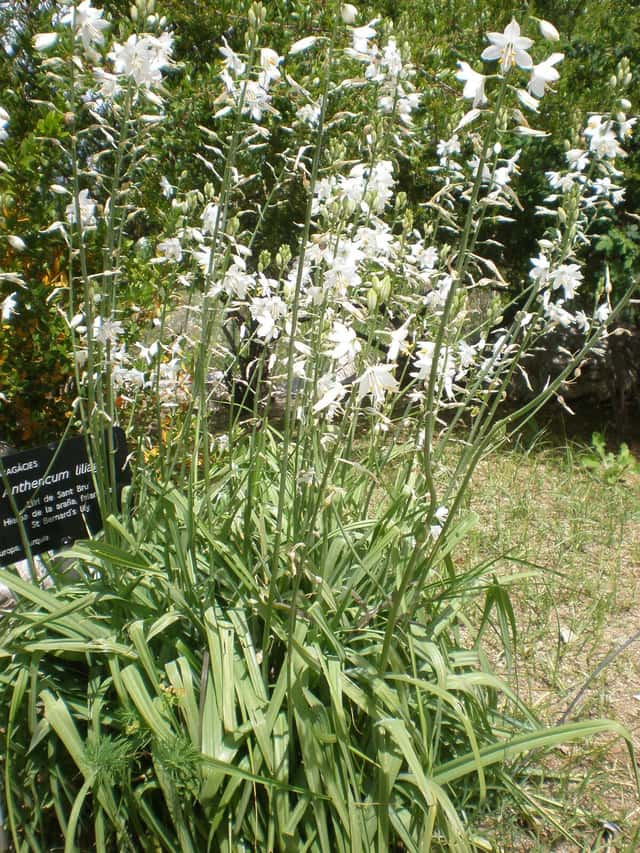
Anthericum liliago is a hardy herbaceous perennial in the asparagus family, native to Europe and Turkey, where it grows in dry pastures, stony ground and open woods. From fleshy, tuberous roots it forms clumps of narrow, grass-like leaves 30-45 cm long, and in late spring to early summer sends up slender stems 60-100 cm tall carrying loose spikes of pure white, trumpet-shaped flowers about 4 cm across, with bright yellow anthers. The foliage dies back in winter. It is slow to establish but forms generous clumps over the years; the cultivar 'Major' has larger flowers.
How to Propagate St Bernard's lily?
Division
Divide only every 3-4 years: the plant establishes slowly and flowers best when left undisturbed.
- 1 Lift an established clump in spring as growth begins
- 2 Separate it into sections, each with healthy fleshy roots and shoots
- 3 Replant at the same depth in well-drained soil
- 4 Water in well and keep lightly moist until new growth appears
Materials needed:
Seed sowing
Germination is slow and benefits from cool temperatures; seedlings usually take about three years to flower.
- 1 Sow seeds just below the surface of pots of seed compost in autumn or early spring
- 2 Keep the pots in a cold frame or cool spot
- 3 Keep the compost lightly moist until germination
- 4 Grow seedlings on and plant out in spring or autumn
Materials needed:
How Big Does St Bernard's lily Grow?
TLDR: St Bernard's lily can reach up to 1.0m tall with Slow growth rate.
Max height
1.0m
Spread
50cm
Growth rate
Slow
Foliage
Deciduous
Plant Uses
Ornamental
Great for decoration
Is your plant showing symptoms?
Click on the symptom to discover possible causes:
What Diseases Commonly Affect St Bernard's lily?
TLDR: St Bernard's lily is susceptible to 2 known diseases. Monitor regularly for early detection.
Slugs and Snails
Slugs and snails are mollusks that feed on plant tissue, causing irregular holes in leaves and damage to young seedlings. They are most active at night and in moist conditions, leaving characteristic silvery slime trails. These pests can quickly devastate gardens, especially during wet seasons.
Root Rot
Root rot is a serious fungal disease that affects the root system of plants, causing them to decay and die. It is primarily caused by overwatering, poor drainage, or soil-borne fungi such as Pythium, Phytophthora, Rhizoctonia, and Fusarium. The disease thrives in waterlogged conditions where roots are deprived of oxygen, making them susceptible to fungal infection.
Fun Facts
The genus name comes from the Greek antherikon, the name used for the asphodel
Its white flowers are set off by conspicuous yellow anthers
It grows wild from southern Sweden and Belgium to Portugal, Greece and Turkey
Frequently asked questions
When does St Bernard's lily flower?
How hardy is Anthericum liliago?
Why is my St Bernard's lily not flowering?
How do I propagate St Bernard's lily?
Compare with similar plants
| Attribute | Difficulty | Light | Watering | Pet Safe |
|---|---|---|---|---|
| Field Maple | Easy | Bright indirect | 14d | ✓ |
| Iberian Houseleek | Easy | Direct sun | 14d | ✓ |
| Silver Birch | Easy | Direct sun | 14d | ✓ |
| Common Blanketflower | Easy | Direct sun | 10d | ✓ |





