Asphodelaceae
Sticky Haworthia (Haworthiopsis viscosa)
Haworthiopsis viscosa
An easy, slow-growing succulent: bright light (part shade or filtered sun, or full sun once acclimatised), a gritty mineral mix and water only when the mix is dry. It grows in spring and autumn and nearly stops in peak summer heat and in winter, so water less and don't feed then. It won't take hard frost: protect it below 0 °C. Pests are rare.
Every 14 days
Bright indirect
-1° - °C
% - %
Categories
What is Sticky haworthia?
Sticky haworthia (Haworthiopsis viscosa) is a easy-care plant from the Asphodelaceae family. Haworthiopsis viscosa (formerly Haworthia viscosa) is a small succulent in the family Asphodelaceae, native to South Africa along the Western and Eastern Cape border: the Little Karoo, the southern edge of the Great Karoo and the Gamtoos Valley. There it grows in very well-drained sandy soil, in ful...
Sticky haworthia grows up to 20cm, watering every 14 days. It is suitable for indoor environments and safe for pets.
Unlike many tropical plants, Sticky haworthia tolerates watering mistakes. Best for beginners. Unlike many popular species, Sticky haworthia is safe to keep around pets. Without adequate drainage, root rot can develop within 28 days.
How to Care for Sticky haworthia?
TLDR: Sticky haworthia needs Bright indirect, watering every 14 days, and temperatures between -1-30°C with 40-70% humidity.
How Often Should You Water Sticky haworthia?
Water deeply until it drains from the pot, then let the mix dry out completely before the next watering: usually every 2 weeks in spring and autumn. In peak summer, when it goes dormant, and in winter, water very sparingly. Soggy roots rot quickly.
How Much Light Does Sticky haworthia Need?
Bright filtered light or part shade suits it best; it also takes full sun, where the leaves turn reddish-brown. Indoors, keep it by a bright window. In low light the columns stretch and turn soft and green.
What Is the Best Soil for Sticky haworthia?
Use a mix that is 50-70% mineral grit (coarse sand, pumice or perlite) blended with cactus soil. Drainage must be perfect.
What Pot Should You Use for Sticky haworthia?
A terracotta or clay pot with a drainage hole, preferably deeper than wide since the roots grow down. Choose one just a little larger than the clump.
What Is Sticky haworthia and Where Does It Come From?
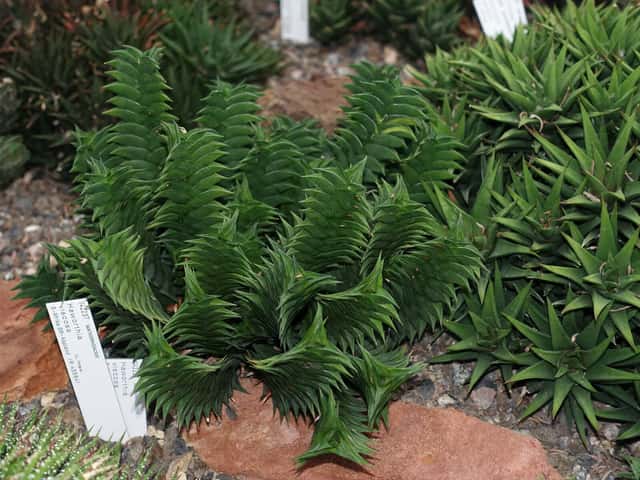
Haworthiopsis viscosa (formerly Haworthia viscosa) is a small succulent in the family Asphodelaceae, native to South Africa along the Western and Eastern Cape border: the Little Karoo, the southern edge of the Great Karoo and the Gamtoos Valley. There it grows in very well-drained sandy soil, in full sun or in the shade of shrubs and rock crevices. It forms upright columns 15-20 cm tall covered in stiff, rough, pointed triangular leaves arranged in three straight or spiralling ranks, which gives it a sculpted, geometric look. Colour ranges from dark green in shade to reddish-brown in strong sun. It offsets from the base and builds dense clumps. In spring it sends up thin stalks up to 30 cm tall with small white flowers veined green or brown.
How to Propagate Sticky haworthia?
Offsets
It offsets freely; leave the pups to form a clump or separate them.
- 1 Gently pull or cut an offset from the base, ideally with some roots
- 2 Let it dry for a day or two
- 3 Pot it in dry gritty mix
- 4 Start watering lightly after a week
Materials needed:
Stem cuttings
Take cuttings in the growing season (spring or autumn), never in the heat of summer.
- 1 Cut a column with a clean knife
- 2 Strip the lowest leaves and let the cut callus for a few days
- 3 Set the cutting on barely moist gritty mix
- 4 Water sparingly until roots form
Materials needed:
How Big Does Sticky haworthia Grow?
TLDR: Sticky haworthia can reach up to 20cm tall with Slow growth rate.
Max height
20cm
Growth rate
Slow
Foliage
Evergreen
Plant Uses
Ornamental
Great for decoration
Is your plant showing symptoms?
Click on the symptom to discover possible causes:
What Diseases Commonly Affect Sticky haworthia?
TLDR: Sticky haworthia is susceptible to 4 known diseases. Monitor regularly for early detection.
Root Rot
Root rot is a serious fungal disease that affects the root system of plants, causing them to decay and die. It is primarily caused by overwatering, poor drainage, or soil-borne fungi such as Pythium, Phytophthora, Rhizoctonia, and Fusarium. The disease thrives in waterlogged conditions where roots are deprived of oxygen, making them susceptible to fungal infection.
Overwatering
Overwatering occurs when plants receive too much water, depriving roots of oxygen and causing root rot. This environmental stress is one of the most common causes of houseplant death, as waterlogged soil prevents roots from breathing and functioning properly.
Mealybugs
Mealybugs are small, soft-bodied insects covered with a white, waxy, cottony material. They are common pests of houseplants and outdoor plants in mild climates. These sap-sucking insects feed on plant tissue, causing damage, stunted growth, and can lead to plant death if left untreated. They produce sticky honeydew which attracts sooty mold.
Cold Damage
Cold damage, also known as frost injury, occurs when plants are exposed to freezing or near-freezing temperatures. This environmental stress can cause cellular damage as ice crystals form within plant tissues, rupturing cells and disrupting normal plant functions. Chilling injury can also occur in sensitive species at temperatures between 32-55°F (0-10°C), even without actual freezing.
Fun Facts
Its leaves grow in three perfect ranks, which is why one old name was Aloe triangularis
Wild plants in the Karoo are often nibbled by grazing animals
DNA studies moved it from Haworthia to the new genus Haworthiopsis in 2013
Frequently asked questions
How often should I water Haworthiopsis viscosa?
Does sticky haworthia need sun?
Is it toxic to cats and dogs?
Why is it called sticky if it isn't?
Compare with similar plants
| Attribute | Difficulty | Light | Watering | Pet Safe |
|---|---|---|---|---|
| Field Maple | Easy | Bright indirect | 14d | ✓ |
| Iberian Houseleek | Easy | Direct sun | 14d | ✓ |
| Silver Birch | Easy | Direct sun | 14d | ✓ |
| Common Blanketflower | Easy | Direct sun | 10d | ✓ |
Choose & Compare
Sources & References
- Haworthiopsis viscosa - Wikipedia
- Mountain Crest Gardens - Haworthia viscosa
- NParks Flora & Fauna Web - Haworthiopsis viscosa
- World of Succulents - Haworthiopsis viscosa
- Lifestyle Seeds - Haworthiopsis viscosa (sticky haworthia)
- RHS - Haworthiopsis viscosa (sticky haworthia)
- Stellenbosch University Botanical Garden - Haworthiopsis viscosa