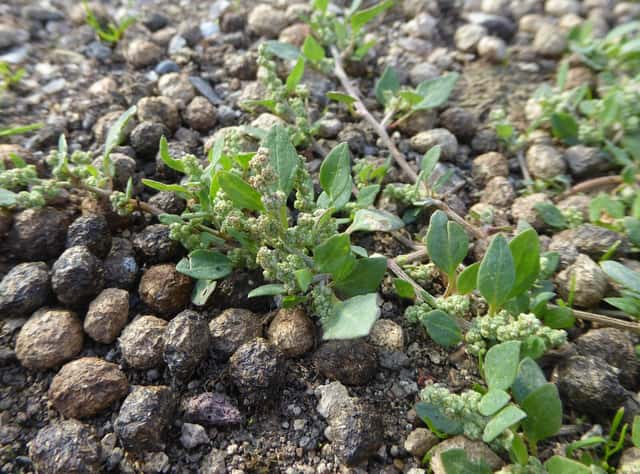
Amaranthaceae
Stinking Goosefoot (Chenopodium vulvaria)
Chenopodium vulvaria
It seeds itself on bare ground and rarely needs any care. If you want to keep it, a sunny spot with ordinary soil is enough.
Every 7 days
Bright indirect
° - °C
% - %
Categories
What is Stinking Goosefoot?
Stinking Goosefoot (Chenopodium vulvaria) is a easy-care plant from the Amaranthaceae family. A small annual weed, sprawling or half upright, with stems up to 2 feet (60 cm) long and a gray, mealy look, as if dusted with flour. The leaves are about half an inch to an inch long and diamond shaped. The easiest clue is the smell: rub a leaf and it reeks of rotten fish, thanks to trimethylamine....
Stinking Goosefoot grows up to 60cm, watering every 7 days. It is not suitable for indoor environments and safe for pets.
Unlike many tropical plants, Stinking Goosefoot tolerates watering mistakes. Best for beginners. Unlike many popular species, Stinking Goosefoot is safe to keep around pets.
How to Care for Stinking Goosefoot?
TLDR: Stinking Goosefoot needs Bright indirect, watering every 7 days, and temperatures between 15-30°C with 40-70% humidity.
How Often Should You Water Stinking Goosefoot?
Rain is usually all it gets. In a long dry spell, water only if you want to keep the plant.
How Much Light Does Stinking Goosefoot Need?
It dislikes shade, so an open, sunny spot suits it.
What Is the Best Soil for Stinking Goosefoot?
It grows in most soils and prefers moderately fertile ground. It often shows up where soil has been disturbed.
What Is Stinking Goosefoot and Where Does It Come From?
A small annual weed, sprawling or half upright, with stems up to 2 feet (60 cm) long and a gray, mealy look, as if dusted with flour. The leaves are about half an inch to an inch long and diamond shaped. The easiest clue is the smell: rub a leaf and it reeks of rotten fish, thanks to trimethylamine. It comes from southern Europe and the Mediterranean and turns up on bare ground, roadsides, at the foot of walls and near manure piles. It usually arrives on its own and is not a houseplant.
How to Propagate Stinking Goosefoot?
Seed
Most seed usually germinates within a few days of sowing.
- 1 Sow in spring right where you want it.
- 2 Keep the soil moist until seedlings appear.
Materials needed:
How Big Does Stinking Goosefoot Grow?
TLDR: Stinking Goosefoot can reach up to 60cm tall with Medium growth rate.
Max height
60cm
Warning: Toxic Plant
This plant can be toxic if ingested. Keep out of reach of:
Plant Uses
Edible
Can be consumed
Medicinal
Medicinal properties
Medicinal Uses
- Dried leaf infusion used in old European folk medicine for nervous and women's complaints (traditional use, not proven)
Culinary Uses
- Leaves and flower buds recorded as edible once cooked, despite the smell (check before eating)
Is your plant showing symptoms?
Click on the symptom to discover possible causes:
Fun Facts
The name vulvaria comes from Latin and has been linked to the smell of the plant.
Britain was down to just 3 known populations in the 1990s, and it has since spread again.
The whole plant can give gold and green dyes.
Frequently asked questions
Why does this plant smell like fish?
Should I pull it or leave it?
Is it poisonous?
Compare with similar plants
| Attribute | Difficulty | Light | Watering | Pet Safe |
|---|---|---|---|---|
| Field Maple | Easy | Bright indirect | 14d | ✓ |
| Iberian Houseleek | Easy | Direct sun | 14d | ✓ |
| Silver Birch | Easy | Direct sun | 14d | ✓ |
| Common Blanketflower | Easy | Direct sun | 10d | ✓ |





