Brassicaceae
Sweet Alyssum (Lobularia genus)
Lobularia
Easy and in flower most of the year: sun, free-draining soil and moderate watering. It tires in strong heat but comes back after a trim.
Every 4 days
Bright indirect
-5° - 30°C
% - %
Categories
What is Sweet Alyssum (genus)?
Sweet Alyssum (genus) (Lobularia) is a easy-care plant from the Brassicaceae family. Lobularia is a small genus in the cabbage family, with four species from the Atlantic islands (Canaries, Madeira, Cape Verde), the Mediterranean and the Middle East. They are annual or perennial herbs 10 to 40 cm tall, with narrow, slightly hairy leaves, forming mounds covered in clusters of tiny fo...
Sweet Alyssum (genus) grows up to 40cm, spread of 30cm, watering every 4 days, -5°C – 30°C. It is not suitable for indoor environments and safe for pets.
Unlike many tropical plants, Sweet Alyssum (genus) tolerates watering mistakes. Best for beginners. Unlike many popular species, Sweet Alyssum (genus) is safe to keep around pets.
How to Care for Sweet Alyssum (genus)?
TLDR: Sweet Alyssum (genus) needs Bright indirect, watering every 4 days, and temperatures between -5-30°C with 40-70% humidity.
How Often Should You Water Sweet Alyssum (genus)?
Water when the top few centimetres of soil are dry, every 3 or 4 days in hot weather. It handles some drought but not soggy soil, which rots the base.
How Much Light Does Sweet Alyssum (genus) Need?
Full sun or partial shade. In very hot summers, a little afternoon shade keeps it flowering.
What Is the Best Soil for Sweet Alyssum (genus)?
Ordinary light soil with good drainage. Sand or clay both work as long as water does not sit at the bottom.
What Pot Should You Use for Sweet Alyssum (genus)?
Window box or shallow pot 15 to 20 cm deep with a drainage hole. It looks good spilling over the edge of larger containers.
Care Schedule
Fertilize
Every 30 days
What Is Sweet Alyssum (genus) and Where Does It Come From?
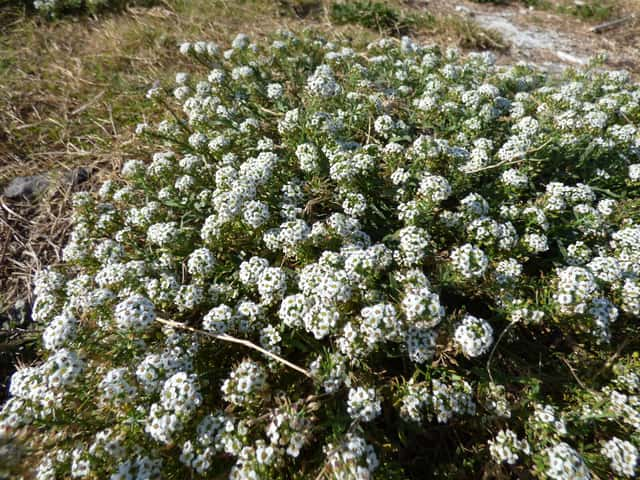
Lobularia is a small genus in the cabbage family, with four species from the Atlantic islands (Canaries, Madeira, Cape Verde), the Mediterranean and the Middle East. They are annual or perennial herbs 10 to 40 cm tall, with narrow, slightly hairy leaves, forming mounds covered in clusters of tiny four-petalled flowers, nearly always white and honey-scented. The best known is garden sweet alyssum (Lobularia maritima), which has its own entry and comes in purple and pink forms.
How to Propagate Sweet Alyssum (genus)?
Seed
A second sowing in late summer gives fall flowers. Plants also self-sow.
- 1 Sow outdoors a few weeks before the last frost, or in trays 5 to 6 weeks earlier
- 2 Scatter seed on the surface and press it in lightly without burying it deep
- 3 Keep moist until seedlings appear
- 4 Transplant seedlings 15 to 20 cm apart
Materials needed:
How Big Does Sweet Alyssum (genus) Grow?
TLDR: Sweet Alyssum (genus) can reach up to 40cm tall with Fast growth rate.
Max height
40cm
Spread
30cm
Growth rate
Fast
Plant Uses
Ornamental
Great for decoration
Ground Cover
Soil coverage
Aromatic
Pleasant fragrance
Is your plant showing symptoms?
Click on the symptom to discover possible causes:
What Diseases Commonly Affect Sweet Alyssum (genus)?
TLDR: Sweet Alyssum (genus) is susceptible to 5 known diseases. Monitor regularly for early detection.
Downy Mildew
Downy mildew is a fungal-like disease caused by oomycetes (water molds) that thrives in cool, wet conditions. It affects a wide range of plants, causing yellowing leaves with fuzzy white-gray growth underneath, leading to defoliation and reduced yields if left untreated.
Crown Rot
Crown rot is a serious fungal disease that attacks the crown (base) of the plant where the stem meets the soil. It is caused by various fungal pathogens including Phytophthora, Fusarium, and Rhizoctonia. The disease thrives in waterlogged conditions and can quickly spread to kill the entire plant if not addressed promptly.
Root Rot
Root rot is a serious fungal disease that affects the root system of plants, causing them to decay and die. It is primarily caused by overwatering, poor drainage, or soil-borne fungi such as Pythium, Phytophthora, Rhizoctonia, and Fusarium. The disease thrives in waterlogged conditions where roots are deprived of oxygen, making them susceptible to fungal infection.
Damping Off
Damping off is a soil-borne fungal disease that affects seeds and young seedlings, causing rotting of stem and root tissues at and below the soil line. It is caused by several fungi including Pythium, Rhizoctonia, Fusarium, and Phytophthora. The disease thrives in cold, wet conditions with poor air circulation.
Meaning & Symbolism
In the language of flowers, alyssum means worth beyond beauty.
Fun Facts
The honey scent draws bees and hoverflies whose larvae eat aphids
Farmers plant alyssum between vegetable rows to attract beneficial insects
The name comes from the Latin lobulus, after the shape of the fruit
Frequently asked questions
Is sweet alyssum toxic to cats and dogs?
Why did my alyssum stop flowering in summer?
How many Lobularia species are there?
Compare with similar plants
| Attribute | Difficulty | Light | Watering | Pet Safe |
|---|---|---|---|---|
| Field Maple | Easy | Bright indirect | 14d | ✓ |
| Iberian Houseleek | Easy | Direct sun | 14d | ✓ |
| Silver Birch | Easy | Direct sun | 14d | ✓ |
| Common Blanketflower | Easy | Direct sun | 10d | ✓ |





