Lamiaceae
Thai basil (Ocimum basilicum var. thyrsiflora)
Ocimum basilicum var. thyrsiflora
An easy, fast-growing herb. It wants full sun, warmth and moist but well-drained soil. Pinch the tips every week so it branches and is slow to flower. It can't take cold below about 10 °C.
Every 3 days
Direct sun
10° - 35°C
40% - 70%
Categories
What is Thai basil?
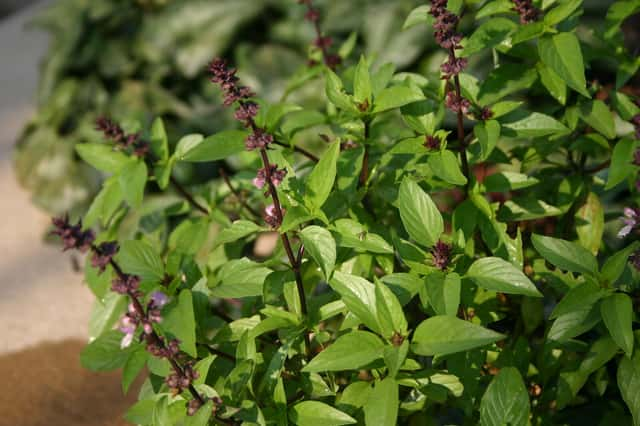
Thai basil (Ocimum basilicum var. thyrsiflora) is a easy-care plant from the Lamiaceae family. Thai basil is a variety of sweet basil grown throughout Southeast Asia, where it is an everyday herb. The plant is sturdy and compact, up to 45 cm tall, with purple square stems and narrow, shiny, slightly serrated leaves. Its scent is of anise and licorice with a slight spiciness that sweet basil l...
Thai basil grows up to 45cm, spread of 30cm, watering every 3 days, 10°C – 35°C, 40–70% humidity. It is suitable for indoor environments and safe for pets.
Unlike many tropical plants, Thai basil tolerates watering mistakes. Best for beginners. Unlike many popular species, Thai basil is safe to keep around pets. Without adequate drainage, root rot can develop within 7 days.
How to Care for Thai basil?
TLDR: Thai basil needs Direct sun, watering every 3 days, and temperatures between 10-35°C with 40-70% humidity.
How Often Should You Water Thai basil?
Keep the soil slightly moist but never soggy; in a pot in hot weather, water every 2-3 days. Water the soil, not the leaves, to avoid downy mildew. Yellowing leaves usually mean too much water.
How Much Light Does Thai basil Need?
At least 6 to 8 hours of sun a day. In shade it grows leggy and weak.
What Is the Best Soil for Thai basil?
Fertile, well-drained mix with a pH of 6 to 7.5. In pots, use potting soil with compost and good drainage.
What Pot Should You Use for Thai basil?
A pot at least 20 cm across with drainage holes.
Care Schedule
Fertilize
Every 30 days
What Is Thai basil and Where Does It Come From?
Thai basil is a variety of sweet basil grown throughout Southeast Asia, where it is an everyday herb. The plant is sturdy and compact, up to 45 cm tall, with purple square stems and narrow, shiny, slightly serrated leaves. Its scent is of anise and licorice with a slight spiciness that sweet basil lacks. The pink flowers come in purple spikes at the tips of the stems, which makes it pretty in the garden too. Its flavour holds up to heat, so it goes into curries, stir-fries and pho, where sweet basil would fade.
How to Propagate Thai basil?
Seed
For a steady supply, sow again every few weeks.
- 1 Sow indoors 4 to 6 weeks before the last frost
- 2 Cover the seeds with 0.5 to 1 cm of mix
- 3 Keep moist in a warm, bright spot
- 4 Plant out 15 to 25 cm apart once frost has passed
Materials needed:
Cuttings in water
Change the water every two or three days.
- 1 Cut a 10 cm shoot tip without flowers
- 2 Strip the lower leaves
- 3 Stand it in a glass of water in a bright spot
- 4 Pot it up once the roots are about 3 cm long
Materials needed:
How Big Does Thai basil Grow?
TLDR: Thai basil can reach up to 45cm tall with Fast growth rate.
Max height
45cm
Spread
30cm
Growth rate
Fast
Foliage
Evergreen
Plant Uses
Edible
Can be consumed
Aromatic
Pleasant fragrance
Ornamental
Great for decoration
Culinary Uses
- Thai curries and stir-fries
- Served fresh with Vietnamese pho and spring rolls
- Holds up to cooking better than sweet basil
Is your plant showing symptoms?
Click on the symptom to discover possible causes:
What Diseases Commonly Affect Thai basil?
TLDR: Thai basil is susceptible to 4 known diseases. Monitor regularly for early detection.
Downy Mildew
Downy mildew is a fungal-like disease caused by oomycetes (water molds) that thrives in cool, wet conditions. It affects a wide range of plants, causing yellowing leaves with fuzzy white-gray growth underneath, leading to defoliation and reduced yields if left untreated.
Fusarium Wilt
Fusarium wilt is a serious fungal disease caused by the soil-borne fungus Fusarium oxysporum. The fungus invades roots and blocks the water-conducting vessels (xylem) of the plant, causing progressive wilting and eventual death. Host-specific forms of the pathogen exist that attack different plant species.
Aphids
Aphids are small, soft-bodied, pear-shaped insects (1/16 to 1/8 inch long) that feed by sucking nutrient-rich sap from plants. They reproduce rapidly and can quickly weaken plants, causing distorted growth and transmitting plant viruses. Aphids come in various colors including green, black, red, yellow, brown, and gray. They secrete honeydew, a sticky substance that attracts ants and encourages sooty mold growth.
Root Rot
Root rot is a serious fungal disease that affects the root system of plants, causing them to decay and die. It is primarily caused by overwatering, poor drainage, or soil-borne fungi such as Pythium, Phytophthora, Rhizoctonia, and Fusarium. The disease thrives in waterlogged conditions where roots are deprived of oxygen, making them susceptible to fungal infection.
Fun Facts
The name thyrsiflora refers to the shape of its flower cluster, a thyrse
In Thailand it is called horapha
Its stem is square, like every member of the mint family
Frequently asked questions
How is Thai basil different from sweet basil?
Why remove the flowers?
Can I grow it indoors?
The leaves have spots and grey fuzz underneath. What is it?
Compare with similar plants
| Attribute | Difficulty | Light | Watering | Pet Safe |
|---|---|---|---|---|
| Field Maple | Easy | Bright indirect | 14d | ✓ |
| Iberian Houseleek | Easy | Direct sun | 14d | ✓ |
| Silver Birch | Easy | Direct sun | 14d | ✓ |
| Common Blanketflower | Easy | Direct sun | 10d | ✓ |





