Liliaceae
Toad lily: Ground Cover Plant
Tricyrtis formosana
An easy-to-grow shade-loving perennial that requires consistently moist, humus-rich soil and protection from direct sun. It is disease-resistant but sensitive to the substrate drying out.
Every 4 days
Low light
-30° - 32°C
50% - 85%
Categories
What is Toad lily?
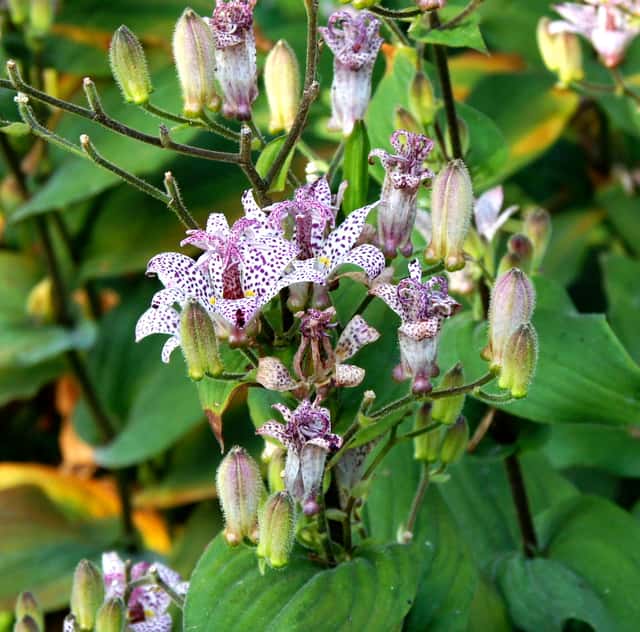
Toad lily (Tricyrtis formosana) is a medium-care plant from the Liliaceae family. Tricyrtis formosana, the Taiwan toad lily, is a hardy perennial native to the woodland understories of Taiwan. In late summer and autumn, it produces small, star-shaped white flowers with prominent purple spots and yellow throats, reminiscent of exotic orchids. The glossy, lance-shaped dark green le...
Toad lily grows up to 90cm, spread of 60cm, watering every 4 days, -30°C – 32°C, 50–85% humidity. It is not suitable for indoor environments and safe for pets.
Unlike many popular species, Toad lily is safe to keep around pets.
How to Care for Toad lily?
TLDR: Toad lily needs Low light, watering every 4 days, and temperatures between -30-32°C with 50-85% humidity.
How Often Should You Water Toad lily?
Keep the soil evenly moist and never let it dry out completely; water more frequently during hot summer months and apply mulch to retain moisture.
How Much Light Does Toad lily Need?
Thrives best in open shade to partial shade—direct sun will scorch the leaves, while deep, heavy shade will slow down flowering.
What Is the Best Soil for Toad lily?
Choose loose, humus-rich soil with good drainage and a slightly acidic to neutral pH (5.5–6.8).
What Pot Should You Use for Toad lily?
If grown in a container, choose a deeper ceramic or terracotta pot with drainage holes to keep the substrate cooler and evenly moist.
Care Schedule
Fertilize
Every 30 days
Repot
Every 730 days
What Is Toad lily and Where Does It Come From?
Tricyrtis formosana, the Taiwan toad lily, is a hardy perennial native to the woodland understories of Taiwan. In late summer and autumn, it produces small, star-shaped white flowers with prominent purple spots and yellow throats, reminiscent of exotic orchids. The glossy, lance-shaped dark green leaves remain attractive throughout the growing season, and the plant eventually forms dense clumps via creeping rhizomes. It is a shade-loving plant resistant to both diseases and pests, making it ideal for woodland gardens, shaded borders, and pond margins.
How to Propagate Toad lily?
Division of clumps
- Water thoroughly after division to reduce transplant shock.
- Perform division only in spring when new shoots are visible.
- 1 Digging up the plant
In early spring, when the first shoots appear, carefully dig up the entire root ball along with the rhizome.
- 2 Division
Using a sharp knife or spade, divide the creeping rhizome into sections, ensuring each has at least one healthy bud.
- 3 Planting
Plant the new sections immediately into humus-rich soil at the same depth as before and water generously.
Materials needed:
Stem cuttings
- Rooting hormone increases the success rate.
- 1 Taking the cutting
In summer, cut a 10-15 cm long terminal shoot that does not have flowers.
- 2 Rooting
Remove the lower leaves and plant the cutting into a moist rooting substrate.
- 3 Care
Maintain high humidity and indirect light until roots are established.
Materials needed:
Sowing seeds
- Do not cover the seeds with substrate; they require light to germinate.
- 1 Seed collection
Collect ripe seeds from the capsules in late autumn.
- 2 Sowing
Sow fresh seeds on the surface of the substrate without covering them, as they need light to germinate.
- 3 Germination
Keep in a cold frame over winter; seeds will germinate in spring after natural stratification.
Materials needed:
How Big Does Toad lily Grow?
TLDR: Toad lily can reach up to 90cm tall with Medium growth rate.
Max height
90cm
Spread
60cm
Growth rate
Medium
Foliage
Deciduous
Plant Uses
Ornamental
Great for decoration
Ground Cover
Soil coverage
Is your plant showing symptoms?
Click on the symptom to discover possible causes:
What Diseases Commonly Affect Toad lily?
TLDR: Toad lily is susceptible to 4 known diseases. Monitor regularly for early detection.
Slugs and Snails
Slugs and snails are mollusks that feed on plant tissue, causing irregular holes in leaves and damage to young seedlings. They are most active at night and in moist conditions, leaving characteristic silvery slime trails. These pests can quickly devastate gardens, especially during wet seasons.
Anthracnose
Anthracnose is a fungal disease caused by fungi in the genus Colletotrichum that affects many plants, including vegetables, fruits, and trees. The disease thrives in cool, wet conditions, causing dark, sunken lesions on leaves, stems, flowers, and fruits.
Aphids
Aphids are small, soft-bodied, pear-shaped insects (1/16 to 1/8 inch long) that feed by sucking nutrient-rich sap from plants. They reproduce rapidly and can quickly weaken plants, causing distorted growth and transmitting plant viruses. Aphids come in various colors including green, black, red, yellow, brown, and gray. They secrete honeydew, a sticky substance that attracts ants and encourages sooty mold growth.
Mosaic Virus
Mosaic virus is a group of plant viruses that cause mottled, patchy patterns on leaves and can affect a wide variety of plants. The virus creates characteristic yellow, white, and green mosaic patterns, often accompanied by stunted growth and deformed plant parts. This highly contagious disease spreads rapidly through insect vectors and contaminated tools.
Meaning & Symbolism
In the language of flowers, it represents hidden beauty that flourishes even in the shade—a symbol of perseverance and unexpected grace in inconspicuous parts of the garden.
Compare with similar plants
| Attribute | Difficulty | Light | Watering | Pet Safe |
|---|---|---|---|---|
| Dark Fieldcap | Medium | Low light | 2d | ⚠️ |
| Azalea | Medium | Partial shade | 3d | ⚠️ |
| Muriel's Bamboo | Medium | Partial shade | 3d | ✓ |
| Bougainvillea | Medium | Direct sun | 7d | ⚠️ |




