Malvaceae
Trailing Abutilon (Callianthe megapotamica)
Callianthe megapotamica
Easy in mild climates: full sun, or part shade where summers are very hot, a spot sheltered from wind, and moist but well-drained soil. Feed monthly from spring to late summer and prune at the end of winter to shape it. It takes light frost (about -5 °C, RHS H3); in colder areas protect it or grow it in a pot. Lovely in hanging baskets, against a wall or trained on a trellis.
Every 4 days
Bright indirect
-5° - °C
% - %
Categories
What is Trailing abutilon?
Trailing abutilon (Callianthe megapotamica) is a easy-care plant from the Malvaceae family. Trailing abutilon (Callianthe megapotamica, formerly Abutilon megapotamicum) is a semi-woody shrub in the mallow family (Malvaceae), native to southern Brazil, Uruguay and north-eastern Argentina. Its long, slender, arching stems trail or lean on walls and fences and reach 1.5 to 2.5 m. The leaves a...
Trailing abutilon grows up to 2.5m, spread of 150cm, watering every 4 days. It is suitable for indoor environments and safe for pets.
Unlike many tropical plants, Trailing abutilon tolerates watering mistakes. Best for beginners. Unlike many popular species, Trailing abutilon is safe to keep around pets. Without adequate drainage, root rot can develop within 8 days.
How to Care for Trailing abutilon?
TLDR: Trailing abutilon needs Bright indirect, watering every 4 days, and temperatures between -5-30°C with 40-70% humidity.
How Often Should You Water Trailing abutilon?
Water when the top 2 cm of the mix is dry, usually every 3 to 5 days for pots in summer and much less in winter. It likes steady moisture but not waterlogging; do not let it dry out completely in hot weather.
How Much Light Does Trailing abutilon Need?
Full sun, or part shade with morning sun in hot-summer areas. Indoors, by a very bright window. In low light the stems get leggy and flowering drops.
What Is the Best Soil for Trailing abutilon?
Fertile, loose, humus-rich soil that stays moist but drains well. In pots, mix garden soil, compost and coarse sand. It tolerates chalky soil but not very dry ground.
What Pot Should You Use for Trailing abutilon?
A 30-40 cm pot with good drainage holes, or a hanging basket to show off the trailing stems; where frosts are hard, a container you can move to a sheltered spot for winter.
Care Schedule
Fertilize
Every 30 days
What Is Trailing abutilon and Where Does It Come From?
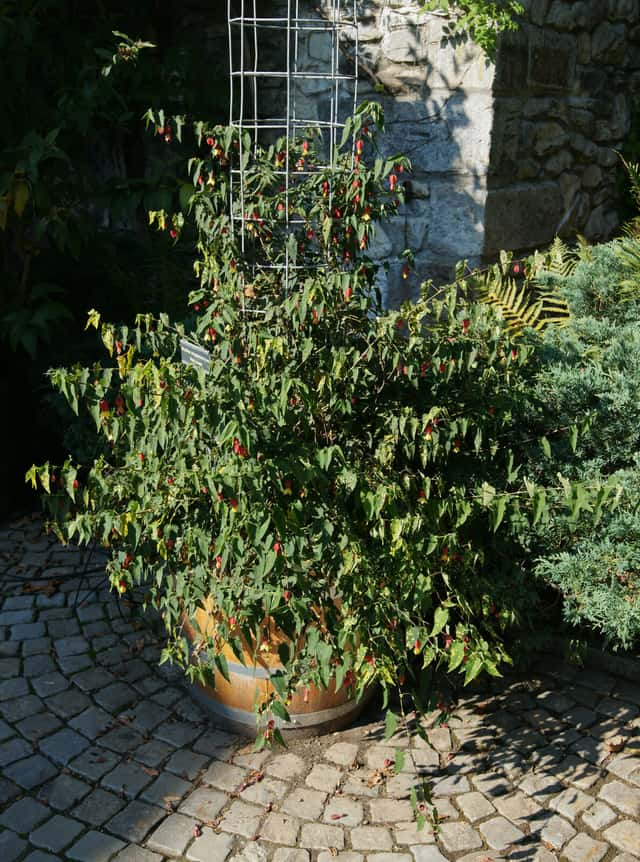
Trailing abutilon (Callianthe megapotamica, formerly Abutilon megapotamicum) is a semi-woody shrub in the mallow family (Malvaceae), native to southern Brazil, Uruguay and north-eastern Argentina. Its long, slender, arching stems trail or lean on walls and fences and reach 1.5 to 2.5 m. The leaves are heart-shaped and toothed, 5 to 8 cm long. The flowers hang singly along the stems: an inflated red calyx with yellow petals and a tuft of dark stamens poking out below, like little lanterns. In mild climates it flowers from late spring until the first frosts and attracts hummingbirds and bees.
How to Propagate Trailing abutilon?
Softwood cuttings
Late-winter or summer cuttings root easily. As plants can be short-lived in the garden, keep a few spare young plants.
- 1 Take 10-12 cm tip cuttings
- 2 Strip the lower leaves
- 3 Root them in water or in moist mix with sand
- 4 Keep them somewhere sheltered and bright, out of direct sun
- 5 Pot them up once the roots are a few centimetres long
Materials needed:
Seed
Cultivars such as 'Variegatum' and hybrids do not come true from seed; propagate them from cuttings.
- 1 Sow in spring in a light seed mix
- 2 Keep moist at 15-18 °C
- 3 Prick out seedlings once they have 2 pairs of leaves
Materials needed:
How Big Does Trailing abutilon Grow?
TLDR: Trailing abutilon can reach up to 2.5m tall with Medium growth rate.
Max height
2.5m
Spread
1.5m
Growth rate
Medium
Foliage
Semi-evergreen
Plant Uses
Ornamental
Great for decoration
Is your plant showing symptoms?
Click on the symptom to discover possible causes:
What Diseases Commonly Affect Trailing abutilon?
TLDR: Trailing abutilon is susceptible to 8 known diseases. Monitor regularly for early detection.
Whiteflies
Whiteflies are small, soft-bodied, winged insects closely related to aphids and mealybugs. They are moth-like in appearance, about 1/16 inch long, triangular in shape, and gray-white in color. These sap-sucking pests feed on plant tissue, causing yellowing, stunted growth, and wilting. They also excrete honeydew, which attracts ants and promotes sooty mold growth. Whiteflies can transmit serious plant viruses.
Spider Mites
Spider mites are tiny arachnids (less than 1/20 inch long) related to spiders and ticks that feed on plant sap. They thrive in hot, dry conditions and can cause significant damage to ornamental and vegetable plants. During severe infestations, crop losses can reach 14% or higher as these pests disrupt vital plant processes including photosynthesis, carbon dioxide absorption, and transpiration.
Aphids
Aphids are small, soft-bodied, pear-shaped insects (1/16 to 1/8 inch long) that feed by sucking nutrient-rich sap from plants. They reproduce rapidly and can quickly weaken plants, causing distorted growth and transmitting plant viruses. Aphids come in various colors including green, black, red, yellow, brown, and gray. They secrete honeydew, a sticky substance that attracts ants and encourages sooty mold growth.
Mealybugs
Mealybugs are small, soft-bodied insects covered with a white, waxy, cottony material. They are common pests of houseplants and outdoor plants in mild climates. These sap-sucking insects feed on plant tissue, causing damage, stunted growth, and can lead to plant death if left untreated. They produce sticky honeydew which attracts sooty mold.
Fun Facts
The name megapotamica means "of the big river", after Rio Grande do Sul in Brazil, where the species was described
It holds the Royal Horticultural Society Award of Garden Merit
The red-and-yellow flowers earned it the nickname "Belgian flag" in some countries
Frequently asked questions
Is trailing abutilon frost hardy?
Why is my trailing abutilon not flowering?
What pests attack trailing abutilon?
How do I prune trailing abutilon?
Compare with similar plants
| Attribute | Difficulty | Light | Watering | Pet Safe |
|---|---|---|---|---|
| Field Maple | Easy | Bright indirect | 14d | ✓ |
| Iberian Houseleek | Easy | Direct sun | 14d | ✓ |
| Silver Birch | Easy | Direct sun | 14d | ✓ |
| Common Blanketflower | Easy | Direct sun | 10d | ✓ |
Choose & Compare
Sources & References
- NC State Extension Plant Toolbox — Callianthe megapotamica (Brazilian bellflower)
- RHS — Abutilon megapotamicum 'Variegatum' (trailing abutilon)
- Wikipedia — Abutilon megapotamicum
- ESALQ/USP — Sininho (Abutilon megapotamicum)
- Promesse de Fleurs — Abutilon megapotamicum
- World Plants — Abutilon megapotamicum (Trailing Abutilon)





