Crassulaceae
Turkish Stonecrop (Sedum pallidum): Care Guide
Sedum pallidum
A very easy, frost-hardy groundcover for sun and sharp drainage. Water young plants regularly until they spread, then let it live mostly on rainfall: mature mats tolerate long dry spells but rot in soggy soil.
Every 14 days
Bright indirect
-29° - °C
% - %
Categories
What is Turkish stonecrop?
Turkish stonecrop (Sedum pallidum) is a easy-care plant from the Crassulaceae family. Sedum pallidum is a tiny mat-forming stonecrop native to Turkey, the Balkans and the Caucasus, where it grows on rocky, sunny ground. Its short, creeping stems are packed with small, succulent, needle-like blue-grey to pistachio-green leaves that form low, rubbery buns only a few centimetres high; i...
Turkish stonecrop grows up to 8cm, spread of 60cm, watering every 14 days. It is not suitable for indoor environments and safe for pets.
Unlike many tropical plants, Turkish stonecrop tolerates watering mistakes. Best for beginners. Unlike many popular species, Turkish stonecrop is safe to keep around pets.
How to Care for Turkish stonecrop?
TLDR: Turkish stonecrop needs Bright indirect, watering every 14 days, and temperatures between -29-30°C with 40-70% humidity.
How Often Should You Water Turkish stonecrop?
Use the soak-and-dry method: water thoroughly, then wait until the soil is dry before watering again. Established plants in the ground need extra water only during long droughts; in pots, water about every two weeks in summer and very little in winter.
How Much Light Does Turkish stonecrop Need?
Full sun gives the most compact, colorful mats; it also accepts part sun. In shade it stretches and thins out.
What Is the Best Soil for Turkish stonecrop?
Plant in poor, gritty, fast-draining soil. In beds or pots, mix in about 50% coarse sand, pumice or perlite; rock gardens, walls and gravel are ideal.
What Pot Should You Use for Turkish stonecrop?
A wide, shallow terracotta pot, trough or hanging basket with drainage holes.
What Is Turkish stonecrop and Where Does It Come From?
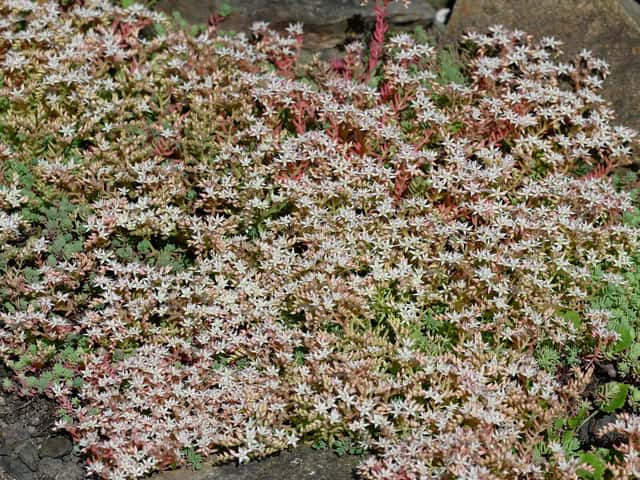
Sedum pallidum is a tiny mat-forming stonecrop native to Turkey, the Balkans and the Caucasus, where it grows on rocky, sunny ground. Its short, creeping stems are packed with small, succulent, needle-like blue-grey to pistachio-green leaves that form low, rubbery buns only a few centimetres high; in a few years a single plant can carpet more than 60 cm. In summer, slender reddish-brown stems rise a few centimetres above the mat carrying tiny white, star-shaped flowers, sometimes blushed pink. In cold weather the foliage often takes on pinkish tints. The form most often grown in gardens is var. bithynicum, also sold as Sedum bithynicum.
How to Propagate Turkish stonecrop?
Stem cuttings
Even small broken pieces root wherever they touch the soil, so you can scatter fragments over bare ground to fill it in.
- 1 Snip pieces about 5 cm long from the mat
- 2 Let them dry for a day
- 3 Lay or press them onto moist, gritty soil
- 4 Keep lightly moist until new growth appears
Materials needed:
Division
The mats have very shallow roots, so divisions lift easily and re-establish fast.
- 1 Lift a section of the mat with a trowel
- 2 Pull or cut it into smaller clumps
- 3 Replant at the same depth in well-drained soil
- 4 Water lightly until established
Materials needed:
How Big Does Turkish stonecrop Grow?
TLDR: Turkish stonecrop can reach up to 8cm tall with Fast growth rate.
Max height
8cm
Spread
60cm
Growth rate
Fast
Foliage
Evergreen
Plant Uses
Ornamental
Great for decoration
Ground Cover
Soil coverage
Is your plant showing symptoms?
Click on the symptom to discover possible causes:
What Diseases Commonly Affect Turkish stonecrop?
TLDR: Turkish stonecrop is susceptible to 5 known diseases. Monitor regularly for early detection.
Root Rot
Root rot is a serious fungal disease that affects the root system of plants, causing them to decay and die. It is primarily caused by overwatering, poor drainage, or soil-borne fungi such as Pythium, Phytophthora, Rhizoctonia, and Fusarium. The disease thrives in waterlogged conditions where roots are deprived of oxygen, making them susceptible to fungal infection.
Overwatering
Overwatering occurs when plants receive too much water, depriving roots of oxygen and causing root rot. This environmental stress is one of the most common causes of houseplant death, as waterlogged soil prevents roots from breathing and functioning properly.
Mealybugs
Mealybugs are small, soft-bodied insects covered with a white, waxy, cottony material. They are common pests of houseplants and outdoor plants in mild climates. These sap-sucking insects feed on plant tissue, causing damage, stunted growth, and can lead to plant death if left untreated. They produce sticky honeydew which attracts sooty mold.
Aphids
Aphids are small, soft-bodied, pear-shaped insects (1/16 to 1/8 inch long) that feed by sucking nutrient-rich sap from plants. They reproduce rapidly and can quickly weaken plants, causing distorted growth and transmitting plant viruses. Aphids come in various colors including green, black, red, yellow, brown, and gray. They secrete honeydew, a sticky substance that attracts ants and encourages sooty mold growth.
Fun Facts
The epithet "pallidum" means "pale", after its soft blue-grey foliage.
Its roots are so shallow that whole mats can be lifted by hand.
A single small plant can spread into a carpet more than 60 cm wide in about three years.
Frequently asked questions
Is Sedum pallidum cold-hardy?
Can you walk on Turkish stonecrop?
How do I propagate Sedum pallidum?
Is Sedum pallidum the same as Sedum hispanicum?
Compare with similar plants
| Attribute | Difficulty | Light | Watering | Pet Safe |
|---|---|---|---|---|
| Field Maple | Easy | Bright indirect | 14d | ✓ |
| Iberian Houseleek | Easy | Direct sun | 14d | ✓ |
| Silver Birch | Easy | Direct sun | 14d | ✓ |
| Common Blanketflower | Easy | Direct sun | 10d | ✓ |





