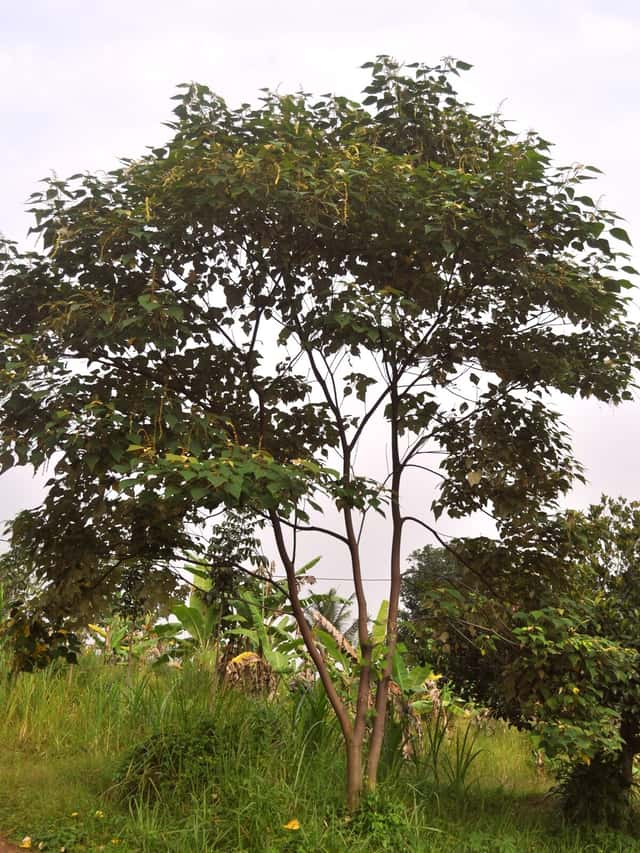
Euphorbiaceae
Turn-in-the-wind: Medicinal Uses & Care Tips
Mallotus paniculatus
A full-sun tree with moderate growth, suitable for gardens, parks, or sidewalks in tropical or subtropical climates. It thrives in fertile, sandy-clay, well-drained soil, tolerates moist soil, and can withstand dry periods once established. It requires regular structural pruning to maintain an attractive canopy. It is not suitable as an indoor plant.
Every 7 days
Bright indirect
° - °C
% - %
Categories
What is Turn-in-the-wind?
Turn-in-the-wind (Mallotus paniculatus) is a easy-care plant from the Euphorbiaceae family. Mallotus paniculatus is a shrub or tree in the Euphorbiaceae family, native to regions ranging from India and southern China to Malaysia, Indonesia, and northeastern Australia. It grows in secondary forests, clearings, forest edges, and roadsides at altitudes up to 1,500 m, and can exceed 20 m in he...
Turn-in-the-wind grows up to 25.0m, watering every 7 days. It is not suitable for indoor environments and safe for pets.
Unlike many tropical plants, Turn-in-the-wind tolerates watering mistakes. Best for beginners. Unlike many popular species, Turn-in-the-wind is safe to keep around pets.
How to Care for Turn-in-the-wind?
TLDR: Turn-in-the-wind needs Bright indirect, watering every 7 days, and temperatures between 15-30°C with 40-70% humidity.
How Often Should You Water Turn-in-the-wind?
Water approximately once a week while the sapling is establishing. Afterward, rainfall is usually sufficient; during long droughts, a deep watering every 1 to 2 weeks will keep the foliage firm.
How Much Light Does Turn-in-the-wind Need?
Plant in full sun. As a pioneer species of clearings and forest edges, it will become sparse and etiolated if grown in the shade.
What Is the Best Soil for Turn-in-the-wind?
Prefers fertile, well-drained soil, such as a sandy-clay garden mix. It tolerates moist soils but avoid areas where water remains stagnant for several days.
What Pot Should You Use for Turn-in-the-wind?
Not recommended for long-term container growth as it matures into a tree. A young sapling can be kept in a large, deep pot with drainage holes until it is ready to be transplanted into the ground.
What Is Turn-in-the-wind and Where Does It Come From?
Mallotus paniculatus is a shrub or tree in the Euphorbiaceae family, native to regions ranging from India and southern China to Malaysia, Indonesia, and northeastern Australia. It grows in secondary forests, clearings, forest edges, and roadsides at altitudes up to 1,500 m, and can exceed 20 m in height. The diamond-shaped or triangular leaves, which sometimes feature three lobes, are dark green on top and white and velvety underneath; because the petiole is flexible, they rotate in the wind to reveal their pale underside, hence the common name 'turn-in-the-wind.' It is a dioecious species with small yellow flowers in panicles at the branch tips, producing prickly capsules with shiny black seeds that are consumed by birds.
How to Propagate Turn-in-the-wind?
Seed
This is the standard method used in nurseries and how the plant reproduces in nature. Fresh seeds have the best germination rates.
- 1 Harvest the capsules when they turn brown and begin to split open
- 2 Remove the black seeds and sow them immediately while still fresh
- 3 Cover with a thin layer of light substrate and keep moist
- 4 Keep in a warm, bright location and transplant once the seedling has 4 to 6 leaves
Materials needed:
How Big Does Turn-in-the-wind Grow?
TLDR: Turn-in-the-wind can reach up to 25.0m tall with Medium growth rate.
Max height
25.0m
Growth rate
Medium
Foliage
Evergreen
Plant Uses
Ornamental
Great for decoration
Medicinal
Medicinal properties
Medicinal Uses
- In Malaysia, a decoction of the plant is used to clean wounds
- The root is administered as a decoction after childbirth and for childhood fevers in traditional Malay medicine
- Used in poultices with other plants to treat headaches
Is your plant showing symptoms?
Click on the symptom to discover possible causes:
Meaning & Symbolism
Associated with resilience: it is one of the first trees to occupy clearings and disturbed areas, helping the forest to regenerate.
Compare with similar plants
| Attribute | Difficulty | Light | Watering | Pet Safe |
|---|---|---|---|---|
| Field Maple | Easy | Bright indirect | 14d | ✓ |
| Iberian Houseleek | Easy | Direct sun | 14d | ✓ |
| Silver Birch | Easy | Direct sun | 14d | ✓ |
| Common Blanketflower | Easy | Direct sun | 10d | ✓ |





