Orchidaceae
Two-edged Laelia: Pet-Safe Plant
Laelia anceps
Grow in bright, filtered light with good air circulation, in a coarse bark substrate that dries out quickly between waterings. Water regularly during the growing season (April to November) and significantly reduce watering in winter.
Every 7 days
Bright indirect
10° - 32°C
50% - 75%
Categories
What is Two-edged Laelia?
Two-edged Laelia (Laelia anceps) is a easy-care plant from the Orchidaceae family. Laelia anceps is an epiphytic orchid from the Orchidaceae family, native to eastern Mexico (rarely Honduras and Guatemala), where it grows on trees in oak-pine forests and coffee plantations at altitudes of 500 to 2,400 meters. It produces ovoid, flattened pseudobulbs (6-12 cm) with one, rarely two,...
Two-edged Laelia grows up to 80cm, spread of 40cm, watering every 7 days, 10°C – 32°C, 50–75% humidity. It is suitable for indoor environments and safe for pets.
Unlike many tropical plants, Two-edged Laelia tolerates watering mistakes. Best for beginners. Unlike many popular species, Two-edged Laelia is safe to keep around pets. Without adequate drainage, root rot can develop within 14 days.
How to Care for Two-edged Laelia?
TLDR: Two-edged Laelia needs Bright indirect, watering every 7 days, and temperatures between 10-32°C with 50-75% humidity.
How Often Should You Water Two-edged Laelia?
During the active growing season (April to November), water approximately once a week when the substrate is nearly dry. Significantly reduce watering in winter—overwatering and root rot are the most common problems for this species.
How Much Light Does Two-edged Laelia Need?
Requires medium to bright light (approximately 21,500-38,000 lux), similar to Cattleya care. Dark green leaves and poor flowering indicate insufficient light.
What Is the Best Soil for Two-edged Laelia?
Plant in a coarse bark mix (pine bark with charcoal and sphagnum moss) or mount on a piece of bark—the substrate must dry out quickly, as roots cannot tolerate constant moisture.
What Pot Should You Use for Two-edged Laelia?
A perforated clay pot or a wooden/plastic basket with coarse bark drainage; in warmer climates, it also thrives mounted on a piece of bark or a branch.
Care Schedule
Fertilize
Every 14 days
Misting
Every 3 days
Rotate
Every 14 days
Repot
Every 730 days
What Is Two-edged Laelia and Where Does It Come From?
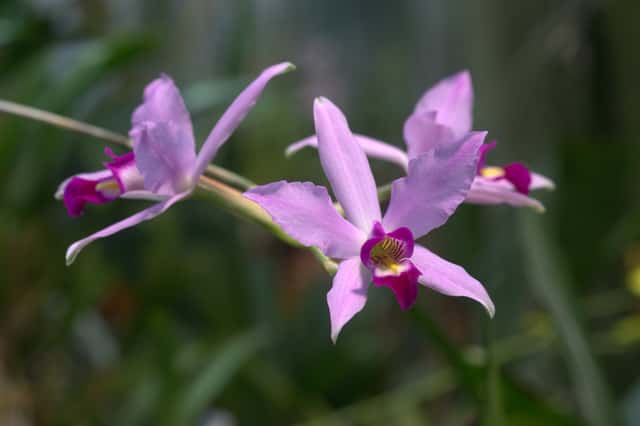
Laelia anceps is an epiphytic orchid from the Orchidaceae family, native to eastern Mexico (rarely Honduras and Guatemala), where it grows on trees in oak-pine forests and coffee plantations at altitudes of 500 to 2,400 meters. It produces ovoid, flattened pseudobulbs (6-12 cm) with one, rarely two, stiff leathery leaves. A long (45-60 cm) flower spike emerges from the base of the pseudobulb, bearing 2 to 4 fragrant flowers 6-12 cm in diameter, ranging in color from lavender to pink, purple, and white. It blooms from November to January. It is one of the most cold-hardy species in the Cattleya alliance, tolerating short-term temperatures just above freezing as well as summer heat exceeding 35°C.
How to Propagate Two-edged Laelia?
Division
- Maintain higher humidity for the first few weeks after division, but limit direct watering of the roots.
- Use sterilized tools to prevent the transmission of infections.
- 1 Plant Preparation
Remove the plant from the pot shortly after flowering when new roots begin to grow.
- 2 Dividing Pseudobulbs
Carefully cut the rhizome so that each new section has at least 3 to 5 healthy pseudobulbs.
- 3 Potting
Plant the divided sections into fresh bark substrate and secure them so they do not move until they take root.
Materials needed:
How Big Does Two-edged Laelia Grow?
TLDR: Two-edged Laelia can reach up to 80cm tall with Slow growth rate.
Max height
80cm
Spread
40cm
Growth rate
Slow
Foliage
Evergreen
Plant Uses
Ornamental
Great for decoration
Is your plant showing symptoms?
Click on the symptom to discover possible causes:
What Diseases Commonly Affect Two-edged Laelia?
TLDR: Two-edged Laelia is susceptible to 6 known diseases. Monitor regularly for early detection.
Leaf Spot
Leaf spot is a common fungal disease caused by various pathogens including Alternaria, Ascochyta, Colletotrichum, Septoria, and Venturia. It primarily affects leaves, causing discolored spots that can lead to premature leaf drop if left untreated.
Root Rot
Root rot is a serious fungal disease that affects the root system of plants, causing them to decay and die. It is primarily caused by overwatering, poor drainage, or soil-borne fungi such as Pythium, Phytophthora, Rhizoctonia, and Fusarium. The disease thrives in waterlogged conditions where roots are deprived of oxygen, making them susceptible to fungal infection.
Powdery Mildew
Powdery mildew is a common fungal disease caused by various fungi species including Erysiphe, Podosphaera, Oïdium, and Leveillula. It affects over 10,000 plant species worldwide. The disease thrives in warm, dry climates with high humidity and appears as a distinctive white powdery coating on plant surfaces.
Spider Mites
Spider mites are tiny arachnids (less than 1/20 inch long) related to spiders and ticks that feed on plant sap. They thrive in hot, dry conditions and can cause significant damage to ornamental and vegetable plants. During severe infestations, crop losses can reach 14% or higher as these pests disrupt vital plant processes including photosynthesis, carbon dioxide absorption, and transpiration.
Meaning & Symbolism
In its native Mexico, it symbolizes resilience and beauty adapted to harsh conditions, growing directly on tree branches even in cooler mountain forests.
Compare with similar plants
| Attribute | Difficulty | Light | Watering | Pet Safe |
|---|---|---|---|---|
| Field Maple | Easy | Bright indirect | 14d | ✓ |
| Silver Birch | Easy | Direct sun | 14d | ✓ |
| Common Blanketflower | Easy | Direct sun | 10d | ✓ |
| Cushion Bush | Easy | Direct sun | 14d | ✓ |





