Anacardiaceae
Umbu (Spondias tuberosa)
Spondias tuberosa
Needs full sun, heat and well-drained soil. Once established it handles long droughts thanks to its water-storing roots; overwatering is the main risk. It cannot take frost. Growth is slow and seedlings take years to fruit, so grafted plants are the better choice.
Every 10 days
Direct sun
10° - 40°C
30% - 70%
Categories
What is Umbu?
Umbu (Spondias tuberosa) is a medium-care plant from the Anacardiaceae family. Umbu (Spondias tuberosa) is a fruit tree in the Anacardiaceae family, native to the Caatinga dry forest of northeastern Brazil. It stays low, around 6 to 7 meters tall, with a short trunk and an umbrella-shaped crown up to 15 meters wide. Its roots form tubers (xylopodia) that store water, starch an...
Umbu grows up to 7.0m, spread of 1500cm, watering every 10 days, 10°C – 40°C, 30–70% humidity. It is not suitable for indoor environments and safe for pets.
Unlike many popular species, Umbu is safe to keep around pets.
How to Care for Umbu?
TLDR: Umbu needs Direct sun, watering every 10 days, and temperatures between 10-40°C with 30-70% humidity.
How Often Should You Water Umbu?
Water every 7 to 10 days during the first year and the growing season, letting the soil dry out between waterings. Established trees in the ground can live on rainfall alone. Water very little while the tree is leafless in the dry season.
How Much Light Does Umbu Need?
Full sun all day. Young seedlings can be raised under 30% to 50% shade cloth, but mature trees need direct light to flower and fruit.
What Is the Best Soil for Umbu?
Deep, sandy or sandy-loam soil with excellent drainage. Add well-rotted manure to the planting hole and correct acidic soil with lime. Avoid spots that stay waterlogged.
What Pot Should You Use for Umbu?
In a container, use a large, deep pot (at least 50 liters) with drainage holes, since the tuberous root needs depth. Planting in the ground is best.
What Is Umbu and Where Does It Come From?
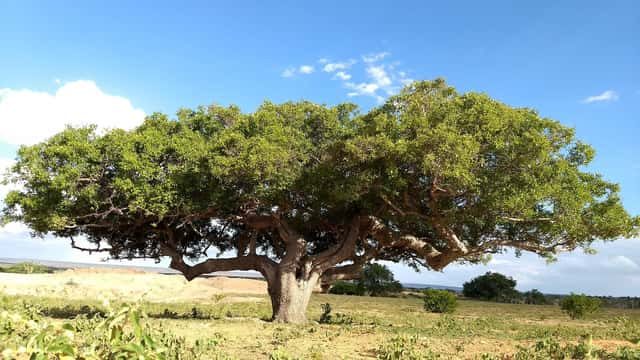
Umbu (Spondias tuberosa) is a fruit tree in the Anacardiaceae family, native to the Caatinga dry forest of northeastern Brazil. It stays low, around 6 to 7 meters tall, with a short trunk and an umbrella-shaped crown up to 15 meters wide. Its roots form tubers (xylopodia) that store water, starch and minerals, letting the tree survive long droughts. It drops its leaves in the dry season, blooms with small white flowers as the drought ends and fruits through the rainy season. Trees live for around 100 years.
How to Propagate Umbu?
Grafting
Avoid grafting in cold or rainy periods. Grafted plants keep the traits of the mother tree and fruit much sooner.
- 1 Grow a rootstock from seed until the stem is 0.8 to 1 cm thick at 20 cm above the base (about 6 months)
- 2 Collect mature scions from a productive mother tree with large, sweet fruit
- 3 Graft a scion of the same diameter as the rootstock and wrap it with grafting tape
- 4 Keep watering steadily for two weeks before and after grafting
Materials needed:
Seed
Seedlings vary a lot and take years to fruit; transplant carefully so you do not damage the tuberous root.
- 1 Clean the pulp from ripe fruit and dry the seeds in the shade for three days
- 2 Use a knife tip to remove the fibrous tissue at the hilum so water can get in
- 3 Soak the seeds for 24 hours
- 4 Sow 1 cm deep in washed sand and water daily until they sprout
Materials needed:
Stem cutting
Cuttings do not develop the typical tuberous root as well as seedlings.
- 1 Cut branches 2 to 3 cm thick and about 30 cm long from inside the crown
- 2 Bury two thirds of the cutting at an angle in fine sand or in its final spot
- 3 Keep the medium moist but not soggy until it sprouts
Materials needed:
How Big Does Umbu Grow?
TLDR: Umbu can reach up to 7.0m tall with Slow growth rate.
Max height
7.0m
Spread
15.0m
Growth rate
Slow
Foliage
Deciduous
Plant Uses
Edible
Can be consumed
Medicinal
Medicinal properties
Ornamental
Great for decoration
Medicinal Uses
- Water stored in the roots is used in folk medicine in northeastern Brazil
- In folk tradition, the fruit is valued as a source of vitamin C
Culinary Uses
- Fresh fruit
- Umbuzada (pulp cooked with milk and sugar)
- Juices, ice cream, sweets and jellies
- Pickles made from the root tubers
Is your plant showing symptoms?
Click on the symptom to discover possible causes:
What Diseases Commonly Affect Umbu?
TLDR: Umbu is susceptible to 4 known diseases. Monitor regularly for early detection.
Cercospora Leaf Spot
Cercospora is a fungal disease that causes round to oval leaf spots with a light center and a dark border. It thrives on prolonged leaf wetness, dense planting, and warm, stagnant weather. Infestations often begin as small dots on older leaves; the leaves eventually turn yellow and drop off. In gardens, it is commonly seen on beets, Swiss chard, sugar beets, roses, as well as in vegetable patches on tomatoes and eggplants. The infection spreads via rain and irrigation splashes and can survive in infected plant debris.
Caterpillars
Caterpillars are the larval stage of moths and butterflies that feed voraciously on plant foliage, stems, flowers, and fruits. Common species include cabbage loopers, tomato hornworms, armyworms, and cutworms. These pests can cause extensive damage by consuming large amounts of plant tissue in a short time. They vary in size from small (1/4 inch) to large (5 inches), with colors ranging from green to brown, often featuring stripes or spots. Caterpillars are highly mobile and can quickly spread throughout gardens, making them one of the most destructive common pests.
Root Rot
Root rot is a serious fungal disease that affects the root system of plants, causing them to decay and die. It is primarily caused by overwatering, poor drainage, or soil-borne fungi such as Pythium, Phytophthora, Rhizoctonia, and Fusarium. The disease thrives in waterlogged conditions where roots are deprived of oxygen, making them susceptible to fungal infection.
Cold Damage
Cold damage, also known as frost injury, occurs when plants are exposed to freezing or near-freezing temperatures. This environmental stress can cause cellular damage as ice crystals form within plant tissues, rupturing cells and disrupting normal plant functions. Chilling injury can also occur in sensitive species at temperatures between 32-55°F (0-10°C), even without actual freezing.
Meaning & Symbolism
Called "the sacred tree of the sertão" by Brazilian writer Euclides da Cunha, the umbu stands for resilience and survival through drought in northeastern Brazil.
Fun Facts
An old tree can have more than a thousand root tubers storing water and reserves
Euclides da Cunha called it "the sacred tree of the sertão" in his book Os Sertões
The tree lives for around 100 years
Its flowers feed native stingless bees with nectar and pollen
Frequently asked questions
How long does an umbu tree take to fruit?
Does the umbu need a lot of water?
Can I grow umbu in a cold climate?
Why does my umbu drop its leaves?
Compare with similar plants
| Attribute | Difficulty | Light | Watering | Pet Safe |
|---|---|---|---|---|
| Dark Fieldcap | Medium | Low light | 2d | ⚠️ |
| Azalea | Medium | Partial shade | 3d | ⚠️ |
| Muriel's Bamboo | Medium | Partial shade | 3d | ✓ |
| Bougainvillea | Medium | Direct sun | 7d | ⚠️ |




