Sapindaceae
Vine Maple (Acer circinatum)
Acer circinatum
An easy maple for part shade, including beneath larger trees; it tolerates sun and deep shade. It wants moist, humus-rich, well-drained soil, acid to neutral, and steady moisture: it dislikes hot, dry conditions. Very cold hardy (USDA zones 4 to 7). Prune little, and only while dormant, from late autumn to midwinter.
Every 7 days
Partial shade
° - °C
% - %
Categories
What is Vine maple?
Vine maple (Acer circinatum) is a easy-care plant from the Sapindaceae family. Acer circinatum is a small deciduous maple native to north-western North America, from southern British Columbia to northern California, mostly west of the Cascades. It grows in the understory of conifer forests, along stream banks and in clearings, from sea level to about 750 m. In shade it forms a...
Vine maple grows up to 7.5m, spread of 600cm, watering every 7 days. It is not suitable for indoor environments and safe for pets.
Unlike many tropical plants, Vine maple tolerates watering mistakes. Best for beginners. Unlike many popular species, Vine maple is safe to keep around pets.
How to Care for Vine maple?
TLDR: Vine maple needs Partial shade, watering every 7 days, and temperatures between 15-30°C with 40-70% humidity.
How Often Should You Water Vine maple?
Keep the soil evenly moist, watering about once a week in dry spells, more in summer and during the first year. Mulch helps hold moisture. Avoid waterlogging.
How Much Light Does Vine maple Need?
Part shade is ideal. In full sun it grows more upright with brighter autumn colour but needs more water; in shade it is more open and shrubby.
What Is the Best Soil for Vine maple?
Loam or sandy soil, rich in organic matter, moist but well-drained, acid to neutral. Work in compost or leaf mould at planting.
What Pot Should You Use for Vine maple?
Can be grown in a large container (50 cm or more) with drainage holes and a rich, moisture-retentive mix; in a pot it stays smaller and needs frequent watering.
What Is Vine maple and Where Does It Come From?
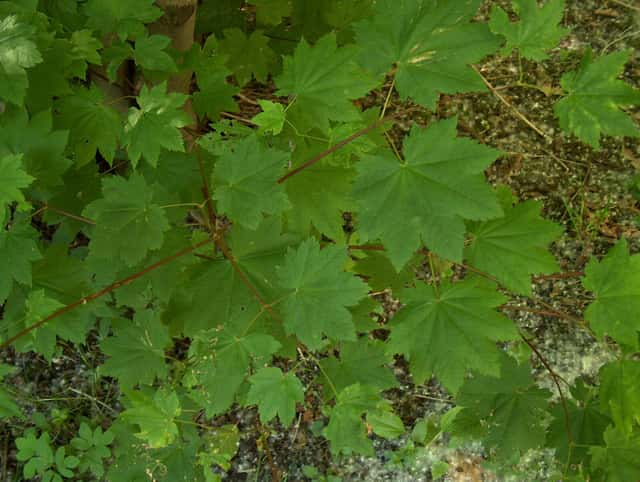
Acer circinatum is a small deciduous maple native to north-western North America, from southern British Columbia to northern California, mostly west of the Cascades. It grows in the understory of conifer forests, along stream banks and in clearings, from sea level to about 750 m. In shade it forms a multi-stemmed shrub with twisting, arching branches that may touch the ground and root, forming thickets (hence "vine maple"); in sun it grows as a single-stemmed small tree of 3 to 7.5 m. The leaves are almost round, with 7 to 9 lobes. In spring it bears small clusters of flowers with deep red sepals and greenish-white petals, followed by red samaras. In autumn the leaves turn yellow, orange or red, more intensely the more sun they get.
How to Propagate Vine maple?
Layering
This is how the plant spreads in the wild: branches that touch the ground root on their own.
- 1 Choose a low, flexible branch that reaches the ground
- 2 Make a small nick in the bark on the underside where it will touch the soil
- 3 Bury that section a few centimetres deep and pin it down with a wire peg or stone
- 4 Keep moist and, once rooted, sever from the parent and transplant
Materials needed:
Seed
Seed needs a period of cold, moist conditions to germinate; for spring sowing, keep it a few months in damp sand in the fridge first.
- 1 Collect ripe samaras in autumn
- 2 Sow outdoors or in pots in autumn so they get a winter chill
- 3 Keep the mix moist; seeds germinate in spring
- 4 Transplant seedlings after their first year
Materials needed:
How Big Does Vine maple Grow?
TLDR: Vine maple can reach up to 7.5m tall with Medium growth rate.
Max height
7.5m
Spread
6.0m
Growth rate
Medium
Foliage
Deciduous
Plant Uses
Ornamental
Great for decoration
Is your plant showing symptoms?
Click on the symptom to discover possible causes:
What Diseases Commonly Affect Vine maple?
TLDR: Vine maple is susceptible to 5 known diseases. Monitor regularly for early detection.
Verticillium Wilt
Verticillium wilt is a soil-borne fungal disease caused primarily by the fungi Verticillium dahliae and V. albo-atrum. These pathogens infect plant roots and grow within the vascular tissues, blocking water and nutrient transport, resulting in wilting and eventual plant death. The disease affects over 350 plant species including vegetables, fruits, ornamental flowers, and trees. The fungi can survive in soil for more than 10 years as resistant structures called microsclerotia.
Aphids
Aphids are small, soft-bodied, pear-shaped insects (1/16 to 1/8 inch long) that feed by sucking nutrient-rich sap from plants. They reproduce rapidly and can quickly weaken plants, causing distorted growth and transmitting plant viruses. Aphids come in various colors including green, black, red, yellow, brown, and gray. They secrete honeydew, a sticky substance that attracts ants and encourages sooty mold growth.
Caterpillars
Caterpillars are the larval stage of moths and butterflies that feed voraciously on plant foliage, stems, flowers, and fruits. Common species include cabbage loopers, tomato hornworms, armyworms, and cutworms. These pests can cause extensive damage by consuming large amounts of plant tissue in a short time. They vary in size from small (1/4 inch) to large (5 inches), with colors ranging from green to brown, often featuring stripes or spots. Caterpillars are highly mobile and can quickly spread throughout gardens, making them one of the most destructive common pests.
Scale Insects
Scale insects are small sap-sucking pests that appear as brown, shell-like bumps on plant stems and leaves. There are over 25 species, divided into armored (hard) and unarmored (soft) scales. They feed by piercing plant tissue and extracting sap, which weakens the plant and can lead to yellowing, stunted growth, and even death if left untreated. They also excrete honeydew, which attracts ants and promotes sooty mold growth.
Fun Facts
Branches that touch the ground take root and form thickets, hence the name vine maple
Its flexible wood was used by Indigenous peoples of the Northwest to make snowshoes and baskets
It is a larval host plant for the imperial moth
Frequently asked questions
Does Acer circinatum like sun or shade?
How big does vine maple get?
What pests and diseases affect Acer circinatum?
When should I prune vine maple?
Compare with similar plants
| Attribute | Difficulty | Light | Watering | Pet Safe |
|---|---|---|---|---|
| Field Maple | Easy | Bright indirect | 14d | ✓ |
| Iberian Houseleek | Easy | Direct sun | 14d | ✓ |
| Silver Birch | Easy | Direct sun | 14d | ✓ |
| Common Blanketflower | Easy | Direct sun | 10d | ✓ |





