Cactaceae
Violet Prickly Pear (Opuntia gosseliniana)
Opuntia gosseliniana
A very low-maintenance cactus for sunny, dry gardens or large patio pots. Give it full sun, fast-draining soil and only occasional deep watering. Once established in the ground it can live on rainfall in arid climates. It tolerates light frost (to about -9 °C) but rots in soggy soil.
Every 14 days
Direct sun
-9° - 45°C
% - %
Categories
What is Violet Prickly Pear?
Violet Prickly Pear (Opuntia gosseliniana) is a easy-care plant from the Cactaceae family. Opuntia gosseliniana is a shrubby prickly pear cactus native to the Sonoran Desert, from southern Arizona (Pima County) to Sonora, Chihuahua and Baja California, where it grows in desert scrub and grasslands at 700-1,600 m. Its rounded, flat pads are bluish-green and turn violet to deep purple in co...
Violet Prickly Pear grows up to 1.2m, spread of 150cm, watering every 14 days, -9°C – 45°C. It is not suitable for indoor environments and safe for pets.
Unlike many tropical plants, Violet Prickly Pear tolerates watering mistakes. Best for beginners. Unlike many popular species, Violet Prickly Pear is safe to keep around pets.
How to Care for Violet Prickly Pear?
TLDR: Violet Prickly Pear needs Direct sun, watering every 14 days, and temperatures between -9-45°C with 40-70% humidity.
How Often Should You Water Violet Prickly Pear?
Water deeply every 1-2 weeks during its first growing season (spring to early fall), letting the soil dry completely between waterings. Established plants in the ground need little or no extra water. In pots, water about every 2 weeks in summer and keep almost dry in winter.
How Much Light Does Violet Prickly Pear Need?
Full sun to very light shade. Strong sun deepens the violet color of the pads. In extremely hot climates a little afternoon shade can prevent sunburn. It is not a good indoor plant; it needs outdoor light.
What Is the Best Soil for Violet Prickly Pear?
Well-drained sandy or gravelly soil is best, although it can grow in most soils as long as water does not pool. In containers use a gritty cactus mix in a pot with drainage holes.
What Pot Should You Use for Violet Prickly Pear?
A large terracotta or clay pot with big drainage holes, wide enough for the spreading pads and heavy enough to keep the plant from tipping.
What Is Violet Prickly Pear and Where Does It Come From?
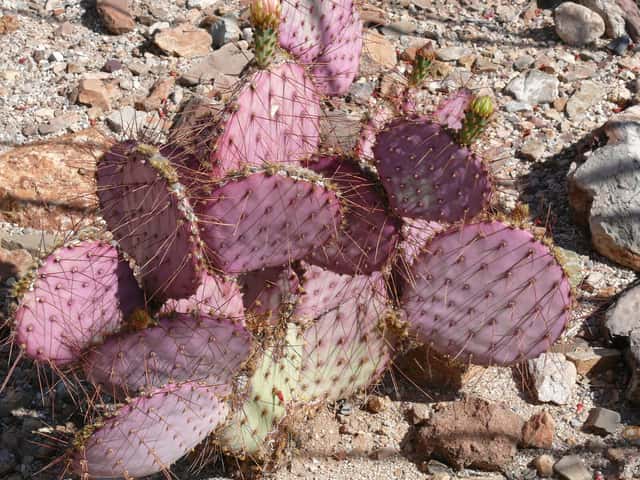
Opuntia gosseliniana is a shrubby prickly pear cactus native to the Sonoran Desert, from southern Arizona (Pima County) to Sonora, Chihuahua and Baja California, where it grows in desert scrub and grasslands at 700-1,600 m. Its rounded, flat pads are bluish-green and turn violet to deep purple in cold or dry weather. Long white to brownish spines appear mostly toward the pad edges, and with age it forms a short trunk. Bright yellow flowers open in spring (April-May), followed by purplish, spineless fruits. It usually reaches about 1-1.2 m tall and wide.
How to Propagate Violet Prickly Pear?
Pad cutting
Handle pads with tongs or folded newspaper: the tiny glochids lodge easily in skin. Never plant a pad before it has callused, or it may rot.
- 1 Wearing thick gloves, cut or twist off a healthy mature pad at the joint
- 2 Leave the pad in a dry, shaded spot for several days to a week until the cut end calluses
- 3 Plant the callused end upright about one third deep in dry cactus mix
- 4 Keep in bright, filtered light without watering for 4-6 weeks
- 5 Once rooted, start watering sparingly and move gradually to full sun
Materials needed:
Seed
Seed is slow and plants may vary from the parent because Opuntia hybridizes freely; pads are the faster way to get a true violet plant.
- 1 Clean seeds from ripe fruit and let them dry
- 2 Sow on the surface of moist, sterile cactus mix
- 3 Keep warm and bright, misting lightly to keep the surface barely moist
- 4 Transplant seedlings once they are large enough to handle
Materials needed:
How Big Does Violet Prickly Pear Grow?
TLDR: Violet Prickly Pear can reach up to 1.2m tall with Medium growth rate.
Max height
1.2m
Spread
1.5m
Growth rate
Medium
Foliage
Evergreen
Plant Uses
Ornamental
Great for decoration
Edible
Can be consumed
Culinary Uses
- The purplish, spineless fruits (25-45 mm) are edible
- Young pads can be cooked as nopales, like other Opuntia species
Is your plant showing symptoms?
Click on the symptom to discover possible causes:
What Diseases Commonly Affect Violet Prickly Pear?
TLDR: Violet Prickly Pear is susceptible to 5 known diseases. Monitor regularly for early detection.
Root Rot
Root rot is a serious fungal disease that affects the root system of plants, causing them to decay and die. It is primarily caused by overwatering, poor drainage, or soil-borne fungi such as Pythium, Phytophthora, Rhizoctonia, and Fusarium. The disease thrives in waterlogged conditions where roots are deprived of oxygen, making them susceptible to fungal infection.
Scale Insects
Scale insects are small sap-sucking pests that appear as brown, shell-like bumps on plant stems and leaves. There are over 25 species, divided into armored (hard) and unarmored (soft) scales. They feed by piercing plant tissue and extracting sap, which weakens the plant and can lead to yellowing, stunted growth, and even death if left untreated. They also excrete honeydew, which attracts ants and promotes sooty mold growth.
Mealybugs
Mealybugs are small, soft-bodied insects covered with a white, waxy, cottony material. They are common pests of houseplants and outdoor plants in mild climates. These sap-sucking insects feed on plant tissue, causing damage, stunted growth, and can lead to plant death if left untreated. They produce sticky honeydew which attracts sooty mold.
Cold Damage
Cold damage, also known as frost injury, occurs when plants are exposed to freezing or near-freezing temperatures. This environmental stress can cause cellular damage as ice crystals form within plant tissues, rupturing cells and disrupting normal plant functions. Chilling injury can also occur in sensitive species at temperatures between 32-55°F (0-10°C), even without actual freezing.
Fun Facts
The pads can shift from blue-green to deep violet with the seasons, depending on cold and drought
In Sonora it is known as duraznilla
Some botanists treat it as a variety of Opuntia violacea or Opuntia chlorotica, and it hybridizes naturally with nearby prickly pears
It eventually forms a short trunk draped with long spines
Frequently asked questions
How often should I water a violet prickly pear?
Why are the pads purple?
How cold can Opuntia gosseliniana tolerate?
Is violet prickly pear dangerous to touch?
Can I keep it small?
Compare with similar plants
| Attribute | Difficulty | Light | Watering | Pet Safe |
|---|---|---|---|---|
| Field Maple | Easy | Bright indirect | 14d | ✓ |
| Iberian Houseleek | Easy | Direct sun | 14d | ✓ |
| Silver Birch | Easy | Direct sun | 14d | ✓ |
| Common Blanketflower | Easy | Direct sun | 10d | ✓ |
Choose & Compare
Sources & References
- Arizona-Sonora Desert Museum - Plant Care Information: Violet Prickly Pear (Opuntia gosseliniana)
- Desert-Tropicals - Violet Prickly Pear (Opuntia gosseliniana)
- The American Southwest - Opuntia gosseliniana, violet prickly pear
- Useful Temperate Plants - Opuntia gosseliniana
- Roger's Gardens - Violet Prickly Pear Cactus
- GBIF - Opuntia gosseliniana F.A.C.Weber (accepted)