Lamiaceae
Wall Germander (Teucrium chamaedrys)
Teucrium chamaedrys
Easy and tough. Full sun, sandy, sharply drained soil and little water. It cannot stand wet ground. Cut back after flowering to keep it compact.
Every 10 days
Direct sun
° - °C
% - %
Categories
What is Wall Germander?
Wall Germander (Teucrium chamaedrys) is a easy-care plant from the Lamiaceae family. Wall germander (Teucrium chamaedrys) is an evergreen perennial subshrub in the mint family (Lamiaceae), native to the Mediterranean regions of Europe and North Africa and the Middle East as far as Iran. It forms low mounds 15-45 cm tall with small, shiny, scalloped leaves that look like tiny oak lea...
Wall Germander grows up to 45cm, spread of 60cm, watering every 10 days. It is not suitable for indoor environments and safe for pets.
Unlike many tropical plants, Wall Germander tolerates watering mistakes. Best for beginners. Unlike many popular species, Wall Germander is safe to keep around pets.
How to Care for Wall Germander?
TLDR: Wall Germander needs Direct sun, watering every 10 days, and temperatures between 15-30°C with 40-70% humidity.
How Often Should You Water Wall Germander?
Water only when the soil has dried out well. Once established it handles drought; soil that stays wet is what harms it most.
How Much Light Does Wall Germander Need?
Full sun, 6 or more hours of direct sun a day.
What Is the Best Soil for Wall Germander?
Sandy or gravelly soil with excellent drainage; poor soil is fine, neutral to alkaline pH.
What Pot Should You Use for Wall Germander?
A wide, shallow terracotta pot with drainage holes; it does best planted in a sunny bed.
What Is Wall Germander and Where Does It Come From?
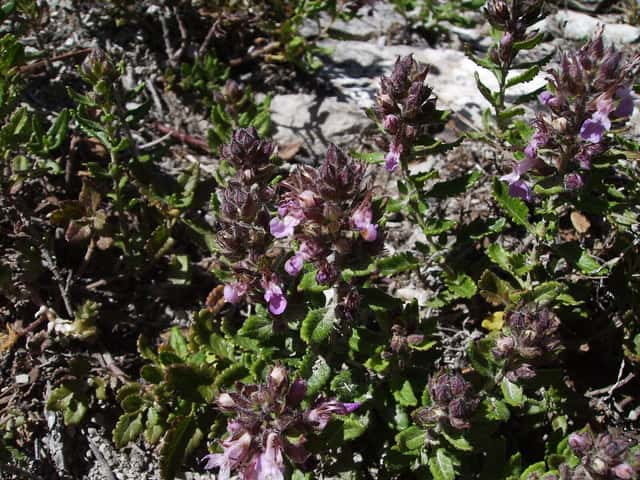
Wall germander (Teucrium chamaedrys) is an evergreen perennial subshrub in the mint family (Lamiaceae), native to the Mediterranean regions of Europe and North Africa and the Middle East as far as Iran. It forms low mounds 15-45 cm tall with small, shiny, scalloped leaves that look like tiny oak leaves and are aromatic when crushed. From late spring into summer it carries whorls of tubular pinkish-purple flowers that bees love. It spreads by rhizomes and is used for edging, rock gardens, knot gardens and low clipped hedges.
How to Propagate Wall Germander?
Stem cuttings
Do not let the mix get soggy or the cuttings will rot.
- 1 Take 5-8 cm non-flowering shoot tips
- 2 Strip the leaves from the lower half
- 3 Insert into a gritty, barely moist mix
- 4 Keep bright, out of strong sun, until rooted
Materials needed:
Division
Because it spreads by rhizomes, dividing also keeps it in check.
- 1 Lift an established clump
- 2 Split off pieces with roots and rhizomes
- 3 Replant at the same depth
- 4 Water in to settle the soil
Materials needed:
Seed
Seedlings take longer to make a full mound than cuttings.
- 1 Sow on the surface of a light mix
- 2 Barely cover
- 3 Keep slightly moist and bright
Materials needed:
How Big Does Wall Germander Grow?
TLDR: Wall Germander can reach up to 45cm tall with Medium growth rate.
Max height
45cm
Spread
60cm
Foliage
Evergreen
Warning: Toxic Plant
This plant can be toxic if ingested. Keep out of reach of:
Plant Uses
Ornamental
Great for decoration
Aromatic
Pleasant fragrance
Ground Cover
Soil coverage
Is your plant showing symptoms?
Click on the symptom to discover possible causes:
What Diseases Commonly Affect Wall Germander?
TLDR: Wall Germander is susceptible to 4 known diseases. Monitor regularly for early detection.
Powdery Mildew
Powdery mildew is a common fungal disease caused by various fungi species including Erysiphe, Podosphaera, Oïdium, and Leveillula. It affects over 10,000 plant species worldwide. The disease thrives in warm, dry climates with high humidity and appears as a distinctive white powdery coating on plant surfaces.
Leaf Spot
Leaf spot is a common fungal disease caused by various pathogens including Alternaria, Ascochyta, Colletotrichum, Septoria, and Venturia. It primarily affects leaves, causing discolored spots that can lead to premature leaf drop if left untreated.
Spider Mites
Spider mites are tiny arachnids (less than 1/20 inch long) related to spiders and ticks that feed on plant sap. They thrive in hot, dry conditions and can cause significant damage to ornamental and vegetable plants. During severe infestations, crop losses can reach 14% or higher as these pests disrupt vital plant processes including photosynthesis, carbon dioxide absorption, and transpiration.
Rust
Rust is a common fungal disease caused by fungi in the order Pucciniales that affects a wide variety of plants. The disease gets its name from the characteristic orange, yellow, or reddish-brown pustules that appear on leaves, resembling metal rust. This obligate fungal parasite requires living plants to survive and can cause significant economic losses in agricultural crops.
Fun Facts
The name chamaedrys comes from Greek for 'ground oak', after its oak-like leaves.
It was a classic plant for European knot gardens, the patterned beds edged with low hedges.
Its dried leaves are used in potpourri.
Frequently asked questions
Can wall germander be used as a herbal tea?
How often should I water wall germander?
Does it need pruning?
Does it get pests or diseases?
Compare with similar plants
| Attribute | Difficulty | Light | Watering | Pet Safe |
|---|---|---|---|---|
| Field Maple | Easy | Bright indirect | 14d | ✓ |
| Iberian Houseleek | Easy | Direct sun | 14d | ✓ |
| Silver Birch | Easy | Direct sun | 14d | ✓ |
| Common Blanketflower | Easy | Direct sun | 10d | ✓ |
Choose & Compare
Sources & References
- NC State Extension Gardener Plant Toolbox - Teucrium chamaedrys
- Wikipedia (en) - Teucrium chamaedrys
- Wikipedia (es) - Teucrium chamaedrys
- Larrey et al. 1992 - Hepatitis after germander (Teucrium chamaedrys) administration (Ann Intern Med)
- PMC review - Teucrium chamaedrys supplements banned for furan neo-clerodane hepatotoxicity





