Oleaceae
Weeping Forsythia (Forsythia suspensa)
Forsythia suspensa
A very easy shrub for full sun. Water young plants until established, then only in long droughts. Prune right after flowering by removing a few of the oldest stems at the base, never by shearing.
Every 10 days
Bright indirect
-26° - 35°C
30% - 70%
Categories
What is Weeping Forsythia?
Weeping Forsythia (Forsythia suspensa) is a easy-care plant from the Oleaceae family. Weeping forsythia (Forsythia suspensa) is a deciduous shrub in the olive family, native to China. It grows up to 3 m tall and as wide, with long, arching, hollow stems that bend to the ground and often root where they touch it. In early spring, before the leaves appear, the bare stems are covered in...
Weeping Forsythia grows up to 3.0m, spread of 300cm, watering every 10 days, -26°C – 35°C, 30–70% humidity. It is not suitable for indoor environments and safe for pets.
Unlike many tropical plants, Weeping Forsythia tolerates watering mistakes. Best for beginners. Unlike many popular species, Weeping Forsythia is safe to keep around pets.
How to Care for Weeping Forsythia?
TLDR: Weeping Forsythia needs Bright indirect, watering every 10 days, and temperatures between -26-35°C with 30-70% humidity.
How Often Should You Water Weeping Forsythia?
Water newly planted shrubs weekly in their first summer. Established plants tolerate dry spells and need watering only in prolonged drought.
How Much Light Does Weeping Forsythia Need?
Full sun gives the most flowers; it grows in partial shade but blooms less.
What Is the Best Soil for Weeping Forsythia?
Any well-drained soil, from slightly acidic to alkaline. It avoids only waterlogged ground.
What Pot Should You Use for Weeping Forsythia?
Best in the ground. A dwarf form can grow in a large container (at least 50 cm wide) with drainage holes, placed in full sun.
What Is Weeping Forsythia and Where Does It Come From?
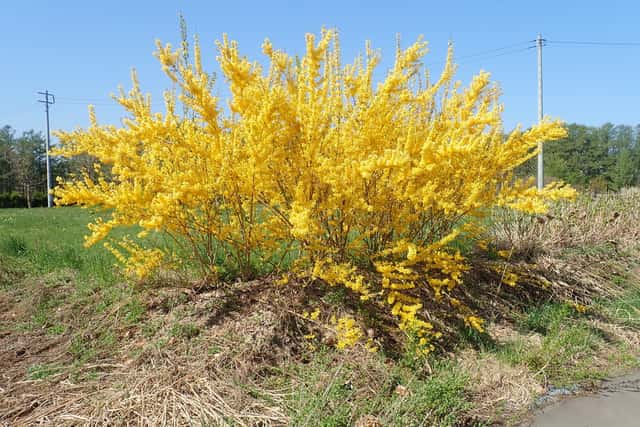
Weeping forsythia (Forsythia suspensa) is a deciduous shrub in the olive family, native to China. It grows up to 3 m tall and as wide, with long, arching, hollow stems that bend to the ground and often root where they touch it. In early spring, before the leaves appear, the bare stems are covered in golden-yellow, four-petalled flowers up to 3 cm across, on longer stalks than other forsythias. The leaves are oval, toothed and sometimes divided into three. It is very tough, and its dried fruit, lian qiao, is a classic herb of traditional Chinese medicine.
How to Propagate Weeping Forsythia?
Layering
The arching stems often root on their own where they touch the soil, so you can simply dig up those rooted tips.
- 1 Bend a long, flexible stem down to the ground
- 2 Scratch the bark lightly where it touches the soil
- 3 Pin it down and cover that part with soil
- 4 Cut it from the parent once it has rooted, usually by autumn
Materials needed:
Softwood cuttings
Hardwood cuttings 20 cm long taken in winter and set outdoors in the ground also root well.
- 1 Take 10-15 cm cuttings from new growth
- 2 Remove the lower leaves
- 3 Dip the base in rooting hormone
- 4 Insert into moist, gritty compost
- 5 Keep in bright shade and humid until rooted
Materials needed:
How Big Does Weeping Forsythia Grow?
TLDR: Weeping Forsythia can reach up to 3.0m tall with Fast growth rate.
Max height
3.0m
Spread
3.0m
Growth rate
Fast
Foliage
Deciduous
Plant Uses
Ornamental
Great for decoration
Medicinal
Medicinal properties
Medicinal Uses
- The dried fruit (lian qiao) is used in traditional Chinese medicine for colds, fever and sore throat
Is your plant showing symptoms?
Click on the symptom to discover possible causes:
What Diseases Commonly Affect Weeping Forsythia?
TLDR: Weeping Forsythia is susceptible to 3 known diseases. Monitor regularly for early detection.
Phytophthora Root Rot
Disease caused by fungus-like organisms (oomycetes) that live in soil and can survive for years. It affects roots, stem, and crown of plants, being especially severe in waterlogged or poorly drained soils. It is the second most common cause of root rot in trees and shrubs.
Leaf Spot
Leaf spot is a common fungal disease caused by various pathogens including Alternaria, Ascochyta, Colletotrichum, Septoria, and Venturia. It primarily affects leaves, causing discolored spots that can lead to premature leaf drop if left untreated.
Crown Gall
Crown gall is a bacterial disease caused by Agrobacterium tumefaciens that affects over 140 species of plants. The bacteria insert DNA into plant cells, causing them to divide uncontrollably and form large tumor-like growths (galls) primarily on roots, stems, and at the soil line. These galls restrict water and nutrient flow, severely impacting plant health and potentially killing the plant.
Meaning & Symbolism
A sign of anticipation and of spring arriving, as it is one of the first shrubs to flower.
Fun Facts
Its stems are hollow except at the nodes.
The arching stems take root wherever they touch the ground.
Its fruit is one of the 50 fundamental herbs of traditional Chinese medicine.
It was once thought to be a parent of the common garden forsythia.
Frequently asked questions
When should I prune weeping forsythia?
Is forsythia poisonous to pets?
Why is my forsythia not flowering?
How is weeping forsythia different from common forsythia?
Compare with similar plants
| Attribute | Difficulty | Light | Watering | Pet Safe |
|---|---|---|---|---|
| Field Maple | Easy | Bright indirect | 14d | ✓ |
| Iberian Houseleek | Easy | Direct sun | 14d | ✓ |
| Silver Birch | Easy | Direct sun | 14d | ✓ |
| Common Blanketflower | Easy | Direct sun | 10d | ✓ |





