Anacardiaceae
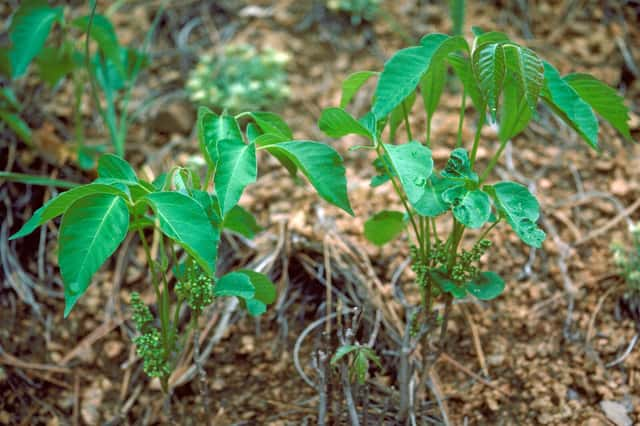
Western Poison Ivy (Toxicodendron rydbergii)
Toxicodendron rydbergii
This is a plant to avoid, not to care for. It grows on its own along trails, streams, fields and woods. If it turns up near your home, remove it wearing gloves, long pants and long sleeves, or get help. Never burn it.
Every 14 days
Partial shade
° - °C
% - %
Categories
What is Western poison ivy?
Western poison ivy (Toxicodendron rydbergii) is a easy-care plant from the Anacardiaceae family. Western poison ivy is a low North American shrub and a close relative of eastern poison ivy. Unlike its cousin it grows upright from a woody stem and doesn't climb trees. It is usually 30 to 60 cm tall, sometimes 1 m, and it spreads underground into large patches. Each leaf has three leaflets: the t...
Western poison ivy grows up to 3.0m, watering every 14 days. It is not suitable for indoor environments and safe for pets.
Unlike many tropical plants, Western poison ivy tolerates watering mistakes. Best for beginners. Unlike many popular species, Western poison ivy is safe to keep around pets.
How to Care for Western poison ivy?
TLDR: Western poison ivy needs Partial shade, watering every 14 days, and temperatures between 15-30°C with 40-70% humidity.
How Often Should You Water Western poison ivy?
No watering needed. It lives on rain alone, in dry or moist spots.
How Much Light Does Western poison ivy Need?
It grows from sun to shade and is often thickest in moderate shade.
What Is the Best Soil for Western poison ivy?
It takes any soil, from sand to clay, which is why it turns up in so many places.
What Pot Should You Use for Western poison ivy?
Do not grow it in a pot. Touching any part of the plant can cause a skin reaction.
What Is Western poison ivy and Where Does It Come From?
Western poison ivy is a low North American shrub and a close relative of eastern poison ivy. Unlike its cousin it grows upright from a woody stem and doesn't climb trees. It is usually 30 to 60 cm tall, sometimes 1 m, and it spreads underground into large patches. Each leaf has three leaflets: the two side ones are lopsided and the middle one is even. They turn yellow or orange in fall. Small yellowish-white flowers open from late spring into summer, followed by round, yellowish berries. Every part contains urushiol, an oil that gives most people an itchy, blistering rash.
How Big Does Western poison ivy Grow?
TLDR: Western poison ivy can reach up to 3.0m tall with Fast growth rate.
Max height
3.0m
Growth rate
Fast
Foliage
Deciduous
Warning: Toxic Plant
This plant can be toxic if ingested. Keep out of reach of:
Is your plant showing symptoms?
Click on the symptom to discover possible causes:
Fun Facts
Birds and other animals eat the berries with no trouble and spread the seeds.
Goats happily eat it with no ill effects.
In one study, seeds that had passed through a grouse germinated at 86%.
Frequently asked questions
I touched it. What should I do?
Can dogs and cats get poison ivy rash?
How do I get rid of it in my yard?
Is it still dangerous in winter with no leaves?
Compare with similar plants
| Attribute | Difficulty | Light | Watering | Pet Safe |
|---|---|---|---|---|
| Field Maple | Easy | Bright indirect | 14d | ✓ |
| Iberian Houseleek | Easy | Direct sun | 14d | ✓ |
| Silver Birch | Easy | Direct sun | 14d | ✓ |
| Common Blanketflower | Easy | Direct sun | 10d | ✓ |
Choose & Compare
Sources & References
- Wikipedia - Toxicodendron rydbergii
- USDA Forest Service FEIS - Toxicodendron radicans, T. rydbergii
- Lady Bird Johnson Wildflower Center - Toxicodendron rydbergii
- Minnesota Wildflowers - Western Poison Ivy
- WSU Whitman County Extension - Western Poison Ivy
- UGA Extension - Poison ivy (pets carrying urushiol, search snippet)
- Zoetis Petcare - Dogs and poison ivy (search snippet)
- Cutis - Botanical Briefs: western poison ivy (search snippet)





