Crassulaceae
White Cloud Plant (Echeveria cante): care guide
Echeveria cante
Give it as much sun as you can, with shelter at the hottest hours of summer, and a free-draining mix. Water when dry and keep water off the leaves, as it slowly wears away the powder that gives the plant its color. Protect from frost.
Every 10 days
Direct sun
1° - °C
% - %
Categories
What is White Cloud Plant?
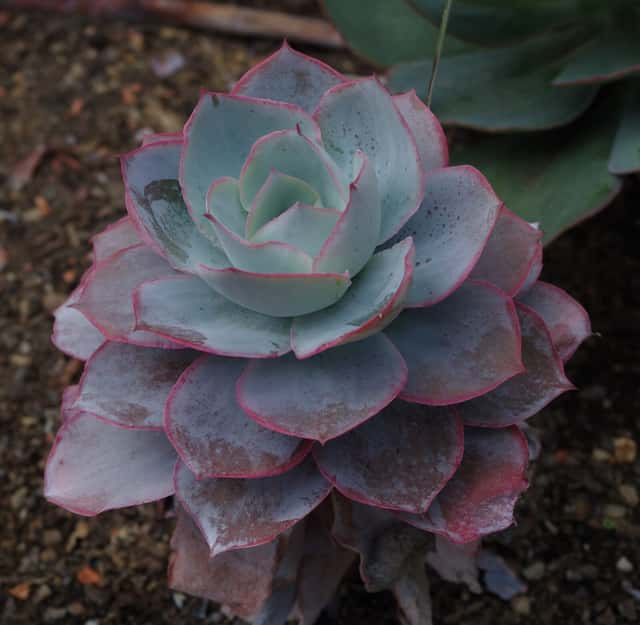
White Cloud Plant (Echeveria cante) is a medium-care plant from the Crassulaceae family. Echeveria cante is a succulent from northwestern Zacatecas, Mexico, with large rosettes of matte leaves running from silver-blue to pink, coated in a pale powder. Rosettes reach 30 to 40 cm across and the plant slowly forms a short trunk. In summer a long stalk carries orange to pink flowers. It hol...
White Cloud Plant grows up to 50cm, spread of 40cm, watering every 10 days. It is suitable for indoor environments and safe for pets.
Unlike many popular species, White Cloud Plant is safe to keep around pets. Without adequate drainage, root rot can develop within 20 days.
How to Care for White Cloud Plant?
TLDR: White Cloud Plant needs Direct sun, watering every 10 days, and temperatures between 1-30°C with 40-70% humidity.
How Often Should You Water White Cloud Plant?
It wants a little more water than other echeverias. When the mix dries, water deeply at the soil, keeping the leaves dry. Do not stop in winter: water every 1 to 2 weeks. If it dries too much, the outer leaves shrivel.
How Much Light Does White Cloud Plant Need?
Full sun. At the peak of summer, avoid direct midday sun. Indoors, keep it at the brightest window.
What Is the Best Soil for White Cloud Plant?
A free-draining succulent mix. A little leaf mold, peat or vermiculite helps it hold moisture.
What Pot Should You Use for White Cloud Plant?
Choose a pot much larger than seems necessary, with drainage: a 12 cm pot for a 7 cm rosette, an 18 cm pot for a 12 cm rosette.
What Is White Cloud Plant and Where Does It Come From?
Echeveria cante is a succulent from northwestern Zacatecas, Mexico, with large rosettes of matte leaves running from silver-blue to pink, coated in a pale powder. Rosettes reach 30 to 40 cm across and the plant slowly forms a short trunk. In summer a long stalk carries orange to pink flowers. It holds the Royal Horticultural Society Award of Garden Merit.
How to Propagate White Cloud Plant?
Offsets
Avoid touching the leaves so the powder stays in place.
- 1 Gently separate an offset from the parent
- 2 Let the cut dry for a few days
- 3 Set it on dry succulent mix
- 4 Start watering when roots appear
Materials needed:
Seed
Growing from seed takes a long time.
- 1 Scatter seeds on fine, moist mix
- 2 Do not cover
- 3 Keep bright and humid
- 4 Pot on when seedlings are firm
Materials needed:
How Big Does White Cloud Plant Grow?
TLDR: White Cloud Plant can reach up to 50cm tall with Medium growth rate.
Max height
50cm
Spread
40cm
Foliage
Evergreen
Plant Uses
Ornamental
Great for decoration
Is your plant showing symptoms?
Click on the symptom to discover possible causes:
What Diseases Commonly Affect White Cloud Plant?
TLDR: White Cloud Plant is susceptible to 4 known diseases. Monitor regularly for early detection.
Mealybugs
Mealybugs are small, soft-bodied insects covered with a white, waxy, cottony material. They are common pests of houseplants and outdoor plants in mild climates. These sap-sucking insects feed on plant tissue, causing damage, stunted growth, and can lead to plant death if left untreated. They produce sticky honeydew which attracts sooty mold.
Aphids
Aphids are small, soft-bodied, pear-shaped insects (1/16 to 1/8 inch long) that feed by sucking nutrient-rich sap from plants. They reproduce rapidly and can quickly weaken plants, causing distorted growth and transmitting plant viruses. Aphids come in various colors including green, black, red, yellow, brown, and gray. They secrete honeydew, a sticky substance that attracts ants and encourages sooty mold growth.
Curculionidae
Curculionidae (weevils) are small beetles that feed on plants. Adults chew leaf margins, leaving crescent-shaped notches, primarily at night. The larvae live in the substrate and consume roots, causing decline, yellowing, and wilting even when the substrate is moist, and in severe cases, plant death. They frequently affect ornamentals and garden plants such as strawberries, citrus, roses, hydrangeas, azaleas, blueberries, begonias, and many potted plants.
Root Rot
Root rot is a serious fungal disease that affects the root system of plants, causing them to decay and die. It is primarily caused by overwatering, poor drainage, or soil-borne fungi such as Pythium, Phytophthora, Rhizoctonia, and Fusarium. The disease thrives in waterlogged conditions where roots are deprived of oxygen, making them susceptible to fungal infection.
Fun Facts
Cante comes from the Chichimeca language and means life-giving water
In the wild it grows between huge limestone rocks on very exposed slopes
The rosette tends to grow to match the size of the pot
Frequently asked questions
Why are the outer leaves of my Echeveria cante drying out?
Can I wet the leaves?
What pests attack Echeveria cante?
Is it toxic to cats and dogs?
Compare with similar plants
| Attribute | Difficulty | Light | Watering | Pet Safe |
|---|---|---|---|---|
| Dark Fieldcap | Medium | Low light | 2d | ⚠️ |
| Azalea | Medium | Partial shade | 3d | ⚠️ |
| Muriel's Bamboo | Medium | Partial shade | 3d | ✓ |
| Iberian Houseleek | Easy | Direct sun | 14d | ✓ |




