Malvaceae
Wild Chestnut (Pachira insignis)
Pachira insignis
A fast-growing tropical tree for large spaces and warm climates. It likes sun or part shade and fertile, moist soil; in the wild it grows on banks that flood. It handles only brief cold snaps near 0 °C. Grown from seed, it shoots up quickly and gives good shade.
Every 3 days
Bright indirect
0° - °C
% - %
Categories
What is Wild chestnut?
Wild chestnut (Pachira insignis) is a easy-care plant from the Malvaceae family. Pachira insignis is a tree from the Amazon, the Guianas and the West Indies, related to the Malabar chestnut (Pachira aquatica) and the baobab. It has a dense, rounded crown and usually reaches 10-18 m, sometimes over 25 m in the forest. The leaves are palmate, with 5 to 9 leaflets. Its flowers are...
Wild chestnut grows up to 30.0m, watering every 3 days. It is not suitable for indoor environments and safe for pets.
Unlike many tropical plants, Wild chestnut tolerates watering mistakes. Best for beginners. Unlike many popular species, Wild chestnut is safe to keep around pets.
How to Care for Wild chestnut?
TLDR: Wild chestnut needs Bright indirect, watering every 3 days, and temperatures between 0-30°C with 40-70% humidity.
How Often Should You Water Wild chestnut?
Keep the soil moist, especially for seedlings and young trees: water every 3 days in dry weather. It copes with temporary flooding better than with drought.
How Much Light Does Wild chestnut Need?
Full sun or part shade. Young plants do well with some shade.
What Is the Best Soil for Wild chestnut?
Deep, fertile soil rich in organic matter that holds moisture. It accepts low, damp ground.
What Pot Should You Use for Wild chestnut?
Only suited to a pot as a seedling. Use a deep pot with a drainage hole and plant it out early, because it becomes a big tree.
What Is Wild chestnut and Where Does It Come From?
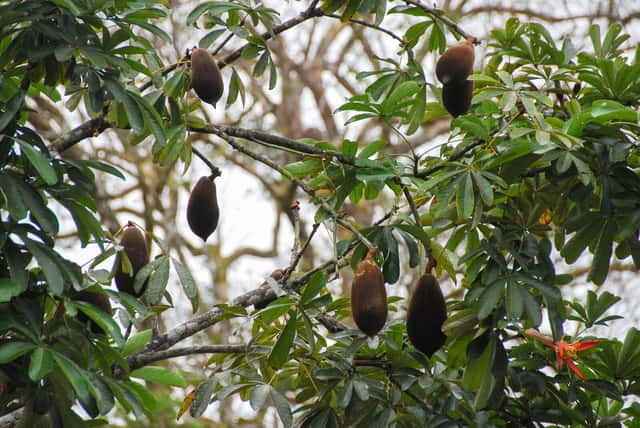
Pachira insignis is a tree from the Amazon, the Guianas and the West Indies, related to the Malabar chestnut (Pachira aquatica) and the baobab. It has a dense, rounded crown and usually reaches 10-18 m, sometimes over 25 m in the forest. The leaves are palmate, with 5 to 9 leaflets. Its flowers are among the largest of any tree: reddish petals up to 34 cm long curl back to show hundreds of long stamens, purple at the base and white at the tip. The fruit is a large brown capsule 14-36 cm long, with seeds eaten raw or roasted. It flowers and fruits through the year.
How to Propagate Wild chestnut?
Seed
The seed loses viability fast, so sow right after harvest. Seedlings grow quickly.
- 1 Use fresh seed as soon as the pod opens
- 2 Sow one seed per bag or pot in moist mix
- 3 Keep in part shade and moist
- 4 Move to its final spot once the seedling is sturdy
Materials needed:
Air layering
Keep the moss moist the whole time. Cuttings also work.
- 1 Pick a healthy branch about 2 cm thick
- 2 Remove a 2-3 cm ring of bark
- 3 Wrap with moist moss and cover with plastic
- 4 When roots show, cut below them and pot up
Materials needed:
How Big Does Wild chestnut Grow?
TLDR: Wild chestnut can reach up to 30.0m tall with Fast growth rate.
Max height
30.0m
Growth rate
Fast
Foliage
Evergreen
Plant Uses
Ornamental
Great for decoration
Edible
Can be consumed
Culinary Uses
- Seeds eaten raw, boiled or roasted
- Young leaves and flowers eaten cooked
Is your plant showing symptoms?
Click on the symptom to discover possible causes:
What Diseases Commonly Affect Wild chestnut?
TLDR: Wild chestnut is susceptible to 3 known diseases. Monitor regularly for early detection.
Scale Insects
Scale insects are small sap-sucking pests that appear as brown, shell-like bumps on plant stems and leaves. There are over 25 species, divided into armored (hard) and unarmored (soft) scales. They feed by piercing plant tissue and extracting sap, which weakens the plant and can lead to yellowing, stunted growth, and even death if left untreated. They also excrete honeydew, which attracts ants and promotes sooty mold growth.
Powdery Mildew
Powdery mildew is a common fungal disease caused by various fungi species including Erysiphe, Podosphaera, Oïdium, and Leveillula. It affects over 10,000 plant species worldwide. The disease thrives in warm, dry climates with high humidity and appears as a distinctive white powdery coating on plant surfaces.
Phytophthora Root Rot
The Phytophthora genus consists of soil-borne oomycetes (water molds) that act as plant pathogens, primarily affecting trees and woody plants. It typically spreads through the root system, leading to systemic decline and eventual plant collapse.
Fun Facts
Its flowers are among the largest borne by any tree.
Each flower has 450 to 700 stamens.
The seed sprouts in just 10 to 15 days.
Frequently asked questions
How is it different from Pachira aquatica?
Are the seeds edible?
Can I grow it indoors?
Is it cold hardy?
Compare with similar plants
| Attribute | Difficulty | Light | Watering | Pet Safe |
|---|---|---|---|---|
| Field Maple | Easy | Bright indirect | 14d | ✓ |
| Iberian Houseleek | Easy | Direct sun | 14d | ✓ |
| Silver Birch | Easy | Direct sun | 14d | ✓ |
| Common Blanketflower | Easy | Direct sun | 10d | ✓ |





