Liliaceae
Wild Tulip (Tulipa sylvestris)
Tulipa sylvestris
Plant in autumn in full sun and well-drained soil. Water moderately while it grows in spring and let the leaves die back on their own after flowering. Very hardy (down to about -20 °C) and low maintenance.
Every 7 days
Bright indirect
-20° - °C
% - %
Categories
What is Wild tulip?
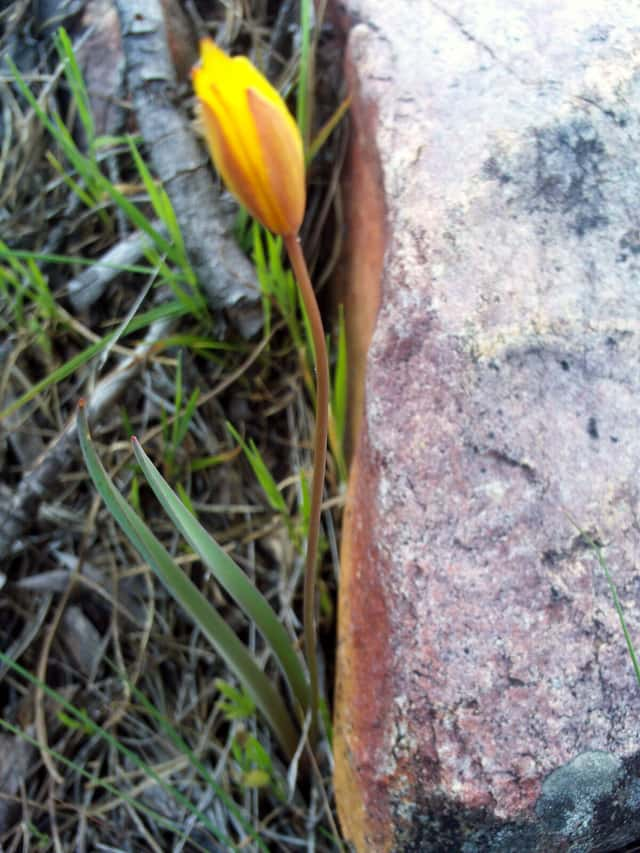
Wild tulip (Tulipa sylvestris) is a easy-care plant from the Liliaceae family. Tulipa sylvestris, the wild tulip, is a bulbous perennial in the lily family (Liliaceae) native to southern Europe and North Africa east to Central Asia. It has narrow blue-grey leaves and stems 10 to 50 cm tall carrying one or two pointed, lemon-scented yellow flowers, often tinged red on the outsi...
Wild tulip grows up to 50cm, spread of 15cm, watering every 7 days. It is not suitable for indoor environments and not safe for pets.
Unlike many tropical plants, Wild tulip tolerates watering mistakes. Best for beginners. Without precautions, ingestion can cause irritation in pets. Keep out of reach of cats and dogs.
How to Care for Wild tulip?
TLDR: Wild tulip needs Bright indirect, watering every 7 days, and temperatures between -20-30°C with 40-70% humidity.
How Often Should You Water Wild tulip?
Keep the soil slightly moist from autumn to spring, watering about once a week if there is no rain. Once the foliage yellows after flowering, cut back on water: soggy soil rots the bulbs.
How Much Light Does Wild tulip Need?
Full sun, ideally a south- or west-facing spot. It tolerates dappled shade but barely flowers in deep shade.
What Is the Best Soil for Wild tulip?
Fertile, well-drained chalk, loam or sandy soil; acid, neutral or alkaline pH is fine. Avoid heavy, waterlogged clay.
What Pot Should You Use for Wild tulip?
A deep pot with drainage holes and gritty compost, though it does best planted in borders or sparse grass.
What Is Wild tulip and Where Does It Come From?
Tulipa sylvestris, the wild tulip, is a bulbous perennial in the lily family (Liliaceae) native to southern Europe and North Africa east to Central Asia. It has narrow blue-grey leaves and stems 10 to 50 cm tall carrying one or two pointed, lemon-scented yellow flowers, often tinged red on the outside. It blooms in April and May, grows in dry grassland and woodland copses, and spreads by underground stolons, slowly forming colonies.
How to Propagate Wild tulip?
Separating offsets
Do not cut green leaves: they feed the bulb for next year. Small offsets may take one or two seasons to flower.
- 1 Wait until the foliage has completely died back after flowering
- 2 Carefully lift the clump
- 3 Separate the offsets and the bulbs formed at the tips of the stolons
- 4 Replant them in autumn 10-15 cm deep and about 10 cm apart
Materials needed:
How Big Does Wild tulip Grow?
TLDR: Wild tulip can reach up to 50cm tall with Medium growth rate.
Max height
50cm
Spread
15cm
Growth rate
Medium
Foliage
Deciduous
Warning: Toxic Plant
This plant can be toxic if ingested. Keep out of reach of:
Plant Uses
Ornamental
Great for decoration
Is your plant showing symptoms?
Click on the symptom to discover possible causes:
What Diseases Commonly Affect Wild tulip?
TLDR: Wild tulip is susceptible to 6 known diseases. Monitor regularly for early detection.
Gray Mold (Botrytis Blight)
Gray mold, caused by the fungus Botrytis cinerea, is one of the most common fungal diseases in plants. It affects over 200 plant species, including ornamentals, vegetables, fruits, and houseplants. The disease thrives in cool, humid conditions with poor air circulation, causing grayish spots and soft rot on infected tissues.
Root Rot
Root rot is a serious fungal disease that affects the root system of plants, causing them to decay and die. It is primarily caused by overwatering, poor drainage, or soil-borne fungi such as Pythium, Phytophthora, Rhizoctonia, and Fusarium. The disease thrives in waterlogged conditions where roots are deprived of oxygen, making them susceptible to fungal infection.
Aphids
Aphids are small, soft-bodied, pear-shaped insects (1/16 to 1/8 inch long) that feed by sucking nutrient-rich sap from plants. They reproduce rapidly and can quickly weaken plants, causing distorted growth and transmitting plant viruses. Aphids come in various colors including green, black, red, yellow, brown, and gray. They secrete honeydew, a sticky substance that attracts ants and encourages sooty mold growth.
Slugs and Snails
Slugs and snails are mollusks that feed on plant tissue, causing irregular holes in leaves and damage to young seedlings. They are most active at night and in moist conditions, leaving characteristic silvery slime trails. These pests can quickly devastate gardens, especially during wet seasons.
Fun Facts
Its yellow flowers smell of lemon, unusual among tulips.
It was brought into gardens in the 16th century and went wild across central and northern Europe.
It almost never sets seed and spreads mainly by underground stolons.
Frequently asked questions
When should I plant wild tulip bulbs?
Is the wild tulip toxic?
Why is my wild tulip not flowering?
Does the wild tulip spread on its own?
Compare with similar plants
| Attribute | Difficulty | Light | Watering | Pet Safe |
|---|---|---|---|---|
| Field Maple | Easy | Bright indirect | 14d | ✓ |
| Iberian Houseleek | Easy | Direct sun | 14d | ✓ |
| Silver Birch | Easy | Direct sun | 14d | ✓ |
| Common Blanketflower | Easy | Direct sun | 10d | ✓ |
Choose & Compare
Sources & References
- RHS - Tulipa sylvestris
- Wikipedia - Tulipa sylvestris
- Natural Bulbs - Tulipa sylvestris (wild tulip)
- BBC Gardeners' World - Tulipa sylvestris
- Flora de Pina de Ebro - Tulipa sylvestris (tulipán silvestre)
- Tracing the introduction history of the tulip that went wild (Tulipa sylvestris)
- Connecticut Plant Pest Handbook - Tulip





