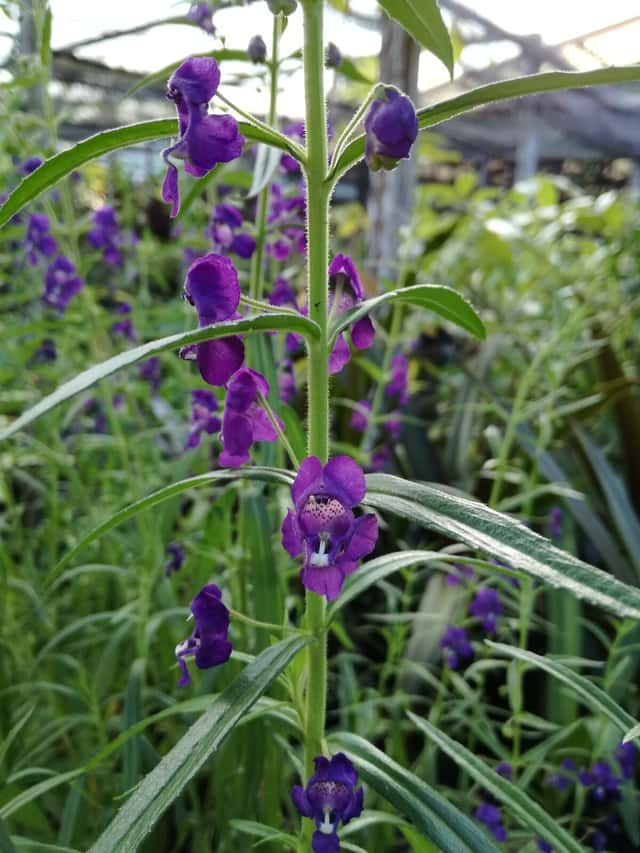
Plantaginaceae
Willowleaf Angelonia (Angelonia salicariifolia)
Angelonia salicariifolia
An easy plant for sun and heat. Give it full sun, well-drained soil and regular water without waterlogging. It survives only brief, light frosts.
Every 4 days
Direct sun
-1° - °C
% - %
Categories
What is Willowleaf Angelonia?
Willowleaf Angelonia (Angelonia salicariifolia) is a easy-care plant from the Plantaginaceae family. Angelonia salicariifolia is a perennial herb in the plantain family (Plantaginaceae), native to Bolivia, Brazil and northeast Argentina. Its stems and leaves carry sticky glandular hairs, and the narrow, glossy, willow-like leaves give off a faint apple scent when crushed. The two-lipped flowers loo...
Willowleaf Angelonia grows up to 1.5m, spread of 45cm, watering every 4 days. It is suitable for indoor environments and safe for pets.
Unlike many tropical plants, Willowleaf Angelonia tolerates watering mistakes. Best for beginners. Unlike many popular species, Willowleaf Angelonia is safe to keep around pets. Without adequate drainage, root rot can develop within 8 days.
How to Care for Willowleaf Angelonia?
TLDR: Willowleaf Angelonia needs Direct sun, watering every 4 days, and temperatures between -1-30°C with 40-70% humidity.
How Often Should You Water Willowleaf Angelonia?
Keep the soil lightly moist, watering every 3-5 days in hot weather. Let the surface dry slightly between waterings and never leave water standing in the saucer, as soggy roots rot.
How Much Light Does Willowleaf Angelonia Need?
Full sun gives the most flowers; it tolerates partial shade but blooms less. Indoors it needs a very bright window.
What Is the Best Soil for Willowleaf Angelonia?
Use a light, well-drained mix with some organic matter. Pots must have drainage holes.
What Pot Should You Use for Willowleaf Angelonia?
A pot at least 20 cm wide with good drainage holes; window boxes work well.
Care Schedule
Fertilize
Every 30 days
What Is Willowleaf Angelonia and Where Does It Come From?
Angelonia salicariifolia is a perennial herb in the plantain family (Plantaginaceae), native to Bolivia, Brazil and northeast Argentina. Its stems and leaves carry sticky glandular hairs, and the narrow, glossy, willow-like leaves give off a faint apple scent when crushed. The two-lipped flowers look like small snapdragons and are violet or purple with white, held on upright spikes through the warm season. Bees, butterflies and hummingbirds visit them. Plants reach about 0.6-1.5 m and are grown in beds and containers. It is a separate species from Angelonia angustifolia, the angelonia most often sold in garden centres.
How to Propagate Willowleaf Angelonia?
Stem cuttings
This is how cultivars are propagated, so the flower colour stays true.
- 1 Cut 8-10 cm tips from shoots without flowers
- 2 Strip the leaves from the lower half
- 3 Insert into a light, moist mix
- 4 Keep warm and bright, out of direct sun, until rooted
Materials needed:
Seed
Seed from cultivars may not come true to colour.
- 1 Sprinkle the fine seed over moist mix
- 2 Cover very lightly or not at all
- 3 Keep at 22-25 °C and moist
- 4 Pot on when seedlings have 2-3 pairs of leaves
Materials needed:
How Big Does Willowleaf Angelonia Grow?
TLDR: Willowleaf Angelonia can reach up to 1.5m tall with Medium growth rate.
Max height
1.5m
Spread
45cm
Plant Uses
Ornamental
Great for decoration
Aromatic
Pleasant fragrance
Is your plant showing symptoms?
Click on the symptom to discover possible causes:
What Diseases Commonly Affect Willowleaf Angelonia?
TLDR: Willowleaf Angelonia is susceptible to 5 known diseases. Monitor regularly for early detection.
Aphids
Aphids are small, soft-bodied, pear-shaped insects (1/16 to 1/8 inch long) that feed by sucking nutrient-rich sap from plants. They reproduce rapidly and can quickly weaken plants, causing distorted growth and transmitting plant viruses. Aphids come in various colors including green, black, red, yellow, brown, and gray. They secrete honeydew, a sticky substance that attracts ants and encourages sooty mold growth.
Powdery Mildew
Powdery mildew is a common fungal disease caused by various fungi species including Erysiphe, Podosphaera, Oïdium, and Leveillula. It affects over 10,000 plant species worldwide. The disease thrives in warm, dry climates with high humidity and appears as a distinctive white powdery coating on plant surfaces.
Phytophthora Root Rot
Disease caused by fungus-like organisms (oomycetes) that live in soil and can survive for years. It affects roots, stem, and crown of plants, being especially severe in waterlogged or poorly drained soils. It is the second most common cause of root rot in trees and shrubs.
Whiteflies
Whiteflies are small, soft-bodied, winged insects closely related to aphids and mealybugs. They are moth-like in appearance, about 1/16 inch long, triangular in shape, and gray-white in color. These sap-sucking pests feed on plant tissue, causing yellowing, stunted growth, and wilting. They also excrete honeydew, which attracts ants and promotes sooty mold growth. Whiteflies can transmit serious plant viruses.
Fun Facts
The genus name comes from 'angelón', the plant's common name in South America.
The leaves smell faintly of apple when crushed.
It has naturalized in India, where it grows outside gardens.
Frequently asked questions
Is Angelonia salicariifolia the same as the common angelonia?
How often should I water willowleaf angelonia?
Does it need full sun?
What pests affect angelonia?
Compare with similar plants
| Attribute | Difficulty | Light | Watering | Pet Safe |
|---|---|---|---|---|
| Field Maple | Easy | Bright indirect | 14d | ✓ |
| Iberian Houseleek | Easy | Direct sun | 14d | ✓ |
| Silver Birch | Easy | Direct sun | 14d | ✓ |
| Common Blanketflower | Easy | Direct sun | 10d | ✓ |





