Passifloraceae
Winged-stem passion flower (Passiflora alata)
Passiflora alata
A vigorous climber that wants sun, warmth, a sturdy support and fertile, moist but well-drained soil. It is not frost hardy: below 5 °C it needs shelter, so in cool climates grow it in a conservatory or large pot. Water freely in growth, sparingly in winter, and tidy-prune each spring.
Every 4 days
Bright indirect
5° - °C
% - %
Categories
What is Winged-stem passion flower?
Winged-stem passion flower (Passiflora alata) is a medium-care plant from the Passifloraceae family. Passiflora alata is a climbing vine in the Passifloraceae family, native to the Amazon from Peru to eastern Brazil. It climbs by tendrils to 6 m or more, and its stem has four thin wings, which give the species its name (alata means winged). The leaves are oval, 10 to 15 cm long. The flower is large...
Winged-stem passion flower grows up to 6.0m, watering every 4 days. It is suitable for indoor environments and safe for pets.
Unlike many popular species, Winged-stem passion flower is safe to keep around pets. Without adequate drainage, root rot can develop within 8 days.
How to Care for Winged-stem passion flower?
TLDR: Winged-stem passion flower needs Bright indirect, watering every 4 days, and temperatures between 5-30°C with 40-70% humidity.
How Often Should You Water Winged-stem passion flower?
Water freely while growing and fruiting, every 3 or 4 days in hot weather, without letting the soil get soggy. Cut watering right back in winter.
How Much Light Does Winged-stem passion flower Need?
Full sun or part shade; it flowers and fruits best with direct sun for much of the day, in a spot sheltered from wind such as a warm wall.
What Is the Best Soil for Winged-stem passion flower?
Moderately fertile, moist, well-drained soil. In containers, use a large pot of loam-based compost.
What Pot Should You Use for Winged-stem passion flower?
A large, deep pot of at least 40 litres with drainage holes and a trellis; best planted in the ground against a warm wall or pergola.
What Is Winged-stem passion flower and Where Does It Come From?
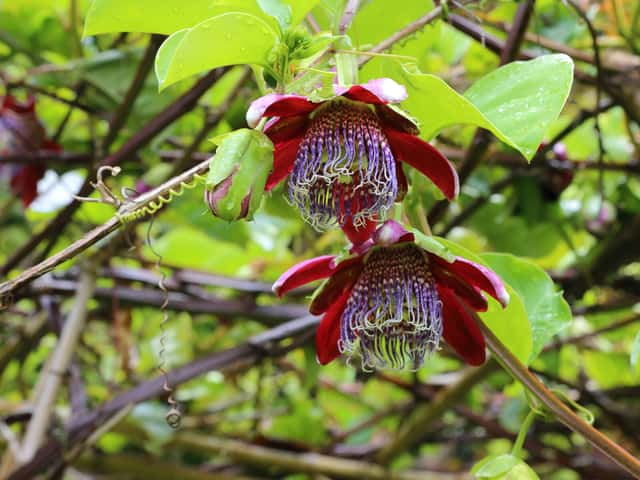
Passiflora alata is a climbing vine in the Passifloraceae family, native to the Amazon from Peru to eastern Brazil. It climbs by tendrils to 6 m or more, and its stem has four thin wings, which give the species its name (alata means winged). The leaves are oval, 10 to 15 cm long. The flower is large, 7 to 10 cm, fragrant, with bright red petals and a fringed corona banded purple and white. The egg-shaped fruit is 8 to 15 cm long, yellow to orange, with sweet pulp eaten fresh. It has been grown commercially in Brazil, where it is called maracujá-doce, since the 1970s, and its leaves have been in the Brazilian Pharmacopoeia since 1929. It holds the RHS Award of Garden Merit.
How to Propagate Winged-stem passion flower?
Seeds
Germination can be uneven; soaking the seeds in water for a day helps.
- 1 Take seeds from a fully ripe fruit and wash off the pulp
- 2 Sow 1 cm deep in moist compost
- 3 Keep at 13-18 °C or warmer in good light
- 4 Pot on when seedlings have 3 or 4 leaves
Materials needed:
Semi-hardwood cutting
Cuttings are true to the parent plant, useful for keeping good fruit quality.
- 1 Cut a 15-20 cm semi-hardwood shoot with 2 or 3 nodes
- 2 Remove the lower leaves, keeping 1 or 2 at the top
- 3 Dip the base in rooting hormone
- 4 Insert in light, moist compost in a humid spot with filtered light
Materials needed:
How Big Does Winged-stem passion flower Grow?
TLDR: Winged-stem passion flower can reach up to 6.0m tall with Medium growth rate.
Max height
6.0m
Foliage
Evergreen
Plant Uses
Ornamental
Great for decoration
Edible
Can be consumed
Medicinal
Medicinal properties
Medicinal Uses
- Leaves used in Brazilian folk medicine as a calming tea
- Listed in the Brazilian Pharmacopoeia since 1929
Culinary Uses
- Sweet pulp eaten fresh from the fruit
- Juices, desserts and mousses
Is your plant showing symptoms?
Click on the symptom to discover possible causes:
What Diseases Commonly Affect Winged-stem passion flower?
TLDR: Winged-stem passion flower is susceptible to 9 known diseases. Monitor regularly for early detection.
Anthracnose
Anthracnose is a fungal disease caused by fungi in the genus Colletotrichum that affects many plants, including vegetables, fruits, and trees. The disease thrives in cool, wet conditions, causing dark, sunken lesions on leaves, stems, flowers, and fruits.
Cladosporium Leaf Mold
Cladosporium is a group of fungi that cause leaf spots and a soft, olive-green to dark brown, velvety growth on leaves and sometimes stems. It thrives in high humidity, poor air movement, and crowded plants. Typical signs are pale or yellow patches on the upper side of the leaf and darker, fuzzy growth on the underside, followed by leaf drop. It is common on tomatoes (especially in greenhouses and high tunnels), peppers, cucumbers, many ornamentals (including roses), and houseplants kept in low light with damp foliage. The fungus spreads by tiny spores moved by air, splashing water, tools, and hands.
Septoria
Septoria (often called septoria leaf spot) is a fungal disease that causes many small spots on leaves and can lead to early leaf drop. It spreads in cool, wet weather by splashing water, wind, tools, and hands. Spots are usually tiny, round, and numerous, with dark brown edges and pale gray centers; you may see tiny black dots in the middle of the spots. Leaves turn yellow and drop, usually starting on lower leaves and moving upward. It is common on tomatoes, peppers, eggplant, parsley, and many ornamental plants.
Bacterial Leaf Spot
Xanthomonas is a group of bacteria that causes leaf spots and blights on many garden and indoor plants. It spreads through splashing water, wet tools, hands, and infected seed or cuttings. Early signs are small, water‑soaked spots that turn yellow, brown, or black; spots often have a yellow halo and can look angular because veins limit their shape. Leaves may yellow, tear, or drop; stems and fruit can develop dark, sunken lesions. Commonly affected plants include tomato and pepper, brassicas (such as cabbage), beans, citrus, orchid, philodendron, coleus, and many other ornamentals.
Fun Facts
The name alata means winged, after the four wings on its stem.
Local peoples call the flower ouvaca, meaning red star.
The flower has several concentric rings of corona filaments.
Frequently asked questions
Is Passiflora alata fruit edible?
Is Passiflora alata hardy?
What pests affect Passiflora alata?
Compare with similar plants
| Attribute | Difficulty | Light | Watering | Pet Safe |
|---|---|---|---|---|
| Dark Fieldcap | Medium | Low light | 2d | ⚠️ |
| Azalea | Medium | Partial shade | 3d | ⚠️ |
| Muriel's Bamboo | Medium | Partial shade | 3d | ✓ |
| Bougainvillea | Medium | Direct sun | 7d | ⚠️ |




