Bignoniaceae
Wonga wonga vine (Pandorea pandorana)
Pandorea pandorana
A vigorous, easy climber for covering fences, pergolas and walls in sun or part shade. It needs a strong support, moderate watering until established and a yearly prune after flowering to keep it in bounds.
Every 7 days
Bright indirect
-5° - °C
% - %
Categories
What is Wonga wonga vine?
Wonga wonga vine (Pandorea pandorana) is a easy-care plant from the Bignoniaceae family. Pandorea pandorana is a woody evergreen climber in the bignonia family, native to Australia, New Guinea and Pacific islands. It grows fast and easily passes 6 m when it has something to climb. Leaves are compound, with 3 to 9 glossy leaflets on adult plants. From late winter into spring it carries h...
Wonga wonga vine grows up to 6.0m, spread of 300cm, watering every 7 days. It is not suitable for indoor environments and safe for pets.
Unlike many tropical plants, Wonga wonga vine tolerates watering mistakes. Best for beginners. Unlike many popular species, Wonga wonga vine is safe to keep around pets.
How to Care for Wonga wonga vine?
TLDR: Wonga wonga vine needs Bright indirect, watering every 7 days, and temperatures between -5-30°C with 40-70% humidity.
How Often Should You Water Wonga wonga vine?
Water weekly in the first year and during dry spells. Established plants handle some drought but flower better with lightly moist soil. Do not let it become waterlogged.
How Much Light Does Wonga wonga vine Need?
Full sun or part shade, with at least a few hours of direct sun a day. In deep shade it grows but flowers poorly.
What Is the Best Soil for Wonga wonga vine?
Sandy or clay soils and almost any pH are fine as long as they drain well. Compost in the planting hole and a layer of mulch help it settle in.
What Pot Should You Use for Wonga wonga vine?
A large, deep pot with a trellis or sturdy support and good drainage. It grows much bigger in the ground.
What Is Wonga wonga vine and Where Does It Come From?
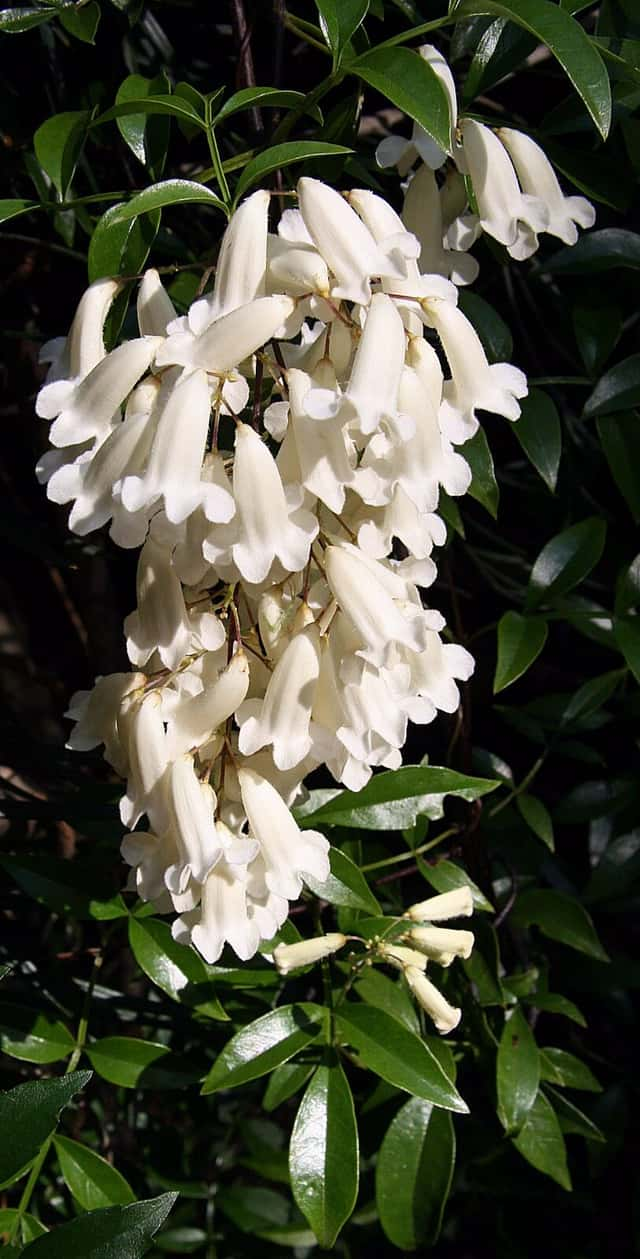
Pandorea pandorana is a woody evergreen climber in the bignonia family, native to Australia, New Guinea and Pacific islands. It grows fast and easily passes 6 m when it has something to climb. Leaves are compound, with 3 to 9 glossy leaflets on adult plants. From late winter into spring it carries hanging clusters of small tubular flowers, white to cream with purple-marked throats; cultivars include yellow 'Golden Showers', pink 'Ruby Belle' and fragrant white 'Snowbells'. Aboriginal Australians used its flexible wood for spear shafts.
How to Propagate Wonga wonga vine?
Semi-hardwood cuttings
Bottom heat speeds rooting. Keep the mix moist but not soggy.
- 1 In summer, cut 10-15 cm tips from semi-ripe shoots
- 2 Remove the lower leaves, leaving one or two pairs
- 3 Dip the base in rooting hormone
- 4 Plant in a light, moist mix and keep warm and out of strong sun
Materials needed:
Layering
This is the surest way to keep a cultivar true to type.
- 1 Choose a flexible stem close to the ground
- 2 Lightly wound the bark at one point and bury that section about 5 cm deep
- 3 Pin it down and keep the soil moist
- 4 Once roots form, cut it from the parent and transplant
Materials needed:
Seed
Use fresh seed; cultivars may not come true from seed.
- 1 Collect ripe capsules and remove the winged seeds
- 2 Sow fresh, on the surface of a light mix
- 3 Cover lightly and keep moist and warm
Materials needed:
How Big Does Wonga wonga vine Grow?
TLDR: Wonga wonga vine can reach up to 6.0m tall with Fast growth rate.
Max height
6.0m
Spread
3.0m
Growth rate
Fast
Foliage
Evergreen
Plant Uses
Ornamental
Great for decoration
Is your plant showing symptoms?
Click on the symptom to discover possible causes:
What Diseases Commonly Affect Wonga wonga vine?
TLDR: Wonga wonga vine is susceptible to 2 known diseases. Monitor regularly for early detection.
Aphids
Aphids are small, soft-bodied, pear-shaped insects (1/16 to 1/8 inch long) that feed by sucking nutrient-rich sap from plants. They reproduce rapidly and can quickly weaken plants, causing distorted growth and transmitting plant viruses. Aphids come in various colors including green, black, red, yellow, brown, and gray. They secrete honeydew, a sticky substance that attracts ants and encourages sooty mold growth.
Spider Mites
Spider mites are tiny arachnids (less than 1/20 inch long) related to spiders and ticks that feed on plant sap. They thrive in hot, dry conditions and can cause significant damage to ornamental and vegetable plants. During severe infestations, crop losses can reach 14% or higher as these pests disrupt vital plant processes including photosynthesis, carbon dioxide absorption, and transpiration.
Fun Facts
Aboriginal people in Central Australia used its flexible wood for spear shafts
The genus name refers to Pandora's box, after the aphids the plant attracted
A single flower cluster can hold dozens of blooms
Frequently asked questions
Is wonga wonga vine frost hardy?
When should I prune it?
Does it need support?
What pests affect it?
Compare with similar plants
| Attribute | Difficulty | Light | Watering | Pet Safe |
|---|---|---|---|---|
| Field Maple | Easy | Bright indirect | 14d | ✓ |
| Iberian Houseleek | Easy | Direct sun | 14d | ✓ |
| Silver Birch | Easy | Direct sun | 14d | ✓ |
| Common Blanketflower | Easy | Direct sun | 10d | ✓ |





