Crassulaceae
Woolly Crassula (Crassula lanuginosa)
Crassula lanuginosa
An easy, slow-growing succulent for a bright spot. Give it a few hours of sun, ideally morning or late afternoon, with some protection from harsh midday sun, and plant it in a gritty, fast-draining mix. Water only when the soil has dried out completely and water even less in winter. It prefers dry air, a temperature of about 15-26 C and no less than about 12 C indoors. Feed every couple of months in spring and summer.
Every 10 days
Bright indirect
12° - 26°C
% - %
Categories
What is Woolly Crassula?
Woolly Crassula (Crassula lanuginosa) is a easy-care plant from the Crassulaceae family. Crassula lanuginosa, the woolly crassula, is a small, mat-forming succulent from the north-eastern Cape region of South Africa, where it grows in cracks on rock outcrops and steep, rocky slopes. Its thin stems lie along the ground or arch over, reaching about 15 cm, and carry small elliptic to obova...
Woolly Crassula grows up to 15cm, watering every 10 days, 12°C – 26°C. It is suitable for indoor environments and safe for pets.
Unlike many tropical plants, Woolly Crassula tolerates watering mistakes. Best for beginners. Unlike many popular species, Woolly Crassula is safe to keep around pets. Without adequate drainage, root rot can develop within 20 days.
How to Care for Woolly Crassula?
TLDR: Woolly Crassula needs Bright indirect, watering every 10 days, and temperatures between 12-26°C with 40-70% humidity.
How Often Should You Water Woolly Crassula?
Water thoroughly, then wait until the mix is completely dry before watering again, roughly every 10 days in the growing season and much less in winter. Constantly damp soil quickly causes root rot. Water the soil, not the hairy leaves, and never leave the pot standing in water.
How Much Light Does Woolly Crassula Need?
Bright light with a couple of hours of direct sun, preferably in the morning or evening. In its habitat it gets some shade from the midday sun and the leaves can scorch in intense afternoon light. In full sun the leaves turn reddish; in too little light the stems stretch and the plant loses its compact shape.
What Is the Best Soil for Woolly Crassula?
Use a cactus and succulent mix with extra grit, coarse sand or perlite. Good drainage is essential, as the plant naturally grows in rock crevices and rots in heavy, wet soil.
What Pot Should You Use for Woolly Crassula?
A shallow terracotta pot or bowl with drainage holes suits its spreading, low habit and helps the mix dry out quickly. It also looks good in mixed succulent bowls, rock gardens or trailing over the edge of a pot.
Care Schedule
Fertilize
Every 60 days
What Is Woolly Crassula and Where Does It Come From?
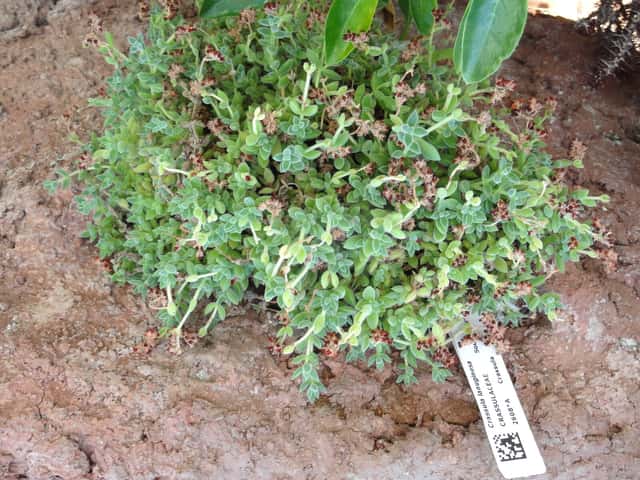
Crassula lanuginosa, the woolly crassula, is a small, mat-forming succulent from the north-eastern Cape region of South Africa, where it grows in cracks on rock outcrops and steep, rocky slopes. Its thin stems lie along the ground or arch over, reaching about 15 cm, and carry small elliptic to obovate leaves 1-3 cm long. Every part of the plant is covered in fine white hairs, which give the leaves a soft, blue-green to grey-green look; in strong sun the leaves blush red. In summer it produces flat-topped clusters of tiny white to cream flowers at the stem tips that attract insects. Two varieties are recognised: var. lanuginosa and var. pachystemon, which includes the popular cultivar 'David'.
How to Propagate Woolly Crassula?
Stem cuttings
Late summer is a good time for cuttings. Keep the mix only barely moist until the cutting roots, because the hairy stems rot easily if kept wet.
- 1 Cut a stem tip 3-5 cm long with clean scissors
- 2 Remove the lowest leaves and let the cutting dry for 1-2 days
- 3 Insert it into dry, gritty succulent mix
- 4 Keep it in bright, indirect light and water lightly once roots form
Materials needed:
Seed
The seed is tiny and needs light to germinate, so never bury it. Germination is slow and can take up to three months.
- 1 Sow the very fine seed on the surface of a moist, sandy seed mix without covering it
- 2 Keep it at 18-24 C in bright, indirect light
- 3 Keep the surface lightly moist until germination
- 4 Move seedlings to individual pots once they are large enough to handle
Materials needed:
How Big Does Woolly Crassula Grow?
TLDR: Woolly Crassula can reach up to 15cm tall with Slow growth rate.
Max height
15cm
Growth rate
Slow
Foliage
Evergreen
Plant Uses
Ornamental
Great for decoration
Ground Cover
Soil coverage
Is your plant showing symptoms?
Click on the symptom to discover possible causes:
What Diseases Commonly Affect Woolly Crassula?
TLDR: Woolly Crassula is susceptible to 3 known diseases. Monitor regularly for early detection.
Root Rot
Root rot is a serious fungal disease that affects the root system of plants, causing them to decay and die. It is primarily caused by overwatering, poor drainage, or soil-borne fungi such as Pythium, Phytophthora, Rhizoctonia, and Fusarium. The disease thrives in waterlogged conditions where roots are deprived of oxygen, making them susceptible to fungal infection.
Overwatering
Overwatering occurs when plants receive too much water, depriving roots of oxygen and causing root rot. This environmental stress is one of the most common causes of houseplant death, as waterlogged soil prevents roots from breathing and functioning properly.
Mealybugs
Mealybugs are small, soft-bodied insects covered with a white, waxy, cottony material. They are common pests of houseplants and outdoor plants in mild climates. These sap-sucking insects feed on plant tissue, causing damage, stunted growth, and can lead to plant death if left untreated. They produce sticky honeydew which attracts sooty mold.
Fun Facts
The species name lanuginosa means woolly, a reference to the fine hairs that cover the whole plant.
It grows wild in cracks on rock outcrops in the Eastern Cape of South Africa.
The cultivar 'David' is named after David Cumming, who collected it in the 1980s.
Frequently asked questions
How often should I water Crassula lanuginosa?
Why are the leaves of my woolly crassula turning red?
Why are the lower leaves yellow and mushy?
Can I grow it indoors?
How do I propagate it?
Compare with similar plants
| Attribute | Difficulty | Light | Watering | Pet Safe |
|---|---|---|---|---|
| Field Maple | Easy | Bright indirect | 14d | ✓ |
| Iberian Houseleek | Easy | Direct sun | 14d | ✓ |
| Silver Birch | Easy | Direct sun | 14d | ✓ |
| Common Blanketflower | Easy | Direct sun | 10d | ✓ |
Choose & Compare
Sources & References
- Crassula lanuginosa Harv. - Plants of the World Online (Kew)
- Crassula lanuginosa Harv. - GBIF Backbone Taxonomy
- Crassula lanuginosa - Random Harvest Indigenous Plant Nursery
- Crassula pachystemon (C. lanuginosa var. pachystemon) - Rock Garden Plants Database
- Crassula lanuginosa var. pachystemon 'David' - Sprouts of Bristol
- Crassula lanuginosa - World of Succulents
- Crassula lanuginosa var. pachystemon - Giromagi