Acanthaceae
Flame Acanthus: Full Sun Plant
Anisacanthus quadrifidus
An easy, low-maintenance shrub built for heat and drought once established. Give it full sun, well-drained soil, and only occasional deep watering; it thrives on neglect and rewards minimal care with months of hummingbird-attracting blooms. Cut it back hard in late winter to keep growth dense and flowering strong.
Every 10 days
Direct sun
-9° - 40°C
% - %
Categories
What is Flame Acanthus?
Flame Acanthus (Anisacanthus quadrifidus) is a easy-care plant from the Acanthaceae family. Flame acanthus is a fast-growing, deciduous shrub native to the rocky slopes, floodplains, and grasslands of west and south-central Texas and adjacent northern Mexico. It forms a loose, spreading mound of narrow lance-shaped leaves and exfoliating bark, topped from early summer through fall with sle...
Flame Acanthus grows up to 1.5m, spread of 120cm, watering every 10 days, -9°C – 40°C. It is not suitable for indoor environments and safe for pets.
Unlike many tropical plants, Flame Acanthus tolerates watering mistakes. Best for beginners. Unlike many popular species, Flame Acanthus is safe to keep around pets.
How to Care for Flame Acanthus?
TLDR: Flame Acanthus needs Direct sun, watering every 10 days, and temperatures between -9-40°C with 40-70% humidity.
How Often Should You Water Flame Acanthus?
Water deeply but infrequently, letting the soil dry out between waterings. Established plants are highly drought-tolerant and need little supplemental irrigation except during extended dry spells or in containers.
How Much Light Does Flame Acanthus Need?
Give it full sun for the heaviest bloom; it tolerates partial shade but flowers less prolifically and grows leggier without direct light.
What Is the Best Soil for Flame Acanthus?
Adapts to nearly any well-drained soil, including sandy, loamy, clay, caliche, and limestone soils; the key requirement is good drainage rather than a specific soil type.
What Pot Should You Use for Flame Acanthus?
A wide, unglazed terracotta or ceramic pot with generous drainage holes suits this shrub well, since porous material helps excess moisture evaporate and matches its drought-tolerant, well-drained-soil preference.
Care Schedule
Fertilize
Every 60 days
Rotate
Every 14 days
Repot
Every 730 days
What Is Flame Acanthus and Where Does It Come From?
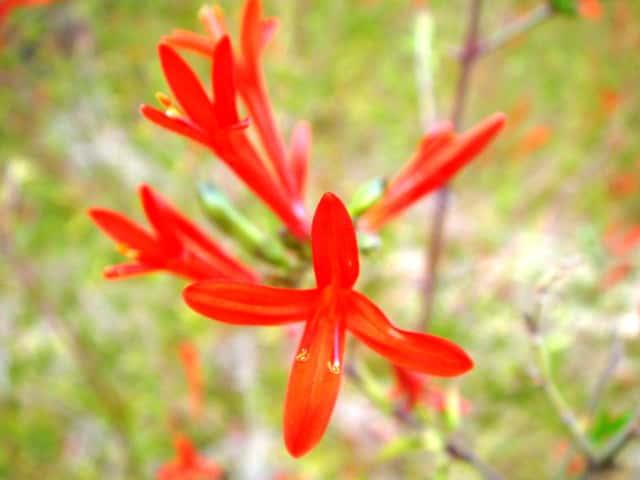
Flame acanthus is a fast-growing, deciduous shrub native to the rocky slopes, floodplains, and grasslands of west and south-central Texas and adjacent northern Mexico. It forms a loose, spreading mound of narrow lance-shaped leaves and exfoliating bark, topped from early summer through fall with slender, tubular red-orange flowers that intensify after rain. Prized in xeriscape and wildlife gardens, its nectar-rich blooms are a magnet for hummingbirds and butterflies, and the foliage serves as a larval host for the Janais patch and Texan crescentspot butterflies.
How to Propagate Flame Acanthus?
Softwood Stem Cuttings
Softwood cuttings root readily and reliably; keeping humidity up (a loose plastic cover) speeds rooting without letting the mix stay waterlogged.
- 1 Take 4-6 inch (10-15 cm) softwood cuttings from healthy new growth, cutting just below a leaf node.
- 2 Strip leaves from the lower half of the cutting and dip the cut end in rooting hormone.
- 3 Insert cuttings into a flat or pots filled with well-drained, moist propagation mix (e.g., perlite and peat).
- 4 Keep in bright, indirect light and consistently moist (not soggy) medium until roots form, then transplant to individual pots or the garden.
Materials needed:
Seed Sowing
The species self-seeds readily in the garden, so unwanted seedlings should be thinned or deadheaded if a tidy planting is desired.
- 1 Collect seed pods once they mature and dry on the plant, or purchase fresh seed.
- 2 Sow seeds fresh in fall directly in the garden, or start indoors in trays 6-8 weeks before the last frost date.
- 3 Keep the seed-starting mix consistently moist and in bright light until germination.
- 4 Transplant seedlings outdoors after all danger of frost has passed and they have several true leaves.
Materials needed:
How Big Does Flame Acanthus Grow?
TLDR: Flame Acanthus can reach up to 1.5m tall with Medium growth rate.
Max height
1.5m
Spread
1.2m
Growth rate
Medium
Foliage
Deciduous
Plant Uses
Ornamental
Great for decoration
Is your plant showing symptoms?
Click on the symptom to discover possible causes:
What Diseases Commonly Affect Flame Acanthus?
TLDR: Flame Acanthus is susceptible to 3 known diseases. Monitor regularly for early detection.
Root Rot
Root rot is a serious fungal disease that affects the root system of plants, causing them to decay and die. It is primarily caused by overwatering, poor drainage, or soil-borne fungi such as Pythium, Phytophthora, Rhizoctonia, and Fusarium. The disease thrives in waterlogged conditions where roots are deprived of oxygen, making them susceptible to fungal infection.
Whiteflies
Whiteflies are small, soft-bodied, winged insects closely related to aphids and mealybugs. They are moth-like in appearance, about 1/16 inch long, triangular in shape, and gray-white in color. These sap-sucking pests feed on plant tissue, causing yellowing, stunted growth, and wilting. They also excrete honeydew, which attracts ants and promotes sooty mold growth. Whiteflies can transmit serious plant viruses.
Aphids
Aphids are small, soft-bodied, pear-shaped insects (1/16 to 1/8 inch long) that feed by sucking nutrient-rich sap from plants. They reproduce rapidly and can quickly weaken plants, causing distorted growth and transmitting plant viruses. Aphids come in various colors including green, black, red, yellow, brown, and gray. They secrete honeydew, a sticky substance that attracts ants and encourages sooty mold growth.
Meaning & Symbolism
Grown for its ability to draw hummingbirds and butterflies into the garden, flame acanthus is often planted as a living symbol of hospitality and vibrant, resilient beauty in harsh conditions.
Compare with similar plants
| Attribute | Difficulty | Light | Watering | Pet Safe |
|---|---|---|---|---|
| Field Maple | Easy | Bright indirect | 14d | ✓ |
| Silver Birch | Easy | Direct sun | 14d | ✓ |
| Common Blanketflower | Easy | Direct sun | 10d | ✓ |
| Cushion Bush | Easy | Direct sun | 14d | ✓ |
Choose & Compare
Sources & References
- Anisacanthus quadrifidus var. wrightii - Missouri Botanical Garden Plant Finder
- Anisacanthus quadrifidus var. wrightii (Flame acanthus) - Lady Bird Johnson Wildflower Center
- Flame Acanthus - AustinTexas.gov Grow Green Plant Guide
- Anisacanthus quadrifidus - Wikipedia
- Anisacanthus quadrifidus var. wrightii (Desert Honeysuckle) - Gardenia.net





