Euphorbiaceae
Yellow Milkbush (Euphorbia mauritanica)
Euphorbia mauritanica
A low-maintenance, drought-tolerant succulent shrub that thrives in full sun with minimal water. Plant in sandy, fast-draining soil and let it dry out completely between waterings. Handle with gloves, as the sap is a skin and eye irritant.
Every 14 days
Bright indirect
-4° - 38°C
20% - 40%
Categories
What is Yellow Milkbush?
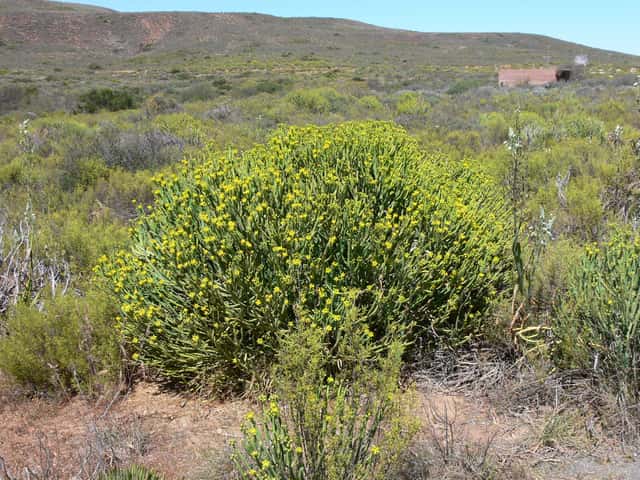
Yellow Milkbush (Euphorbia mauritanica) is a easy-care plant from the Euphorbiaceae family. Euphorbia mauritanica is a spineless, much-branched succulent shrub native to the Succulent Karoo of South Africa and Namibia, where it is one of the most widespread shrubby euphorbias. It grows upright, pencil-thin, yellowish-green cylindrical stems from a woody base, reaching up to 1.5 m tall. Sma...
Yellow Milkbush grows up to 1.5m, spread of 180cm, watering every 14 days, -4°C – 38°C, 20–40% humidity. It is suitable for indoor environments and not safe for pets.
Unlike many tropical plants, Yellow Milkbush tolerates watering mistakes. Best for beginners. Without precautions, ingestion can cause irritation in pets. Keep out of reach of cats and dogs. Without adequate drainage, root rot can develop within 28 days.
How to Care for Yellow Milkbush?
TLDR: Yellow Milkbush needs Bright indirect, watering every 14 days, and temperatures between -4-38°C with 20-40% humidity.
How Often Should You Water Yellow Milkbush?
Water only when the soil is completely dry, roughly every two weeks in the growing season and even less in winter. Overwatering is the most common cause of failure, leading to root and stem rot.
How Much Light Does Yellow Milkbush Need?
Give it full sun to very bright light for at least 4-6 hours a day. Indoors, place it in the brightest window available; outdoors it tolerates full, intense sun once established.
What Is the Best Soil for Yellow Milkbush?
Use a sandy, well-draining cactus or succulent mix. Adding extra coarse sand or perlite improves drainage and prevents waterlogging around the roots.
What Pot Should You Use for Yellow Milkbush?
A terracotta or unglazed clay pot with drainage holes is ideal, as it wicks away excess moisture and helps prevent root rot.
What Is Yellow Milkbush and Where Does It Come From?
Euphorbia mauritanica is a spineless, much-branched succulent shrub native to the Succulent Karoo of South Africa and Namibia, where it is one of the most widespread shrubby euphorbias. It grows upright, pencil-thin, yellowish-green cylindrical stems from a woody base, reaching up to 1.5 m tall. Small, bright yellow flower clusters (cyathia) appear at the branch tips from late winter into spring. All parts contain a milky latex sap that is irritant and toxic if it contacts skin or eyes, or if ingested.
How to Propagate Yellow Milkbush?
Stem Cutting
Always wear gloves and avoid touching your eyes when handling cut stems, as the latex sap is a strong irritant. Rooting hormone is optional but can speed things up.
- 1 Wearing gloves, cut a healthy stem section 10-15 cm long using a clean, sharp knife.
- 2 Let the cut end callus over in a dry, shaded spot for 5-7 days until it stops oozing sap.
- 3 Insert the callused end a few centimeters into slightly moist, well-draining cactus mix.
- 4 Keep in bright, indirect light and water sparingly until roots establish, then treat as a mature plant.
Materials needed:
How Big Does Yellow Milkbush Grow?
TLDR: Yellow Milkbush can reach up to 1.5m tall with Slow growth rate.
Max height
1.5m
Spread
1.8m
Growth rate
Slow
Foliage
Evergreen
Warning: Toxic Plant
This plant can be toxic if ingested. Keep out of reach of:
Plant Uses
Ornamental
Great for decoration
Is your plant showing symptoms?
Click on the symptom to discover possible causes:
What Diseases Commonly Affect Yellow Milkbush?
TLDR: Yellow Milkbush is susceptible to 5 known diseases. Monitor regularly for early detection.
Powdery Mildew
Powdery mildew is a common fungal disease caused by various fungi species including Erysiphe, Podosphaera, Oïdium, and Leveillula. It affects over 10,000 plant species worldwide. The disease thrives in warm, dry climates with high humidity and appears as a distinctive white powdery coating on plant surfaces.
Bacterial Soft Rot
Bacterial soft rot is a destructive plant disease caused primarily by bacteria from the genera Pectobacterium (formerly Erwinia) and Dickeya. These bacteria produce enzymes that break down plant cell walls, causing rapid and foul-smelling tissue decomposition. It mainly affects succulent tissues such as tubers, fruits, stems, and bulbs, being especially problematic in warm and humid conditions.
Mealybugs
Mealybugs are small, soft-bodied insects covered with a white, waxy, cottony material. They are common pests of houseplants and outdoor plants in mild climates. These sap-sucking insects feed on plant tissue, causing damage, stunted growth, and can lead to plant death if left untreated. They produce sticky honeydew which attracts sooty mold.
Spider Mites
Spider mites are tiny arachnids (less than 1/20 inch long) related to spiders and ticks that feed on plant sap. They thrive in hot, dry conditions and can cause significant damage to ornamental and vegetable plants. During severe infestations, crop losses can reach 14% or higher as these pests disrupt vital plant processes including photosynthesis, carbon dioxide absorption, and transpiration.
Meaning & Symbolism
In its native Succulent Karoo, the Yellow Milkbush represents resilience and endurance, surviving where few other plants can in one of the driest, most nutrient-poor regions on Earth.
Fun Facts
Despite looking almost leafless, its pencil-thin green stems perform photosynthesis just like leaves would.
It is the most widely distributed shrubby euphorbia native to South Africa, found from the Northern Cape to KwaZulu-Natal.
Only a few specialized browsers, like steenbok and klipspringer, can safely eat this toxic plant.
Its bright yellow flowers bloom in the depths of the Southern Hemisphere winter and into spring, brightening the otherwise dry Karoo landscape.
Frequently asked questions
Is Euphorbia mauritanica toxic to pets?
How often should I water my Yellow Milkbush?
Can Euphorbia mauritanica be grown indoors?
How do I propagate Yellow Milkbush?
Why is my plant dropping stems or turning soft?
Compare with similar plants
| Attribute | Difficulty | Light | Watering | Pet Safe |
|---|---|---|---|---|
| Field Maple | Easy | Bright indirect | 14d | ✓ |
| Silver Birch | Easy | Direct sun | 14d | ✓ |
| Common Blanketflower | Easy | Direct sun | 10d | ✓ |
| Cushion Bush | Easy | Direct sun | 14d | ✓ |





