Bromeliad Potting Mix: Can You Use Orchid Bark?
Yes, and it is one of the best choices for tank bromeliads because their roots function more as anchors than for drinking water. Here is which orchid mix to use, the DIY recipe, the right pot, and the exception for terrestrial bromeliads.
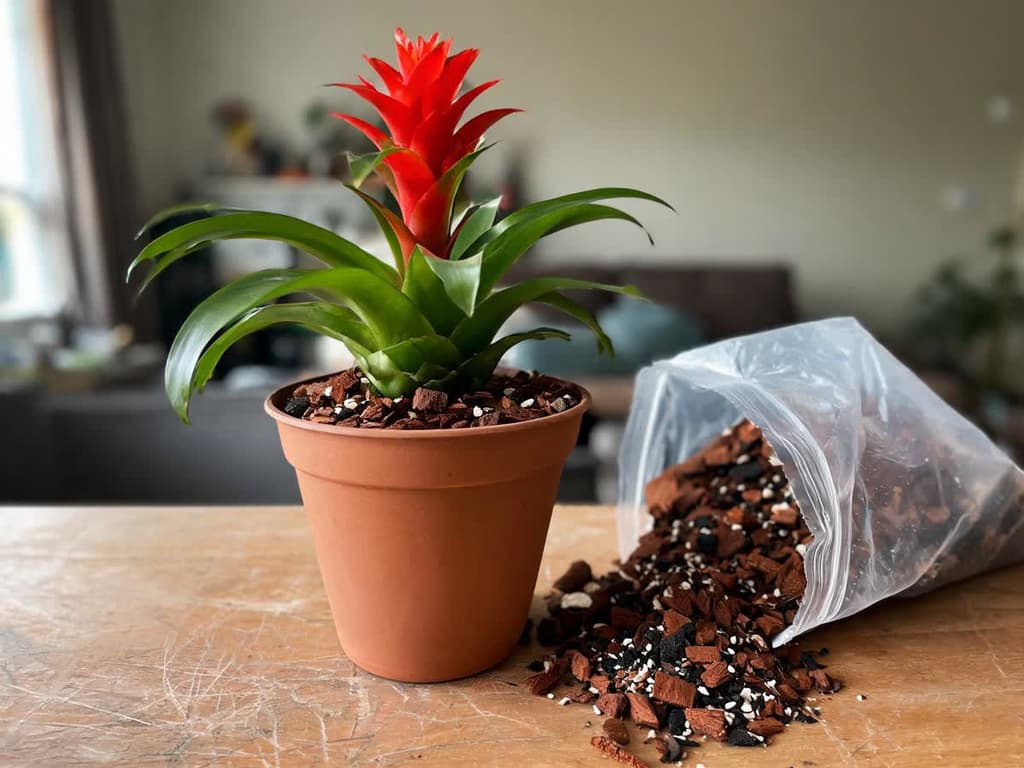
Orchid mix works for bromeliads, and it is one of the best choices for the tank bromeliads sold in pots: Guzmania, Aechmea, Vriesea, and Neoregelia. The roots of these plants are small and serve mainly to hold the plant in place. Because of that, the roots need a medium that drains quickly and never stays waterlogged, and the pine bark in an orchid mix bag does exactly that.
Potting mix is the material that fills the pot instead of soil. Two adjustments make a difference: if the bag contains only coarse chunks, mix in one-third coconut coir. And if your bromeliad is one of those that grow in the ground, like pineapples and Cryptanthus, it requires a mix that holds more moisture.
Quick summary:
A tank bromeliad's roots anchor the plant, while the leaves drink water and nutrients. The potting mix only needs to support the plant and dry quickly.
Pine bark works well as the base of the mix. In a Brazilian experiment with Aechmea fasciata, it worked at 20% to 80% of the mix, while coconut coir at 80% produced one of the worst results.
Bromeliad pots are small: 3 to 5 inches (7.5 to 12.5 cm) across the rim for most plants. A large pot stays wet and rots the roots.
A blooming bromeliad that tips over or looks too big for its pot almost never needs a larger pot. Place the pot inside a heavy cachepot.
Replacing the potting mix will not save a bromeliad with a brown, mushy center. What you can save are the pups, and the old mix goes into the trash.
Can you use orchid mix for bromeliads?
Yes. Orchid mix is a blend of tree bark chunks, sometimes with charcoal and perlite. It is made to drain quickly and keep air around the roots. Tank bromeliads require the same thing: a medium that supports the plant and dries between waterings. On these plants, the leaves absorb most of the water.
Two university extensions and the main horticultural society in the United Kingdom say this in the same words. The University of Florida describes the bromeliad root as small and serving "mainly as an anchor." The University of Wisconsin Extension is more direct. For them, the main function of the potting mix "is to hold the plant upright, not to provide water and nutrients to the roots," with the exception of terrestrial species. The Royal Horticultural Society, in the United Kingdom, states that the roots of an epiphytic bromeliad are "mainly anchors."
The recommendation for orchid mix appears in the sources themselves. North Carolina Extension, on its Aechmea factsheet, says that "a bark-based orchid mix is good." Wisconsin recommends orchid bark with coarse perlite and humus. The RHS accepts orchid mix on its own or in a recipe.
Substrate manufacturer Scotts gives different guidance: plant the bromeliad in cactus mix or in houseplant potting mix. This guide follows the extension services and the RHS, because they explain the choice based on the plant's roots, while the manufacturer does not.
Which bromeliad do you have: tank or terrestrial?
Bromeliad is the common name for the entire Bromeliaceae family, which is divided into two groups with different potting mix needs. Wisconsin estimates that about half of the species live attached to trees or rocks, and the other half grow in the ground.
Tank bromeliad (epiphytic). The leaves form a funnel in the center, the tank, which holds water. In nature, the plant lives attached to tree branches. This is the case with Guzmania, Aechmea, Vriesea, and Neoregelia, the flowering bromeliads found in florist shops and supermarkets. Orchid mix is made for them.
Terrestrial bromeliad (ground-dwelling). The leaves form a flat star or a rosette without a tank, and the plant grows rooted in the soil. This is the case with Cryptanthus, Dyckia, and pineapple. It requires a mix that holds more moisture.
A note about the name. In Brazil, "bromélia" is also the popular name for Bromelia antiacantha, the gravatá, a terrestrial bromeliad grown in full sun. This guide covers potted bromeliads, the tank types, and addresses terrestrials in their own section.
If your plant's tag is gone, the genus name settles the question. The Bloom app identifies the plant from a photo, and the genus tells you which of the two groups it belongs to.
Which orchid mix works, and which one needs an adjustment
Not every bag of orchid mix is the same, and the difference lies in the particle size. Moth orchids, the most common type sold, require medium to coarse bark because their aerial roots are thick and need plenty of air. Tank bromeliads need a slightly denser mix.
Wisconsin defines what bromeliads need: a mix that "holds moisture yet drains quickly." The mix the extension recommends for most bromeliads is a Cymbidium orchid mix, which is bark with coarse perlite and humus. The RHS calls for composted fine bark, or orchid mix, and also mentions Cymbidium mix. Both sources call for bark with some water-retentive material, rather than pure coarse bark.
In Brazil, a bag of orchid mix is usually pine bark, sometimes with charcoal. In practice:
What the bag says | Does it work for tank bromeliads? | What to do |
|---|---|---|
Fine or medium pine bark, with coconut coir or peat moss | Yes | Use it straight |
Fine or medium pine bark, with charcoal | Yes | Use it straight |
Coarse pine bark (pieces of 0.8 in / 2 cm or larger) | It works, but dries out too quickly | Mix 2 parts from the bag with 1 part coconut coir |
The 2-to-1 ratio with coconut coir does not appear directly in any single source. It combines the Wisconsin guideline of bark with organic matter and the results of the Brazilian experiment in the next section. There, coconut coir works in small amounts but fails as a primary base.
The bark growers in the United States use is fir bark, which is not sold in Brazil. Pine bark plays the same role in the mix. For this reason, this guide refers to chunk size and proportions rather than measurements based on fir bark. For orchids, the same pine bark is used in larger pieces, and the rest of the plant's care is covered in the orchid care guide.
What Brazilian research measured in bromeliads
Pine bark works as a base for bromeliad mix, and coconut coir does not. That is what an experiment by the Instituto de Botânica de São Paulo, Esalq/USP, and the Instituto Biológico showed. The tested plant was Aechmea fasciata, the bromeliad with grayish leaves, silver bands, and a pink flower. The study was published by Kanashiro and colleagues in Pesquisa Agropecuária Brasileira in 2008.
The researchers grew the bromeliads for 435 days until the start of flowering, which is when the plants reach stores. They tested five materials as bases: pine bark, eucalyptus bark, coxim (a commercial fern-fiber substitute), coconut coir, and xaxim (tree fern fiber). Each was mixed with peat moss and perlite in three ratios: 20%, 50%, and 80% of the tested material.
Pine bark ranked among the best mixes across all three ratios, including at 80%.
Coconut coir, eucalyptus bark, and coxim only ranked among the best at 20%. At 80% of the mix, with 10% peat moss and 10% perlite, they produced the worst results in the study.
The caveat is that the experiment was conducted in a commercial greenhouse under 70% shade cloth, not in an apartment. What matters for your home is the ranking among the materials. Pine bark can hold up as the largest portion of the pot, while coconut coir should remain a minor component.
The same experiment also included xaxim, which is the trunk of the tree fern Dicksonia sellowiana and the traditional substrate for bromeliads and orchids in Brazil. A study from the State University of Londrina notes that this fern must be preserved and that the use of xaxim should be discouraged. For bromeliads, pine bark performed the same role as xaxim in the 2008 experiment.
Bromeliad potting mix recipe
If you do not have a bag of orchid mix, the simplest homemade blend uses three equal parts. Use an 8-oz (200 ml) cup as a measure: six cups yield around 1.3 quarts (1.2 liters), enough for a 5-inch (12 cm) pot.
Material | Parts | Purpose |
|---|---|---|
Fine or medium pine bark | 1 | Acts as the base: maintains air pockets and breaks down slowly |
Coconut coir or peat moss | 1 | Holds a bit of moisture for the roots |
Perlite or coarse sand | 1 | Opens up the mix and lets water drain quickly |
Three sources give nearly identical recipes. The RHS uses equal parts fine bark, grit, and coconut fiber. The University of Florida uses equal parts peat, bark, and coarse sand. The North Carolina Extension in Beaufort County cites orchid bark, perlite, and peat or coconut fiber.
Coconut coir makes up one-third of the mix, well below the 80% that failed in the Brazilian experiment. The holiday cactus is another potted epiphyte. The holiday cactus potting mix recipe follows the same logic: pine bark as the base and coir as the water-retaining component.
Terrestrial bromeliads: the exception
Terrestrial bromeliads need a mix that holds more moisture than orchid bark does. For them, Wisconsin makes an explicit exception: in terrestrial species, the potting mix supplies water and nutrients to the roots. The extension describes Cryptanthus as a moisture-loving plant that does well in terrariums.
The RHS groups tankless bromeliads together, such as ornamental pineapple and Cryptanthus zonatus. For these, the recommendation is to keep the mix consistently moist but never wet, letting water drain away after each watering. The RHS also provides a second recipe that holds more moisture: equal parts fine bark and standard potting mix. That is the one that suits terrestrial bromeliads.
Coconut coir works for terrestrial bromeliads. A study published in Horticultura Brasileira in 2006 grew Cryptanthus sinuosus in coconut coir instead of tree fern fiber. It is a terrestrial species from the restinga of Rio de Janeiro. The plants grew slightly less than in tree fern fiber, and the foliage turned out more reddish.
The Dyckia is the most drought-tolerant terrestrial. Wisconsin notes that it tolerates months without water and requires very bright light, but needs abundant water during the growing season.
Pots for bromeliads: small and heavy
A bromeliad pot should be smaller than what you would use for another plant of the same size. Wisconsin explains why: the root system is small, and a large pot stays wet for days, encouraging rot. The RHS provides measurements: 3 to 5 inches (7.5 to 12.5 cm) across the rim for most bromeliads. A large plant that has become top-heavy can go into a pot up to 7 inches (17.5 cm).
Bromeliads do not need a deep pot for the same reason: their roots take up very little space. The real challenge with a small pot is different. A blooming bromeliad is top-heavy, and the setup tips over.
If the plant tips over: place the small pot inside a larger, heavier container, such as a ceramic cachepot. Wisconsin recommends doing exactly this instead of repotting into a large container.
If you tend to overwater, or live in a very humid area: use a terracotta pot. Terracotta is porous and dries out faster.
If your home has dry air, air conditioning, or heating, or if you forget to water: use a plastic pot, which retains moisture longer.
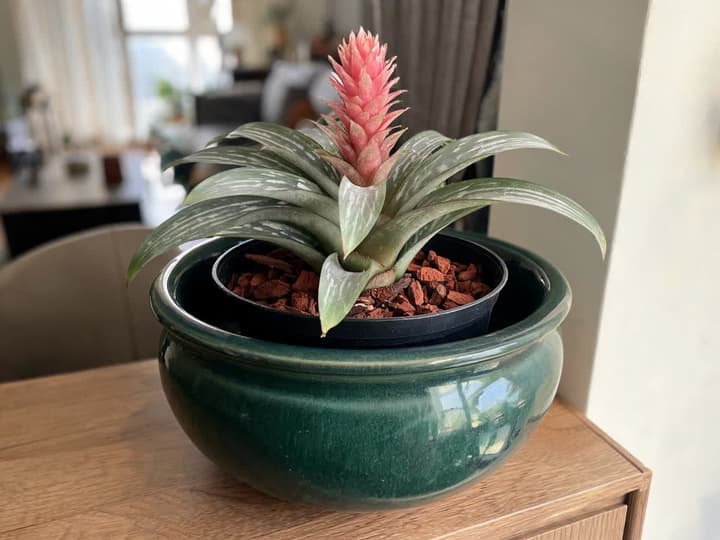
Any pot needs a drainage hole at the bottom. A layer of stones at the bottom does not replace a drainage hole, and the test that measured the effect of that layer is in the guide on potting mix for peace lilies.
My bromeliad is outgrowing its pot: does it need repotting?
Almost never. A bromeliad sold in bloom is already a mature plant. The specialist website Bromeliads.info states that a bromeliad bought in bloom does not need to be repotted during its lifetime in your home. When it seems "too big for the pot," it is usually top-heavy, and a cachepot solves the problem.
Repot a tank bromeliad in three situations:
The potting mix does not dry out. If the pot stays soggy days after watering and you are not overwatering, the mix is too dense.
The pot broke or lacks drainage holes.
A pup has grown and needs its own pot. The pup, the offset growing at the base of the mother plant, is the most common reason to repot.
The RHS recommends repotting during the warm season, when the plant is actively growing. A blooming plant can wait until the flower fades.
How to repot a bromeliad in orchid mix, step by step
Moisten the orchid mix before use so it does not touch the roots completely dry.
Remove the plant from its old pot and gently loosen any old mix that comes away easily with your fingers. Do not pull off the roots.
Select a pot with drainage holes, only slightly larger than the root ball (the cluster of roots and mix). If in doubt, use the smaller size.
Add mix to the bottom and position the plant at the same depth it sat in the old pot, as recommended by the RHS.
Fill in around the sides with orchid mix without packing it down firmly. Keep the base of the leaves above the mix: buried leaves rot.
If the plant wobbles, secure it with a stake until the roots anchor.
Fill the central tank and water the mix until water drains through the bottom hole.
After repotting, keep the mix on the drier side until new roots appear. Wisconsin provides this instruction for newly potted pups specifically to prevent rot.
Brown and mushy center: does changing the mix save the bromeliad?
Changing the mix will not cure a bromeliad with a brown, mushy center. That is a sign of heart rot, which starts in the center of the rosette, not in the roots. The test is to tug gently on a center leaf. If the leaf slides out without resistance, with a soft base and a foul smell, the rot is already advanced.
Heart rot and root rot usually share the same cause: the microorganism Phytophthora cinnamomi. The Bromeliad Society of New Zealand explains that it thrives where oxygen is lacking, such as in waterlogged mix. The same source estimates that its resting spores survive for 12 to 15 years.
What to do, in order:
If only the base of one or two leaves is dark: the BSNZ recommends trimming away the affected tissue until you reach firm, white tissue. Let the cut dry before watering the plant again.
If the entire center pulls out in your hand: the BSNZ notes that the plant can only sometimes be saved when rot is caught early. With the center loose, rot is already advanced. Healthy pups at the base, if firm and unblemished, are what you can salvage and plant in fresh mix.
In either case: throw out the old mix and wash the pot before reusing it. Never reuse mix from a plant that rotted.
Fresh orchid mix is a good choice for repotting because it dries quickly. It just cannot reverse damage that is already inside the center of the plant.
What not to use on bromeliads
Garden soil. Wisconsin warns never to use garden soil in the mix: it is dense, becomes waterlogged, and rots the roots quickly.
Standard potting soil on its own. The North Carolina Extension in Beaufort County notes that it holds too much moisture and can suffocate roots. Blended with bark in equal parts, it works for terrestrial bromeliads.
Coconut coir as the base. In the Brazilian experiment, 80% coconut coir produced one of the worst results.
Tree fern fiber (xaxim). Its use is discouraged to protect the fern species it comes from, and pine bark serves the exact same purpose.
A large pot "so the plant can grow." A mature bromeliad will not grow to fill a larger pot, and the excess potting mix will just stay wet.
Frequently asked questions
Can I plant a bromeliad in regular soil?
It is not recommended for tank bromeliads. Their roots serve primarily to anchor the plant, and regular soil stays waterlogged and rots these small roots. Wisconsin forbids garden soil in the mix. Use orchid mix or equal parts pine bark, coconut coir, and perlite.
Do bromeliads need a deep pot?
No. Bromeliad roots are small and take up very little space. According to the RHS, a pot 3 to 5 inches across the rim is suitable for most plants. A deep pot simply holds more wet mix beneath the roots. If the plant tips over, place the small pot inside a heavy cachepot.
What other plants can use orchid mix?
Orchid mix works for other potted epiphytes that also grow attached to trees in nature. Holiday cacti are one example, with coconut coir added to the blend. It is not suitable for cacti and succulents, as those plants require a mix with a higher mineral content that dries out completely between waterings.
Can I use an old bag of orchid mix?
Yes, provided the bag remained sealed and dry, and the bark pieces still snap cleanly without crumbling. Bark that crumbles like soil has decomposed and will retain too much moisture. If the mix smells rotten or shows white fungal threads, throw it out. Moisten before using.
What is the best potting mix for bromeliads?
For tank bromeliads (Guzmania, Aechmea, Vriesea, Neoregelia), the best choice is a fine or medium pine bark orchid mix. The homemade alternative is equal parts pine bark, coconut coir, and perlite. For terrestrial bromeliads like Cryptanthus, use equal parts fine bark and regular potting mix.
Conclusion
Orchid mix works for tank bromeliads because their roots function mainly as anchors. They need a medium that supports the plant and dries quickly. Choose fine or medium pine bark, adding one-third coconut coir if the bark pieces are coarse. Keep the pot small, and stabilize a tipping plant with a heavy cachepot instead of moving it to a larger container.
If you are unsure whether your bromeliad is a tank or terrestrial type, identifying the species settles the question before you buy a bag of mix.
Related articles
How to Care for a Goldfish Plant: Light, Watering, and Blooms
How to care for a goldfish plant: bright light without strong sun, water when the soil surface dries, and humid air. Learn how to tell a Nematanthus from a Columnea, why it drops leaves, and how to get it to bloom again.
Lavender Leaves Turning Yellow: Where the Yellowing Starts Shows the Cause
Lower leaves turning yellow with moist soil means overwatered roots, the most common cause. Old leaves drying one by one on woody stems is normal. Take the stem and root test, see if your plant can still be saved, and find out what to do today.
How to Propagate Lavender: Where to Cut and Why Cuttings Rot
A lavender cutting comes from a non-flowering branch tip, about 4 inches long, planted in sandy soil that never stays soggy. Learn where to cut, rooting times, seasonality in Brazil, and what to do if the base turns black.