How to care for orchids: watering, light, and how to make them rebloom
The orchid that dies at home almost never died of thirst — it drowned. Learn to read the roots to know when to water, correct the light by leaf color, and the temperature protocol that makes the plant bloom again.
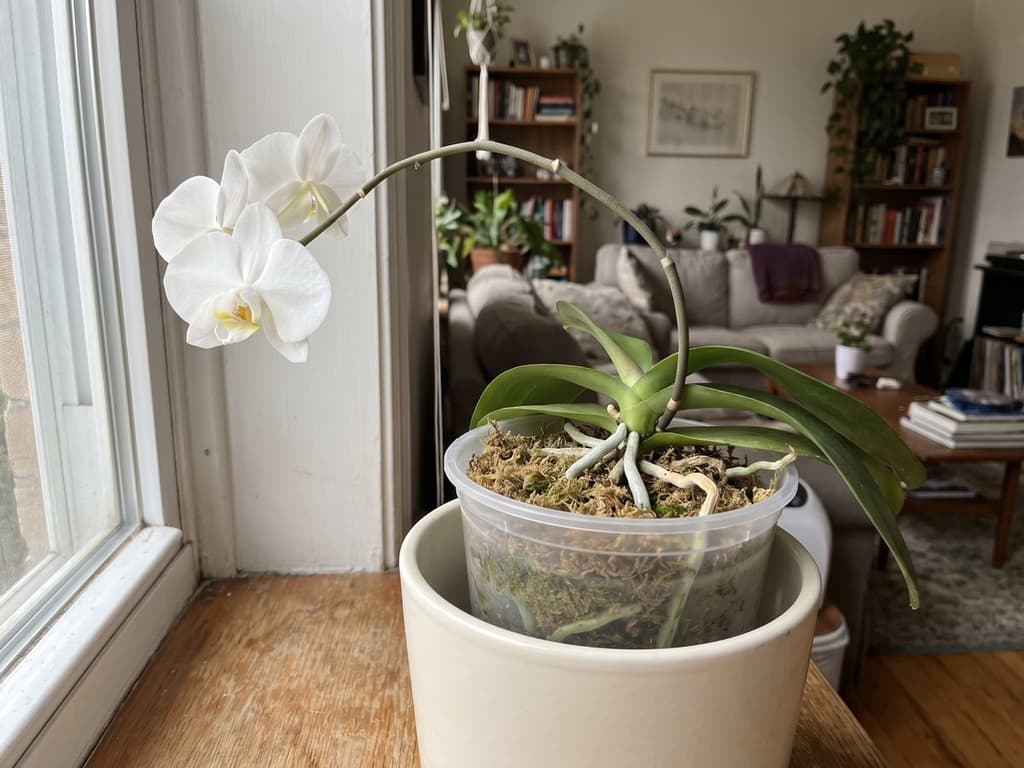
How to care for orchids, in one sentence: water only when the roots turn silvery, place the plant in bright light without direct sun on the leaves, and never leave standing water in the decorative pot. The orchid that dies indoors almost never died of thirst — it drowned, with its roots rotting under waterlogged substrate.
This guide is for anyone who bought or received a blooming orchid, watched the last flower fall, and doesn't know if the plant is still alive. You don't even need to know its name to start: you can get everything right just by looking at the roots and leaves.
Quick summary:
The roots are your meter. Silvery means dry, so you can water; green means they still have water. That clear plastic pot from the store is not packaging: it is a measurement tool.
Bright light, never direct sun on the leaves. Phalaenopsis blooms well with 16,000 to 18,000 lux, equivalent to 1,500–1,700 foot-candles in technical sheets (Clemson University Extension): this is the brightness of an east-facing window, not a sunny windowsill at noon.
To bloom again, they need cold, not fertilizer. Several weeks with nights between 13 °C and 18 °C (55 °F to 65 °F) and a difference of 6 °C to 8 °C (10 °F to 15 °F) between day and night is what triggers the flower spike (Iowa State University Extension, revised January 2026).
Your orchid is probably a Phalaenopsis
If you bought the plant at a supermarket, flower shop, or received it as a gift with open flowers, it is almost certainly a Phalaenopsis, the moth orchid. It is also the least light-demanding of the genera sold in pots, making it the easiest to keep alive indoors (Clemson University Extension). This guide is written for it.
You can recognize it by its shape: two to six thick, wide, fleshy leaves growing very close to the pot, with no apparent stem, and a thin, arching spike from which the flowers grow. If your plant has another shape, care changes in specific ways:
Genus | How to recognize | Light | Night minimum |
|---|---|---|---|
Phalaenopsis (moth orchid) | Wide, fleshy leaves at the base, no apparent stem; arching spike | Lowest requirement of the three: 16,000–18,000 lux | 18 °C |
Cattleya | Thickened cigar-shaped stem (pseudobulb) with 1–2 stiff leaves on top | Double that of Phalaenopsis | 15 °C |
Dendrobium | Several thin, tall upright stems with leaves along them | Double that of Phalaenopsis | 11 °C |
The light ranges and night minimums for each genus come from the Clemson University Extension orchid factsheet. If your plant is none of these three — another common houseplant is the Oncidium, or dancing lady orchid, with flattened pseudobulbs and small, numerous flowers —, it's best to identify the species before changing your routine, because light and minimum temperature change from genus to genus. A plant identification app that works from photos can solve this in a minute; mistaking the genus means mistaking the watering frequency.
When to water: read the roots, not the calendar
This is the only watering rule that works in any house, in any climate, and in any season. And it doesn't rely on counting days.
Orchid roots are covered by a tissue called velamen: several layers of dead, spongy cells that wrap around the root like a sponge. When these cells are empty, they fill with air, and the air reflects light — the root looks silvery or whitish. When they are full of water, light passes through, and you can see the green root underneath. This color is not a symptom of disease: it is a moisture meter the plant wears outside its pot.
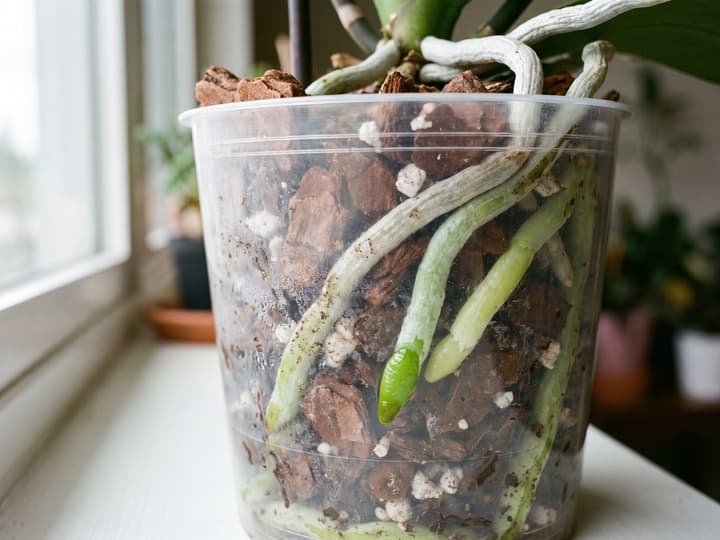
In practice:
Green roots — there is still water. Do not water.
Silvery or white roots — the velamen has dried out. You can water.
Brown, mushy root that falls apart between your fingers — rotted. This is not thirst: it is excess water, and watering more will make it worse.
The University of Maryland Extension describes the same signal from the other side: aerial roots "change from a dull silvery/white to light green when you have applied enough water" (Care of Phalaenopsis Orchids, updated March 2023). This is why you should keep the plant in its clear plastic pot and use the decorative pot only on the outside.
The interval in days changes depending on the material filling the pot, which is why the generic "water once a week" advice kills orchids:
What is in the pot | How it is | Typical frequency |
|---|---|---|
Pine bark | Large, loose pieces, plenty of air between them | Every 5–7 days; in small pots or warm rooms, 2× a week |
Sphagnum moss (fluffy, greyish-green moss) | Holds much more water | Every 10–14 days, and only when the surface is dry to the touch |
Coconut fiber or coir chips | Intermediate, retains more than bark | Every 7–10 days |
Orchids in loose bark mixes may need watering twice a week, while those in sphagnum moss require less frequency because the moss retains water. The rule remains the roots — the table just tells you what to expect before looking.
How to water (and the decorative pot mistake)
Watering an orchid is not about giving it a quick sip of water. The velamen needs to fill up, and that takes a few minutes.
You will need: the plant in its clear pot, a sink or shower, and room temperature water. It takes 10 minutes.
Take the clear pot out of the decorative cachepot. This is the step most people skip.
Drench it thoroughly. The University of Maryland recommends running lukewarm water through the plant, bark, and air roots for three or four drenchings over 10 minutes. If you prefer soaking, submerge the entire pot in water for about 20 minutes (UConn Home & Garden Education Center).
Let it drain until it stops dripping — completely, don't rush. The roots need air between waterings.
Only then return it to the decorative pot, and check that no standing water is left at the bottom.
Water in the morning, so the leaves and crown (the point where leaves meet) can dry during the day.
If water pools at the bottom of the decorative pot, the roots remain submerged without you seeing it. The Clemson University Extension is direct: "one of the fastest ways to kill an orchid is to let it sit in a waterlogged pot".
Standing water in the crown will also rot the plant. If you get water there, dry it with a paper towel.
Regarding temperature and air humidity: Phalaenopsis prefers days 6 °C to 8 °C (10 °F to 15 °F) warmer than nights — in practice, days between 24 °C and 27 °C (75 °F to 80 °F) with a night minimum of 18 °C (65 °F) — and relative humidity between 40% and 60% year-round (Clemson University Extension). In most homes, this is already the natural environment of a living room. The problem arises in air-conditioned rooms, which dry out the air: in this case, a wide tray with pebbles and water under the pot — with the bottom of the pot resting on the pebbles, above the water line — solves the issue without wetting the roots.
Do ice cubes really work?
This is the most common question about orchids, and the honest answer contradicts both sides of the debate.
Researchers at Ohio State University and the University of Georgia tested exactly this: 48 Phalaenopsis at each institution, monitored for four to six months. Half received three ice cubes a week; the other half received the same amount of water at room temperature. There was no difference in the lifespan of individual flowers or overall bloom duration, and there was no difference in the invisible metrics: chlorophyll, photosynthesis, and plant mass remained identical in both groups. The work by Kaylee South and Michelle Jones was published in the journal HortScience in 2017 (summary published by Ohio State University).
However, the study has three limitations, which are often left out:
It only applies to bark substrate. In sphagnum moss, which holds much more water, the volume of three ice cubes was not tested.
It only applies to Phalaenopsis. It was not tested on Cattleya, Dendrobium, or Oncidium.
The ice sits on the substrate, away from the leaves and without touching the aerial roots. In the test, substrate temperature dropped to 11–13 °C (52–55 °F) and returned to 21 °C (70 °F) within five hours.
The practical conclusion: ice cubes are not the villains people say they are, but they are also not better than proper watering. Three ice cubes a week deliver very little water, and most indoor orchid problems come from overwatering — not from an exotic watering method. If you already use ice and your plant is healthy, there is no need to change. If you are starting out, drenching and draining is simpler to get right.
Light: the leaves will tell you if it's right
The best place for an orchid indoors is near an east-facing window, with bright light all morning and no direct sun hitting the leaves. A west or north window works well if a sheer curtain filters the light.
The leaves work as a light meter: their color shows if the light is right before the plant stops blooming.
Leaf color and appearance | What it means | What to do |
|---|---|---|
Light green, slightly yellowish | Ideal light | Do not move it |
Dark green, stiff and flat | Not enough light — the most common reason for not blooming | Move it closer to the window |
Reddish or purplish edges, yellow-green leaf | Too much light, close to burning | Move it back or use a sheer curtain |
White, dry, paper-like patch | Direct sunburn | Move out of the sun; the patch will not recover |
This leaf color reading is the same as described by the University of Maryland Extension: adequate light produces light green leaves, low light produces dark green and stiff leaves, and excess light leaves reddish edges.
Direct midday sun can burn a leaf in one afternoon, and the scar remains forever. If your only available window gets strong sun, move the plant three feet back instead of placing it right against the glass.
Fertilizer: which, how much, and when
Fertilizer does not make orchids bloom. Fertilizer keeps the plant structured to bloom when the right trigger arrives (and that trigger is temperature, not nutrients).
In spring and summer, use a soluble fertilizer high in nitrogen, such as a 30-10-10 ratio, every two weeks. In fall and winter, switch to a fertilizer high in phosphorus, 10-30-20, at half strength. If the plant is in sphagnum moss instead of bark, a balanced 10-10-10 works better. These three formulations are recommended by the UConn Home & Garden Education Center.
Dilute it more than the label says. The classic rule among orchid growers is "weakly, weekly," and the American Orchid Society adopts this as a starting point (Fertilizer).
Always water before fertilizing. Many growers water first with plain water and only then apply the fertilizer solution, because Phalaenopsis roots are sensitive and their tips can burn when encountering concentrated salts in dry substrate (American Orchid Society, Fertilizer Burn).
Once a month, flush the pot with plain water. Drenching the substrate with pure water dissolves and washes away mineral salts that accumulate from fertilizing — built-up salts burn roots.
Stop fertilizing during winter if the plant is not growing new leaves.
The flowers fell off. Now what?
Losing flowers is not death or disease. Phalaenopsis blooms last two to three months, and with proper care, the plant will bloom again once or twice a year (Iowa State University Extension) — the plant itself can live for many years. When the last flower falls, it hasn't died: it has entered its resting period.
First, what to do with the spike. If it remains green and firm, cut it about 1.5 cm (half an inch) above the second node — those small visible rings along the spike, counted from the bottom up (University of Maryland Extension). Phalaenopsis is one of the few genera that sometimes sprouts new flowers from the same spike, and new blooms may appear in 8 to 12 weeks, though there are no guarantees (Iowa State University Extension). If the spike turns brown and dry, cut it off at the base: nothing more will grow from it.
Next, the trigger — and it is cold, not fertilizer:
Several weeks with night temperatures between 13 °C and 18 °C (55 °F to 65 °F), with days 6 °C to 8 °C (10 °F to 15 °F) warmer than nights (Iowa State University Extension). UConn notes that nights around 13 °C (55 °F) initiate bud formation. Note that this is cooler than the 18 °C (65 °F) night minimum recommended for the rest of the year: this drop is intentional and temporary, lasting a few weeks in autumn. Going below 13 °C (55 °F) won't speed things up — it just stresses the plant.
When the new spike appears, return the plant to its usual spot and keep temperatures stable — sudden drafts or temperature shifts at this stage can cause buds to drop. It is also wise to keep fruit bowls away: ethylene gas released by ripening apples, pears, peaches, melons, figs, and tomatoes causes buds to wither and drop before opening, and Phalaenopsis is one of the most sensitive genera to this (American Orchid Society, Bud Blast).
Expect 6 to 9 weeks between the first sight of the spike and the first open bloom (UConn).
If you live in an area where indoor night temperatures never drop to 18 °C (65 °F), the plant will remain healthy but simply won't bloom — this is the most common reason for orchids that grow nothing but leaves for years. Practical solutions include moving the plant to a covered balcony or protected outdoor area during cool nights, where natural temperature fluctuations can do the work, or taking advantage of autumn cold fronts by leaving it near an open window at night, away from direct drafts. In hot climates year-round, blooming tends to be less frequent even when everything else is perfect — and that is not your fault.
When and how to repot
Orchids are not repotted because of the size of the pot: they are repotted because the substrate has decomposed. Pine bark breaks down over about two years and, once decomposed, it retains water like soil — exactly what orchid roots cannot stand (UConn). The recommended interval is every one to two years (University of Maryland Extension).
Repot when: the bark has turned into dark, structureless crumbs; water takes too long to drain; there are more roots than substrate in the pot; or you find brown, mushy roots.
Wait until the blooming cycle ends. Repotting with open flowers will cause them to drop.
Remove the plant and shake off all old substrate, carefully untangling the roots.
Cut away only the brown, hollow, or mushy roots using clean scissors. Firm roots, whether silvery or green, should stay — including aerial roots growing outside the pot, which are normal and should not be trimmed.
Use medium or coarse grade pine bark. Bark that is too fine retains too much moisture and leads to the same rot problems.
Choose a pot with drainage holes and go up only one size if the roots truly do not fit.
Do not water for 3 to 5 days after repotting: any cuts need time to heal.
Diagnostics: what the symptoms mean
The same leaf symptom can have opposite causes. What tells them apart is the roots — which is why a clear pot is worth more than any guide.
What you see | How the roots look | Probable cause | What to do |
|---|---|---|---|
Single bottom leaf slowly yellowing | Firm, silvery or green | Normal aging | Nothing. Let it fall off naturally |
Several yellow, limp leaves, darkened base | Brown, mushy, bad smell | Root rot from overwatering | Repot, trim dead roots, reduce watering |
Wrinkled, limp leaves | Silvery, firm, dry | Underwatering or insufficient roots | Soak the pot and return to proper watering |
Wrinkled, limp leaves | Brown and mushy | Rot — the plant can no longer absorb water | Repot immediately; watering more will kill it |
Buds dry up and fall before opening | Any | Sudden change in environment, drafts, fumes, or ripening fruit nearby | Stabilize the environment and move fruit away |
Water-soaked black or brown spot on leaf | Any | Standing water on leaf or crown | Cut away the affected part, dry, and improve airflow |
Leaves only, no flowers | Healthy | Not enough light or lack of night temperature drop | Move closer to the window and encourage cool nights in fall |
Look at the two lines for "wrinkled, limp leaves": the symptom is identical, but the treatment is opposite. Watering an orchid with root rot will finish it off.
If you cannot decide which of the two cases you have, take a close-up photo of the roots and leaves: phone cameras can capture texture and color better than the eye, and in the Bloom app, you can compare symptoms with the disease diagnostic tool (the diagnostic feature is part of the Premium version; the app is iOS only).
Common orchid pests
Indoor orchids get few pests, and almost always the same three.
Mealybugs are the most frequent: white, cotton-like masses hidden in leaf joints, under leaves, and between roots. They won't wash off with a water spray because they have a waxy coating that repels liquids.
Spider mites appear in dry air: pale speckles on leaves, a dusty appearance, and, in severe infestations, fine webbing underneath. Aphids attack flower spikes and buds, leaving a sticky residue — treatment using soap solutions in correct concentrations is detailed in our guide on aphids on plants, and works just as well for orchids.
For any of the three: isolate the plant from others, treat, and repeat the application every 5 to 7 days at least three times. Insecticidal soaps and horticultural oils kill on contact and have no residual effect, so a single application only kills the pests present on that day, and the next generation will restart the infestation (Colorado State University Extension).
What NOT to do
Leave water in the bottom of the decorative pot. Roots stay submerged unseen and rot — and Clemson University Extension classifies waterlogged pots as one of the quickest ways to kill an orchid. Roots need air between waterings.
Cut off aerial roots. Those roots that grow wild outside the pot are normal and absorb moisture from the air. Trimming them does not make the plant prettier — it just makes it less self-sustaining.
Put coffee grounds in the pot. Coffee grounds are not a nitrogen fertilizer: incorporated directly into the substrate, they can actually temporarily tie up nitrogen by feeding microorganisms that consume this nutrient to grow. Once brewed, their pH is near neutral, between 6.5 and 6.8, so they do not acidify either (University of Minnesota Extension). Inside an orchid pot, they will compact between bark pieces and trap moisture exactly where roots need air.
Fertilize when the substrate is dry. This burns root tips. Water first.
Move the plant around constantly. Orchids with closed buds react to environmental changes by dropping their buds.
Expect flowers year-round. Phalaenopsis blooms once or twice a year. A flowerless period is not a disease.
Frequently asked questions
How often should you water an orchid?
There is no fixed number: it depends on your substrate and home climate. In pine bark, the average is every 5 to 7 days; in sphagnum moss, every 10 to 14 days. Always confirm by checking the roots — silvery means water, green means do not water.
What should you do with an orchid after the flowers fall?
If the spike remains green, cut it about 1.5 cm (half an inch) above the second node from the bottom. New flowers can sprout from the same spike in 8 to 12 weeks. If the spike turns dry and brown, cut it off at the base and care for the leaves and roots.
What do orchids dislike?
Standing water at the bottom of decorative pots, direct sun on leaves, fertilizer applied to dry substrate, water pooling between leaves, and sudden location changes when buds are closed. All five produce visible symptoms within days, and the first is the most dangerous: submerged roots rot in silence.
Are coffee grounds good for orchids?
No. The University of Minnesota Extension shows that grounds do not work as a nitrogen fertilizer and, applied directly, can temporarily tie up nitrogen. They also compact between bark pieces and trap moisture around roots, which need air.
Why is my orchid not blooming?
The two most common causes are insufficient light — indicated by dark green, stiff leaves — and a lack of night temperature drops. The plant needs several weeks with nights between 13 °C and 18 °C (55 °F to 65 °F) and a day-to-night difference of 6 °C to 8 °C (10 °F to 15 °F) to form a flower spike.
In summary
An orchid that "died for no reason" almost always tells its story through its roots: brown and mushy means too much water, silvery and shriveled means too little, and both produce the same wrinkled leaves. Caring for orchids, in the end, is about checking the roots before watering, providing bright light without direct sun, and accepting the resting periods between blooms. If you do one thing after reading this guide, take your clear pot out of the decorative cachepot right now and check the root color — the answer on whether to water today is right there.
For those who have other houseplants besides orchids, the same principles of watering and light apply with adjustments for each species.
Related articles
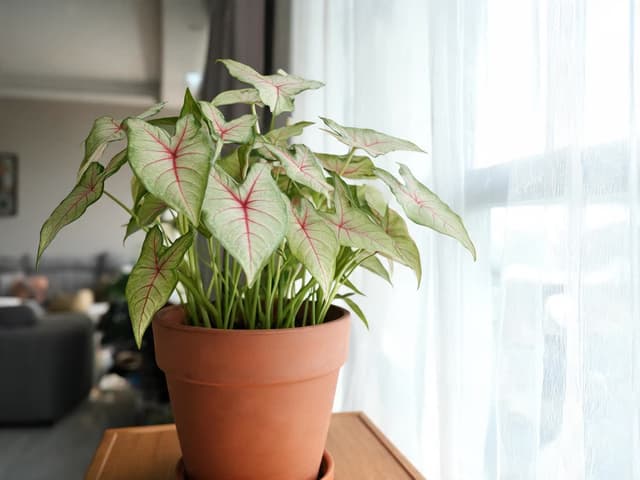
How to Care for Syngonium: Light, Watering, Cuttings, and Pests
How to care for syngonium indoors: bright indirect light, watering when the soil surface dries, 64 to 81°F (18 to 27°C), and 40 to 60% humidity. Also cover water cuttings, thrips, yellow leaves, and pet toxicity.
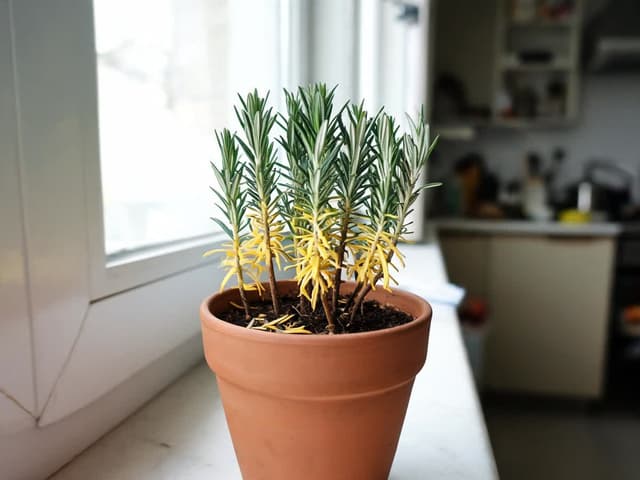
Rosemary Leaves Turning Yellow: Causes and Solutions
Rosemary with yellow leaves usually has overly wet roots. Check where the yellowing appears to see if it stems from wet roots, low light, spider mites, powdery mildew, or normal leaf shed, and learn how to save the plant.
Is Your Rosemary Dying? How to Save Soap-Burned Rosemary
Rosemary with soap-burned leaves can usually be saved: the damage stays on the affected needles. Rinse the leaves, wait a week, scrape the stems, and prune only what is brown inside.