Cold-Hardy Eucalyptus: Which Species Tolerate Frost and How to Protect Them
The hardiest eucalyptus for winter is snow gum, followed closely by Eucalyptus gunnii. Round-leaved floral varieties tolerate far less cold. Learn the cold limits for each species, how to protect potted plants, and what to do if frost burns your plant.
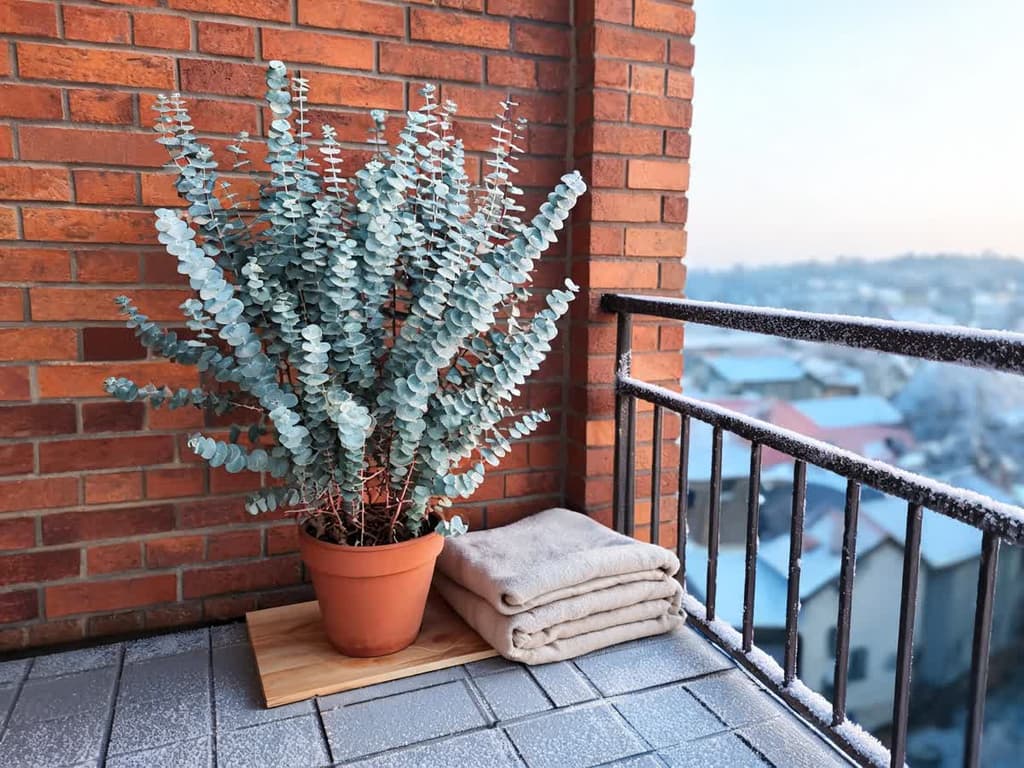
The most cold-hardy eucalyptus is the snow gum (Eucalyptus pauciflora), followed closely by Eucalyptus gunnii, the variety with rounded, bluish leaves commonly sold in pots. Both tolerate hard freezes once established for a few years. On the other hand, Eucalyptus cinerea and Eucalyptus pulverulenta, popular in floral arrangements, suffer damage much earlier.
In Brazil, the question only matters for those living in the South or in the highlands, where frost occurs between June and August. In the rest of the country, winter changes two things for potted eucalyptus: light decreases, and the soil takes longer to dry.
Quick summary:
For frost-prone regions, choose E. gunnii or snow gum. Avoid growing E. cinerea and E. pulverulenta outdoors in the ground.
Temperature limits apply to mature plants established in the ground for several years. Young saplings and potted plants tolerate less cold.
A sudden freeze following warm weather causes far more damage than the same temperature in the middle of a sustained cold winter.
In a pot, roots suffer damage before the foliage does. Push the container against a wall, lift it off the cold ground, and ensure the soil neither completely dries out nor sits waterlogged.
If frost scorches the foliage, do not prune anything right away. Wait for new spring growth and perform the scratch test on the branches.
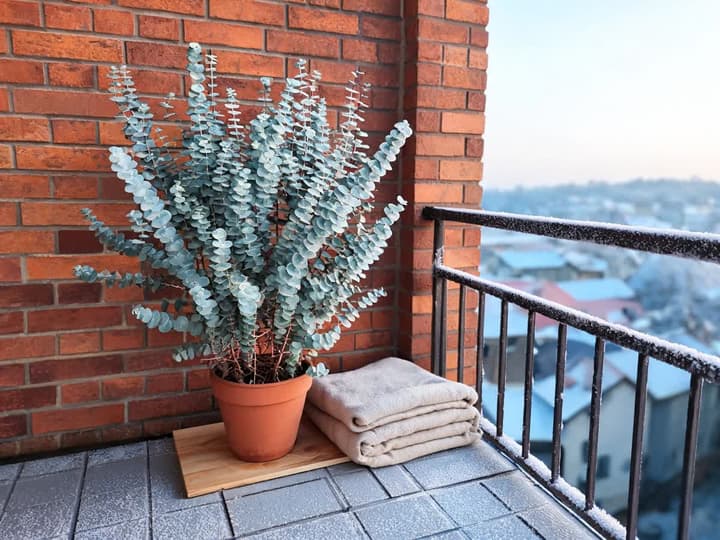
Which eucalyptus species survive winter
A cold-hardy eucalyptus is a species that, once mature, withstands freezes below −10 °C without dying. In practice, this refers to snow gum and E. gunnii, native to the mountains of Tasmania and southeastern Australia. Other species sold as potted plants suffer freeze damage much sooner.
The genus Eucalyptus contains hundreds of species, and nearly all of them are cold-sensitive. Embrapa Florestas summarizes the limit of the genus: most suffer damage below 0 °C (32 °F). Few species survive between −15 °C and −18 °C, and none tolerate less than −20 °C (questions and answers about eucalyptus, Embrapa Florestas, updated in December 2019). This is the general rule for the genus. The mountain populations of snow gum, in the table below, are the documented exception, and the coldest record of all involves a plant that died back to the ground and resprouted from the root.
Nurseries in colder climates market these alpine species as "cold-hardy eucalyptus." The table below outlines cold tolerance limits and identification traits for each species.
Species | Identification traits | Cold tolerance limit | Practical notes |
|---|---|---|---|
Snow gum (E. pauciflora subsp. niphophila and subsp. debeuzevillei) | mottled white bark, elongated glossy adult leaves | high-altitude populations endure −16 °C to −23 °C in nature | among the hardiest in the genus, though performance depends on seed provenance |
E. gunnii | rounded bluish juvenile leaves, elongated adult foliage | −12 °C to −14 °C for mature established plants | the hardiest commercially available potted option |
E. neglecta | large, broad green leaves | survived −18 °C with minor tip dieback in North Carolina trials | rare in commercial trade |
E. cinerea | silver-gray rounded leaves paired closely along the stem | damage occurs below −10 °C | tolerates light frost; in pots, protect from any freeze |
E. pulverulenta | blue-gray juvenile foliage, in pairs clasping the stem directly | around −7 °C to −9 °C | the most cold-sensitive species on this list |
E. dalrympleana | pale peeling bark, elongated adult leaves | less hardy than E. gunnii | grow only in areas with mild frost |
The figures in the table come from different sources. Snow gum and E. neglecta come from Trees and Shrubs Online, a reference work by the International Dendrology Society (snow gum, E. neglecta, E. cinerea, and E. dalrympleana). The same work calls E. gunnii the hardiest among tree-sized eucalyptus planted in sufficient numbers to judge (E. gunnii).
The −12 °C to −14 °C range for E. gunnii comes from the German gardening magazine Mein Schöner Garten, for a plant 4 to 5 years in the ground. The University of Washington Botanic Gardens confirms this order of magnitude with 85 years of records in Seattle. There, E. gunnii and the snow gum are among the few that survived drops to −7 °C to −12 °C (10 °F to 20 °F) (profile of E. gunnii, February 2019). The range for E. pulverulenta comes from a California nursery, San Marcos Growers, and we found no university measurements for that species.
Why temperature ratings vary across sources
The same E. gunnii receives ratings of −12 °C, −15 °C, and even −20 °C depending on the source. Trees and Shrubs Online attributes these differences to three main factors.
Seed provenance. Every species comprises populations adapted to different elevations. Snow gum specimens from one seed source died at −7 °C in Oregon, while trees from another source resprouted after enduring −30 °C in Cincinnati.
Age. Young plants are significantly more cold-sensitive than mature specimens. The University of Washington Botanic Gardens reports the same trend for E. gunnii: hardiness increases as the tree ages.
Acclimation (the gradual conditioning of plant tissues to cold through weeks of chilling autumn nights). In England, an early frost of −9 °C following an unusually mild autumn killed numerous actively growing eucalyptus trees. The exact same temperature, arriving after weeks of steady cold, would have caused far less harm.
For this reason, this guide uses data from universities and botanic gardens rather than retail nursery tags. For saplings and potted specimens, assume the most conservative value in the table. Published hardiness limits reflect mature trees with deep root systems established in open ground.
Forestry eucalyptus differs from potted ornamental eucalyptus
Roadside plantation eucalyptus belongs to other species. Embrapa Florestas lists the most planted species in Brazil for timber: E. grandis, E. saligna, E. urophylla, E. viminalis, hybrids of E. grandis with E. urophylla, and, in the South, E. dunnii.
For frost-prone southern zones, Embrapa recommends E. benthamii, the most cold-tolerant commercial forestry species in Brazil. Even E. benthamii can suffer up to 100% canopy scorch in extreme freezes, as documented at −7.2 °C in Santa Catarina in 2011.
These figures apply strictly to commercial forestry plantations established directly in the field. Do not use commercial forestry tolerances to manage a potted eucalyptus on a patio or balcony.
In Brazil, who needs to protect eucalyptus in winter
In Brazil, winter runs from June to August. Frost is common in the Southern Plateau, in the mountains of Rio Grande do Sul and Santa Catarina, and in the high elevations of the Mantiqueira Mountains. If you live in these regions or keep a pot on a balcony exposed to cold winds, species selection and protection make all the difference.
The primary freeze hazard for eucalyptus in these climates is a sudden frost directly following unseasonably warm weather. Embrapa Florestas documents this in plantation E. grandis: freezes after extended high temperatures trigger severe tissue damage and can kill mature trees outright. Trees and Shrubs Online notes the exact same pattern in garden eucalyptus in England, where an unseasonable −9 °C freeze following a mild autumn killed actively growing trees.
Watch weather forecasts closely whenever an arctic front sweeps in after a run of warm afternoons. That sudden transition night is when protective blankets and moving pots against walls provide the greatest benefit.
In frost-free regions, winter changes other factors. With less light and less heat, potting soil takes longer to dry out, and keeping your summer watering schedule waterlogs roots. Your winter zone depends on the minimum temperature of your coldest night, not the calendar month. The succulent guide explains how to identify Brazil's three winter hardiness zones.
Winter protection for potted eucalyptus
In a container, root systems freeze well before aerial foliage does. In the ground, surrounding soil insulates roots from sharp temperature plunges; in a pot, the limited soil volume is exposed to freezing ambient air on all sides. Embrapa Florestas highlights the mechanism: when root-zone moisture freezes solid, fine feeder roots die, leading to severe canopy collapse.
To overwinter a potted eucalyptus safely in a frost-prone area:
Move the pot flush against an exterior building wall, ideally one shielded from cold winds. Masonry walls slowly release heat absorbed throughout the day during the night.
Elevate the pot off cold surfaces. Place the container on wooden blocks or a sheet of dense foam insulation.
Wrap the container itself, not just the foliage, using burlap, thermal plant blankets, or exterior bubble wrap. The primary goal is insulating the root ball.
Cover the canopy only during actual freezing nights, using breathable frost cloth or non-woven fabric (the material used in reusable grocery bags). Never allow plastic sheeting to make direct contact with foliage. Remove covers in the morning, as trapped solar radiation quickly overheats the enclosed air.
Maintain lightly moist soil. Eucalyptus trees are evergreen and continue transpiring water all winter. Moisture loss accelerates during dry, sunny, windy afternoons trailing a cold front. Water when the top 3 cm of soil dries out, applying water in the morning, and only if freezing weather is not forecasted for the coming night.
Do not fertilize during the winter, which runs from June to August in Brazil. Resume fertilizing when the plant sprouts in the spring.
For potted E. cinerea and E. pulverulenta, bring the plant indoors on nights forecasted at 0 °C or lower. NC State Extension, the extension service of North Carolina State University, notes that in cold climates potted E. cinerea must be brought inside before the first frost (plant profile for E. cinerea). For young E. gunnii, Mein Schöner Garten recommends covering with fleece at the latest when temperatures drop below −4 °C.
Inside, locate the brightest, coolest area available, safely distant from forced-air heat vents or radiators. Mein Schöner Garten notes that eucalyptus drops foliage rapidly in dark locations. Once freezing night temperatures pass, return the container outdoors immediately. Eucalyptus requires direct sunlight and cannot survive full-time indoor living throughout the winter.
Ground-planted eucalyptus: managing the first two winters
Young trees planted in open ground in freeze-prone regions face their greatest mortality risks during their first two winters. Frost tolerance increases with maturity and stem caliper, meaning published hardiness tables apply strictly to established specimens.
Plant in the spring, which in Southern Brazil runs from September to November. That way, the root system has the entire summer to grow before the first frost.
Mulch the ground around the base using a thick ring of straw, bark mulch, or dry deciduous leaves. This organic layer traps residual soil heat overnight.
Shield young saplings during freezes with thermal plant fleece. Trees and Shrubs Online strongly emphasizes guarding young eucalyptus against desiccant winter winds during their first winter, as cold, drying winds kill saplings just as reliably as freezing temperatures.
Embrapa Florestas classifies characteristic cold injuries on eucalyptus bark and wood. "Frost collar" creates localized dead bark lesions at the base of the stem, appearing most frequently on young trees early in winter. Frost cracks form deep radial splits running from the core of the trunk out to the exterior bark during severe freezes.
Cold damage vs. drought: can a damaged eucalyptus be saved?
In most situations, recovery is possible, provided you avoid the urge to prune immediately. Eucalyptus possesses exceptional capacity to regenerate from its basal lignotuber even when top growth dies back completely. Trees and Shrubs Online notes this characteristic across the genus. NC State confirms the same resilient trait for E. cinerea, which routinely recovers vigorously during the growing season following hard freezes.
Dry, brown foliage during winter typically stems from three distinct problems, each requiring a specific response:
Visible symptoms | Probable cause | Recommended action |
|---|---|---|
top and outer foliage scorches abruptly following a single freeze event | freeze injury | wait for active spring growth before pruning away dead stems |
leaves curl and turn brittle while deep container soil dries out | drought stress, frequent during dry, windy weather | water deeply until moisture runs freely from bottom drainage holes, watering in the morning |
leaves shed steadily while potting mix has stayed persistently damp for weeks | cold, suffocated, waterlogged root system | halt watering completely until top 3 cm of mix dries out, and confirm drainage holes are clear |
If you are unsure of your exact eucalyptus species because of a missing tag or inheritance, confirm its botanical identity before formulating a winter plan. Freezing thresholds vary dramatically among species. The Bloom app (iOS) identifies species directly from a clear leaf photograph.
After a freeze, follow this sequence. It comes from the University of Florida Extension (UF/IFAS) for cold-damaged plants (Henry Mayer, February 2, 2026):
Wait at least 3 to 7 days before evaluating damage. Tissue injury often appears far more disastrous immediately following the cold spell than it actually is.
Do not fertilize, do not perform heavy pruning, and do not overwater during this recovery window. Fertilizer applications and severe pruning shock injured plants and stimulate premature tender flushes, which will freeze in subsequent cold snaps.
Perform the scratch test. Gently scrape away thin outer bark on small branches using a fingernail. Moist green tissue underneath indicates active living wood; brittle brown wood indicates dead tissue.
Leave dead stems in place until all seasonal freeze risks pass. Intact dead foliage and stems insulate living lower structures during subsequent cold events.
Prune in spring, when shoots appear. In southern Brazil, this is usually in September and October. Cut back to just above a living shoot.
If your plant dies back entirely to the ground and sprouts solely from the base, train the strongest, most erect shoot to become the new primary trunk, as advised by Trees and Shrubs Online. The same reference documents a mature E. dalrympleana in England that lost all foliage during the severe 1962–1963 winter yet recovered rapidly. The University of Washington Botanic Gardens observed this dynamic repeatedly: eucalyptus specimens frozen to the ground regrew with immense vigor from basal buds come spring.
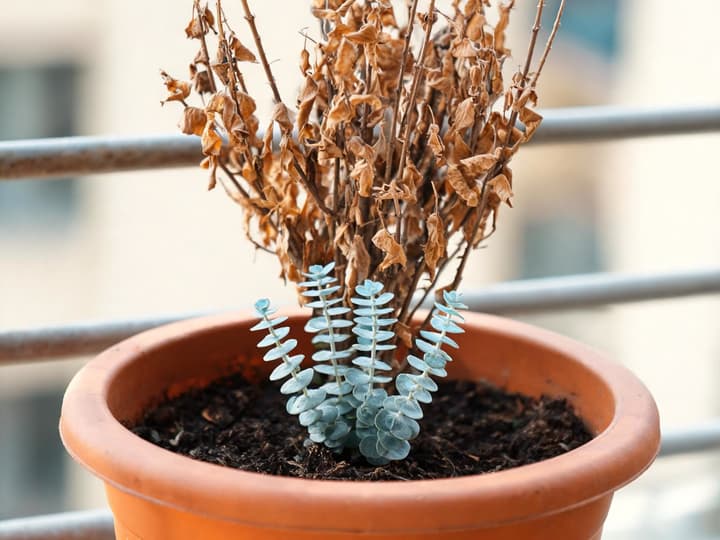
If the scratch test shows brown across all branches and at the base, and nothing sprouts by the end of October (in Brazil), the plant has died. For other symptoms that do not match the table above, use the symptom screening by plant part.
Eucalyptus toxicity in dogs and cats
Yes. The ASPCA, an American animal protection organization, lists eucalyptus as toxic to dogs, cats, and horses (eucalyptus profile). The toxic compound is eucalyptol, found in the leaf oil. Signs include salivation, vomiting, diarrhea, depression, and weakness.
NC State Extension notes that the bark and foliage can also trigger contact dermatitis in sensitive handlers. Wear protective garden gloves while pruning.
Frequently asked questions
Which eucalyptus varieties survive freezes?
Snow gum (E. pauciflora subsp. niphophila and subsp. debeuzevillei) and E. gunnii exhibit the highest freeze hardiness. Mature E. gunnii tolerates −12 °C to −14 °C. E. cinerea suffers tissue damage below −10 °C, while E. pulverulenta tolerates only around −7 °C to −9 °C. Young saplings and container specimens tolerate less cold.
Can eucalyptus stay outside on a patio during winter?
Yes, provided the species matches the minimum seasonal temperatures of your local area. During freezing nights, shift the container against a wall, lift the pot off cold surfaces using wooden blocks or foam, and drape the canopy in frost fabric. For potted E. cinerea and E. pulverulenta, move containers indoors whenever forecasts predict 0 °C or lower.
When should eucalyptus be pruned?
Prune eucalyptus in the spring, when shoots appear. In Southern Brazil, this is usually in September and October. Do not prune right after a frost. Wait until the cold risk has passed, perform the scratch test, and cut back only to just above a live shoot. Hard pruning in winter forces new growth, which burns during the next frost.
Why do eucalyptus trees shed leaves in winter?
Eucalyptus is naturally evergreen, but plants shed older leaves gradually: NC State reports that individual E. cinerea leaves typically persist for roughly one year. Heavy shedding indicates acute stress: freezing temperatures, inadequate light levels, severe root drought, or cold, oxygen-depleted soggy soil. Abrupt, total defoliation following a freezing night indicates direct frost burn.
Can a freeze-damaged potted eucalyptus recover?
In most cases, it comes back. Eucalyptus typically resprouts from the base even when the top dies. Wait 3 to 7 days to assess and perform the scratch test on the branch. Leave the dead growth in place until the risk of frost passes and prune once the new shoots appear, in September or October in southern Brazil.
What to do before the next freeze
Check which species you have and compare it to your area's minimum temperature. If your eucalyptus is E. cinerea or E. pulverulenta and you live in the South or in the mountains, keep the frost cloth and board near the pot. Monitor the forecast with each cold front. In Brazil, if July frost burned the plant, new growth in September and October shows what survived.
Related articles
How to Care for a Maidenhair Fern: Light, Water, and Revival Tips
Learn how to care for a maidenhair fern indoors: bright indirect light, consistently moist soil, high humidity, and how to revive it if it dries out completely.
How to Propagate Spider Plants: Root the Pup Before Cutting
The safest spider plant cutting comes from a pup still attached to the mother plant: rest the plantlet on soil in a small pot, wait for roots to establish, and only then cut the stolon. Learn when the pup is ready, whether rooting in water is worth it, how to divide the clump, and why plants fail to produce babies.
Banana plant fertilizer: fertilizing potted and backyard plants
Banana plant fertilizer needs more potassium than nitrogen, in a 3-1-6 ratio. For a potted plant on a balcony, use the label dose in spring and summer. In the backyard, fertilize every 2 months, adjusting the amount by mat age. Learn the formula, timing in Brazil, and signs of deficiency or excess.