Eucalyptus: How to Care for It in Pots, on Balconies, and in Gardens
Potted eucalyptus requires at least 6 hours of direct sun, a large pot with drainage holes, and watering only when the soil is almost dry. Learn which species you have, how to prune for round leaves, and what to do about dry or sticky foliage.
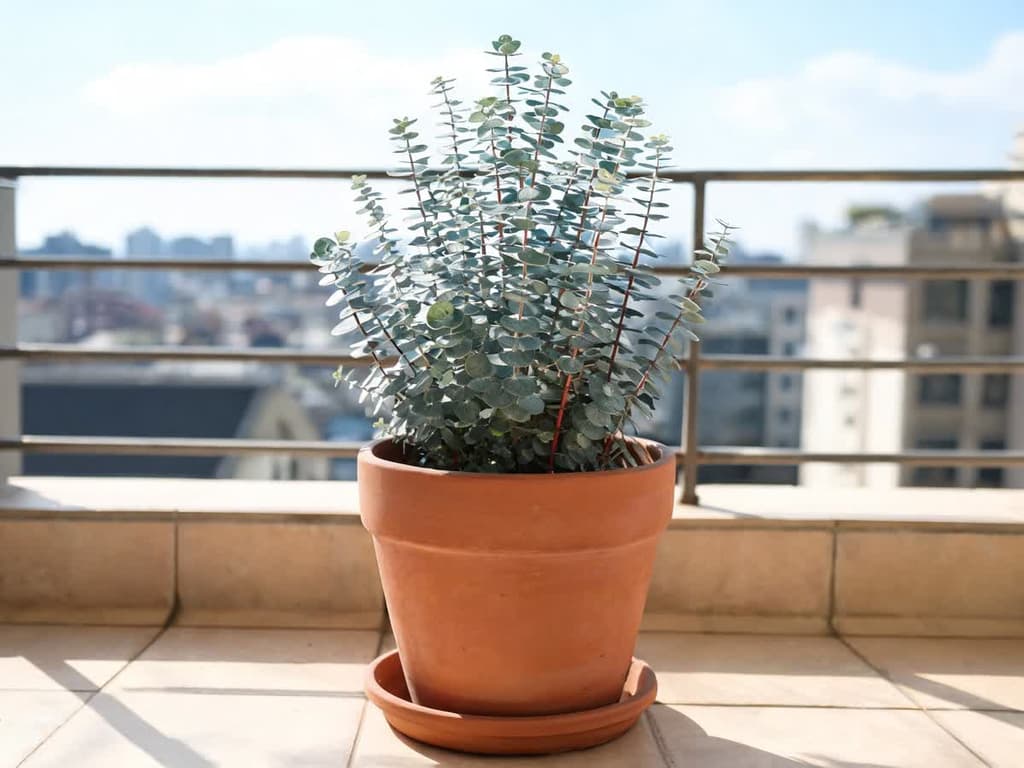
To care for eucalyptus, give it at least 6 hours of direct sunlight a day, a large pot with drainage holes at the bottom, and water only when the soil is almost dry. To maintain the round, silvery-blue foliage used in floral arrangements, cut the plant back to the ground in late winter. Indoors, eucalyptus only survives temporarily: it grows rapidly and sheds leaves without sufficient light.
Potted eucalyptus is not the same plant found in roadside timber plantations. Potted and garden varieties are smaller with blue-gray foliage, and this guide covers those ornamental types.
Quick summary:
Light: Direct sun for at least 6 hours per day. In low-light spots, the plant declines quickly.
Watering: Water thoroughly until liquid drains from the bottom hole, and allow the soil to almost dry out before the next watering. Empty the saucer.
Pot: Always with drainage holes. The Royal Horticultural Society, the British gardening charity, recommends containers 60 cm (24 in) in diameter or larger for eucalyptus.
Pruning: In late winter (February to March in the Northern Hemisphere, August to September in the Southern Hemisphere), cut back to 5–7.5 cm from the ground to get only round leaves.
Crispy leaves paired with moist soil indicate waterlogged roots, not thirst.
Toxicity: The ASPCA lists eucalyptus as toxic to dogs, cats, and horses.
Identifying your eucalyptus species
Eucalyptus sold in pots at florists and garden centers almost always belongs to one of three species: Eucalyptus gunnii, Eucalyptus cinerea, or Eucalyptus pulverulenta. All three feature rounded, blue-gray juvenile leaves identical to those in bouquets. Left unpruned, all will eventually develop into full-sized trees.
Eucalyptus | Leaf characteristics | Unpruned height in ground | Cold hardiness rating (RHS) |
|---|---|---|---|
E. gunnii | Blue, rounded juvenile leaves; adult foliage becomes elongated, sickle-shaped, and gray-green | Over 12 m (40 ft) tall and over 8 m (26 ft) wide | −15 to −10 °C (5 to 14 °F) |
E. gunnii 'France Bleu' | Identical leaves, dwarf growth habit | 1.5 to 2.5 m (5 to 8 ft) tall | −15 to −10 °C (5 to 14 °F) |
E. cinerea | Silvery round leaves with a powdery white coating; juvenile leaves persist for years | 10 to 15 m (33 to 50 ft) tall | −15 to −10 °C (5 to 14 °F) |
E. pulverulenta ('Baby Blue') | Heart-shaped or round leaves, up to 5 cm (2 in); they typically remain rounded on mature plants | Large shrub or small tree up to 10 m (33 ft) | −15 to −10 °C (5 to 14 °F) |
The table data comes from the Royal Horticultural Society (RHS) plant profiles for each species. The RHS describes the dwarf variety 'France Bleu' as ideal for containers and small gardens.
The eucalyptus found in plantations in Brazil is a different plant. According to Embrapa Florestas, the most widely planted species are Eucalyptus grandis, Eucalyptus urophylla, and their hybrid, known as urograndis. These are timber trees that reach 30–40 m (98–131 ft). Their cultivation guidelines (spacing, fertilization, height) do not apply to potted eucalyptus.
If your plant came without a tag, photograph a leaf and the stem. The Bloom app identifies the species from a picture, and its mature size dictates how you should manage it.
How to care for eucalyptus: Light and placement
Eucalyptus needs direct sun for at least 6 hours a day. This is the guideline from the plant information service at the New York Botanical Garden (NYBG). The NYBG also warns that the plant deteriorates quickly in low light.
The NYBG recommends a south-facing window. This applies to the Northern Hemisphere, where strong sun comes from the south. In the Southern Hemisphere, such as in Brazil, strong sun comes from the north, and the best window is a north-facing one. In both hemispheres, the second best is a west-facing window.
The best spot for potted eucalyptus is an open balcony or a patio with direct sun for at least 6 hours a day. The RHS recommends sheltering young specimens from harsh, cold winds.
Growing eucalyptus indoors
The NYBG notes that eucalyptus makes a difficult houseplant. It demands intense light and expands rapidly: an E. gunnii that fits in your living room now must move outside within a few years. Other species and dwarf varieties can stay indoors for 1 to roughly 5 years, according to the NYBG.
If keeping eucalyptus indoors, maintain these conditions outlined by the NYBG:
Position the pot right against the sunniest window available.
Maintain temperatures between 18 and 24 °C (65 to 75 °F), away from air conditioners, heating vents, and drafty doorways.
Prevent sudden temperature swings, which stress the plant.
Do not mist the foliage. Standard household humidity is adequate.
The NYBG also recommends a winter rest, from November to February in the Northern Hemisphere, with little water, no fertilizer, and temperatures of 7 to 10 °C. Without this rest, the plant loses vigor. In the Southern Hemisphere, as in Brazil, winter runs from June to August.
How to water potted eucalyptus
Water potted eucalyptus thoroughly until water runs out of the bottom drainage hole. Afterward, let the soil dry out almost completely before watering again. This follows NYBG guidelines. Watering schedules cannot rely on fixed calendar intervals: bright summer sun dries the mix quickly, whereas the plant consumes far less water during cold spells.
To test soil dryness, insert your finger two knuckles deep into the mix. If it emerges damp, wait another day. When in doubt, a soil moisture meter inserted into the root zone provides clarity, as suggested by the NYBG.
Empty the saucer after every watering session. The NYBG cautions that containers without drainage or saucers holding stagnant water leave roots overly wet, causing the plant to decline quickly. According to the same source, most eucalyptus troubles originate in decorative cachepots lacking drainage holes.
In-ground eucalyptus demands far less attention. The RHS suggests watering thoroughly at planting time and only during prolonged dry spells during its first few years. Once established, it almost never requires supplemental watering.
Eucalyptus leaves drying out or dropping
Dry, brittle foliage over moist soil points straight to root rot from waterlogging. Oxygen-starved roots stop pulling moisture upward, making leaves dry out as though dehydrated. Adding more water under these conditions worsens the decline. Check immediately whether the container has drainage holes and whether the drip tray is dry.
Symptom | Probable cause | Corrective action |
|---|---|---|
Brittle, dry leaves alongside soggy soil for days | Root suffocation (pot lacking drainage, flooded saucer, watering before the mix dries) | Repot into a container with holes and water only when the mix is nearly dry |
Small water-filled blisters on the foliage | Edema, which the RHS identifies as a sign of waterlogged soil | Space out waterings and improve substrate drainage |
Leaves gradually shedding, plant placed far from a window | Insufficient light | Move to direct sunlight providing at least 6 hours daily |
Wilted, crispy leaves, hard dry soil, lightweight pot | Underwatering | Soak slowly until water drains out through the base |
Sticky foliage, white wax specks on new growth | Psyllids (see section below) | Prune off infested tips and apply treatment |
Sudden leaf drop after moving or repotting | Abrupt temperature swings or root disturbance | Keep the pot in a stable location and avoid handling the roots |
Yellow or brown leaves have other causes beyond those specific to eucalyptus. The guide to yellow leaves distinguishes between overwatering, underwatering, nutrients, and light by the pattern of yellowing on the leaf. If the symptom does not appear in the table, the guide what is wrong with my plant screens by symptom.
Can a dried-out eucalyptus be saved?
Yes, provided the stem base and root system remain alive. Eucalyptus can resprout vigorously from cut stems and even from ground-level stumps, which forms the foundation of RHS rejuvenation pruning. Withered leaves never recover, but healthy new stems replace lost foliage.
Slide the root ball out of the pot to inspect it. Firm, light-colored roots are viable. Dark, soft, foul-smelling roots have rotted: trim away decayed sections and repot into fresh, dry soil inside a draining pot.
White bugs and sticky leaves on eucalyptus
White waxy dots on shoots, sticky leaves, and black mold on top are usually psyllids. The psyllid is a small insect that sucks plant sap. According to the University of California Integrated Pest Management Program (UC IPM), the blue gum psyllid (Ctenarytaina eucalypti) specifically attacks E. pulverulenta ('Baby Blue') and the young leaves of other eucalyptus species. It covers leaves and tips with flaky white wax.
All psyllids excrete honeydew, a sticky, sugar-rich liquid, according to UC IPM. Sooty mold, a fungus that forms a dark coating over the foliage, grows on top of this honeydew.
Mealybugs also produce honeydew and appear white, but they do not jump. Adult psyllids resemble tiny cicadas and leap when you disturb the branch, notes UC IPM. If the insects stay stationary and look like bits of cotton on the stem, refer to the guide on mealybugs.
To treat psyllids on potted eucalyptus:
Prune off heavily infested tips showing white wax and sticky residue, discarding them in a sealed bag.
Spray neem oil, insecticidal soap, or horticultural mineral oil, coating the entire plant including leaf undersides. UC IPM notes all three are effective when complete coverage of infested parts is achieved.
Repeat the application. UC IPM advises that multiple sprays per season are typically needed.
If psyllids reappear after neem oil, spray again, ensuring thorough coverage of tips and leaf undersides. UC IPM also advises against fertilizing in-ground eucalyptus, as excessive nutrients make the tree more susceptible to psyllid infestations.
Pots, potting mix, and fertilizer for eucalyptus
Choose a container with drainage holes, picking the largest size your space permits. The RHS recommends pots 60 cm (24 in) in diameter or wider. Smaller containers dry out too rapidly and constrict roots on a plant capable of growing 1 m (3 ft) per year in the ground, per the same source.
For soil, the RHS recommends a soil-based potting mix amended with up to 30% coarse grit to ensure sharp drainage. The NYBG recommends equal parts potting soil, perlite (or sharp sand), and peat moss. Both formulations allow irrigation water to drain rapidly through the medium.
Sources differ on repotting frequency. The RHS advises stepping up to a slightly larger container every 2 years. The NYBG advises annual repotting in spring, specifically addressing young specimens grown indoors. Let root development guide you: repot when roots emerge from the base holes or circle the bottom of the pot.
Eucalyptus does not like having its roots disturbed, according to the RHS. When repotting, transfer the root ball, the block of soil attached to the roots, intact into the new pot, without loosening or cutting the roots. Repot in spring (March to May in the Northern Hemisphere, September to November in the Southern Hemisphere).
Fertilize only potted eucalyptus. The RHS recommends a standard liquid fertilizer once a month during growth, from April to September in the Northern Hemisphere and from October to March in the Southern Hemisphere. In-ground eucalyptus that is already established does not need fertilizer, also according to the RHS.
Pruning eucalyptus to maintain round leaves
Eucalyptus produces two leaf forms: juvenile foliage that is round and blue-toned, and adult foliage that becomes elongated and sickle-shaped. Florists prize the round juvenile leaves. To keep the plant producing this juvenile foliage, the RHS recommends cutting stems back to the ground every year or two, a practice known as coppicing.
How to coppice eucalyptus, according to the RHS pruning guide:
Prune in late winter, just before the plant resumes growth. The RHS recommends February to March in the Northern Hemisphere; in the Southern Hemisphere, it is between August and September.
Cut the trunk or branches 5–7.5 cm (2–3 in) from the ground. In subsequent years, cut back to the stump left from the previous pruning.
The plant resprouts with multiple stems and only round leaves.
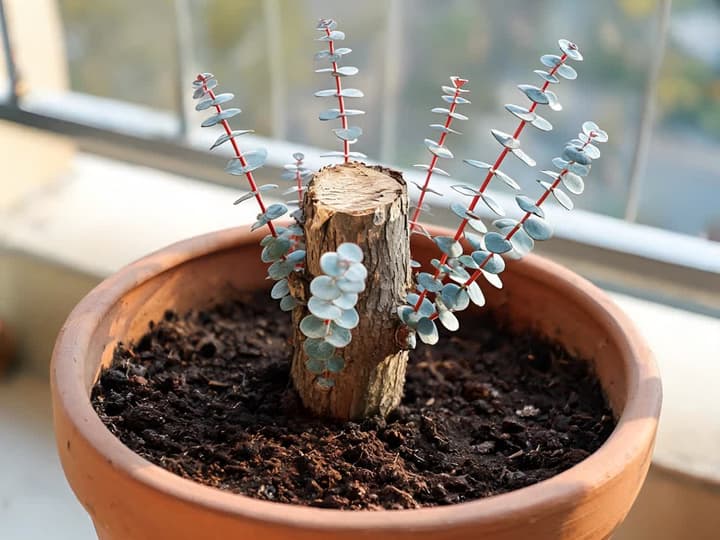
The RHS recommends coppicing for E. gunnii, among other species. For the dwarf variety 'France Bleu', the RHS recommends hard annual pruning in early spring for the same purpose. Fragile new growth on freshly pruned plants snaps easily in high winds: keep the container in a sheltered location for the first few weeks after cutting back.
Pruning also manages overall dimensions. To curb vertical growth without cutting to the base, prune branches back to stubs on the main trunk, typically around 2 m (6.5 ft) high. This technique is pollarding, which the RHS notes is more challenging and, on mature specimens, best handled by professionals.
Growing eucalyptus in the ground: Size and building clearance
Grown in the ground without pruning, E. gunnii exceeds 12 m (40 ft) in height, according to the RHS. Before transplanting eucalyptus out of its container, verify the mature dimensions in the table at the beginning of this guide.
Eucalyptus roots consume immense amounts of water. The RHS categorizes eucalyptus among high water demand trees. According to the same source, tree roots can spread outward up to 3 times the tree's height. The RHS advises planting large species well clear of foundations, as they dry out the surrounding soil, especially clay substrates.
The RHS provides these recommendations for planting eucalyptus in the ground:
Plant small nursery stock under 1 m (3 ft) tall. Smaller specimens establish much better than mature trees.
Plant in spring or summer (March to September in the Northern Hemisphere, September to March in the Southern Hemisphere).
Select the permanent site carefully before planting: once established, eucalyptus does not tolerate relocation.
Do not add manure or compost to the planting hole: overly fertile soil encourages excessive, weak leafy growth.
Maintain a 1 m (3 ft) diameter ring free of grass and weeds around the trunk during its first few years.
The four plants in the table tolerate −15 to −10 °C (5 to 14 °F), according to the RHS. Where winters get colder than that, potted eucalyptus must spend the winter protected. In Brazil, winter in most of the country stays well above this temperature.
Is eucalyptus toxic to cats and dogs?
Yes. The ASPCA, the American Society for the Prevention of Cruelty to Animals, lists eucalyptus as toxic to dogs, cats, and horses. The toxic substance is eucalyptol, found in the plant's essential oil. The signs are salivation, vomiting, diarrhea, lethargy, and weakness.
The foliage and bark can also irritate skin, according to the North Carolina State University Plant Toolbox. Wear gloves when pruning and keep the pot out of reach of cats and dogs.
Frequently asked questions
What conditions harm eucalyptus the most?
Eucalyptus cannot tolerate soggy roots, dim light, or root disruption. Pots without drainage or waterlogged saucers cause rapid decline, per the NYBG. Providing fewer than 6 hours of direct sun prompts leaf drop. When repotting, transfer the root ball intact without loosening the roots.
Can I prune eucalyptus down to ground level?
Yes, you can. Pruning back to the ground, called coppicing, is what the RHS recommends to maintain the round leaf of E. gunnii. Cut to 5–7.5 cm from the ground in late winter (February to March in the Northern Hemisphere, August to September in the Southern Hemisphere). The plant resprouts with multiple stems. New shoots break in strong winds during the first weeks.
Can you propagate eucalyptus from cuttings?
Almost never successfully. The RHS notes that eucalyptus cuttings are exceptionally difficult to root, making seeds the preferred propagation route. Sow seeds directly into deep pots or root-trainer cells, as developing roots cannot withstand disturbance during transplanting.
Where is the best place to keep eucalyptus?
The best spot is an open balcony or a yard with direct sun for at least 6 hours a day. In the Northern Hemisphere, south-facing areas receive the most sun; in the Southern Hemisphere, such as in Brazil, north-facing areas do. Indoors, keep the pot right next to the sunniest window, and only temporarily. According to the NYBG, the plant grows rapidly and demands more light than the home provides.
Summary of eucalyptus care
Provide at least 6 hours of direct sunlight, a spacious draining pot, water only when the mix is nearly dry, and coppice in late winter. If your plant shows drying leaves right now, check the container drainage holes and saucer moisture before adding any water.
Related articles
How to Care for a Maidenhair Fern: Light, Water, and Revival Tips
Learn how to care for a maidenhair fern indoors: bright indirect light, consistently moist soil, high humidity, and how to revive it if it dries out completely.
How to Propagate Spider Plants: Root the Pup Before Cutting
The safest spider plant cutting comes from a pup still attached to the mother plant: rest the plantlet on soil in a small pot, wait for roots to establish, and only then cut the stolon. Learn when the pup is ready, whether rooting in water is worth it, how to divide the clump, and why plants fail to produce babies.
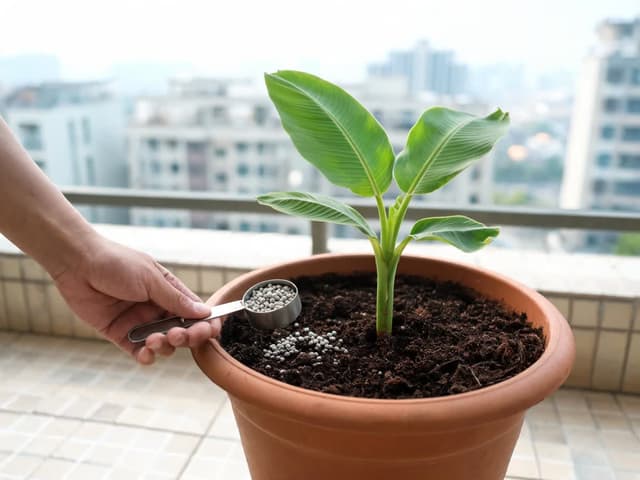
Banana plant fertilizer: fertilizing potted and backyard plants
Banana plant fertilizer needs more potassium than nitrogen, in a 3-1-6 ratio. For a potted plant on a balcony, use the label dose in spring and summer. In the backyard, fertilize every 2 months, adjusting the amount by mat age. Learn the formula, timing in Brazil, and signs of deficiency or excess.